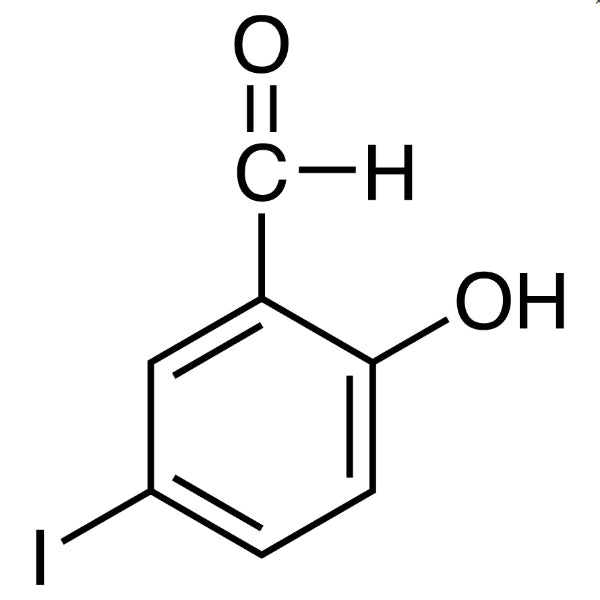

2-Hydroxy-5-iodobenzaldehyde is a chemical compound widely used in organic synthesis reactions within laboratory settings. It serves as a fundamental building block for the creation of more complex molecules, playing a crucial role in various synthetic pathways. This compound is commonly found in research laboratories, where it is utilized as a key reagent in the development of new chemical structures. Its versatility makes it an essential component in both academic and industrial chemical research.
The unique chemical properties of 2-Hydroxy-5-iodobenzaldehyde make it a preferred choice for chemists. The presence of both a hydroxyl group and an iodine atom contributes to its high reactivity, enabling it to participate in a range of chemical reactions, including nucleophilic substitution and condensation reactions. Its aromatic structure provides stability, while the iodine substituent enhances its reactivity in various synthetic transformations. These characteristics make it a valuable tool in the synthesis of pharmaceuticals and advanced materials.
In Indonesian laboratories, 2-Hydroxy-5-iodobenzaldehyde is frequently used in chemical research, particularly in the fields of organic synthesis and drug development. It is a common reagent in university and research institute laboratories, where it supports the creation of new compounds and the exploration of chemical mechanisms. Its role in building complex molecular structures is essential for advancing scientific knowledge in chemistry.
- Organic synthesis is a primary application where this compound is used to build complex molecular structures through various chemical reactions.
- Pharmaceutical research benefits from its reactivity, allowing the development of new drug compounds and therapeutic agents.
- Material science applications leverage its chemical properties to create advanced polymers and functional materials.
- Analytical chemistry utilizes its stability and reactivity for the identification and characterization of unknown compounds.
- Educational institutions use it in teaching laboratories to demonstrate key chemical reactions and synthetic techniques.
| Brand | TCI |
|---|---|
| CAS number | 1761-62-2 |
| Molecular formula | — |
| Purity | — |
| Category | Chemistry > Building Blocks > Non-Heterocyclic Building Blocks |
| Pack sizes | Available in various quantities as per standard laboratory supply |
| Physical form | Solid |
| Storage | Store in a cool, dry place away from light and moisture |
This compound should be stored in a cool, dry environment, away from direct light and moisture to maintain its chemical integrity. It is recommended to use airtight containers to prevent exposure to air and humidity, which may affect its stability. Due to its reactivity, it should be handled with appropriate personal protective equipment, such as gloves and safety goggles, to ensure laboratory safety. It is important to store it separately from incompatible substances to avoid any potential chemical interactions. Proper labeling and secure storage are essential to prevent accidental exposure and ensure safe handling in laboratory settings.
—
Produk Terkait
-
4-Hydroxy-3-iodobenzaldehyde TCI H1960
Regular price From Rp 1.087.800,00Regular price -
3-Hydroxy-2,4,6-triiodobenzaldehyde TCI H1944
Regular price From Rp 2.889.600,00Regular price -
4-Hydroxy-3,5-diiodobenzaldehyde TCI H1539
Regular price From Rp 2.650.200,00Regular price -
4-Iodobenzaldehyde TCI I0612
Regular price From Rp 1.431.150,00Regular price -
3-Iodobenzaldehyde TCI I0611
Regular price From Rp 3.419.850,00Regular price -
2-Iodobenzaldehyde TCI I0610
Regular price From Rp 2.491.650,00Regular price -
2-Hydroxy-3,5,5-trimethyl-2-cyclohexen-1-one TCI T2723
Regular price Rp 1.273.650,00Regular price -
2-Bromo-5-hydroxy-4-methoxybenzaldehyde TCI B4681
Regular price Rp 4.293.450,00Regular price