

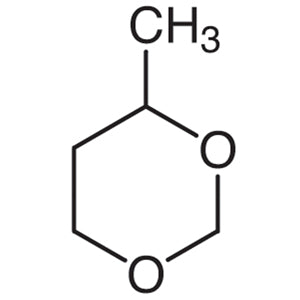
TCI M0209 4-Methyl-1,3-dioxane is a liquid heterocyclic compound built around a six-membered ring carrying two oxygen atoms at positions 1 and 3, with a single methyl group attached at the fourth position. Cyclic acetal structures of this kind occupy an important place in organic chemistry because they can serve a dual role: as a relatively stable cyclic ether solvent, and as an intermediate framework that can be reopened into carbonyl compounds or diols through controlled hydrolysis under acidic conditions. This dual character makes the material a recurring presence on the synthetic bench rather than a single-purpose reagent.
Laboratory interest in this compound arises chiefly from its stability toward bases and nucleophiles, combined with its sensitivity to aqueous acidic conditions. That combination is precisely why the 1,3-dioxane ring is so commonly employed as a temporary protecting group for aldehydes and ketones during multi-step synthesis, and then removed again once it is no longer needed. The methyl substituent on the ring provides a useful stereochemical reference point for studies of ring conformation, while the liquid form simplifies measuring, mixing, and repurification by distillation at laboratory scale.
In Indonesia, this compound is generally encountered in the organic synthesis laboratories of universities and in research institutions where multi-step preparative work is carried out. It suits settings where carbonyl protection and deprotection strategies form part of routine methodology, where cyclic acetal chemistry is taught and demonstrated, and where a liquid heterocyclic building block that can be handled and purified with standard glassware is preferred over more demanding alternatives.
- Carbonyl protection chemistry — the 1,3-dioxane ring masks aldehydes and ketones during multi-step sequences, resisting bases and nucleophiles until deliberate acidic hydrolysis restores the original carbonyl function.
- Heterocyclic building block synthesis — the preformed six-membered ring with oxygen atoms at positions 1 and 3 supplies a ready scaffold for constructing more elaborate heterocyclic targets without assembling the ring from scratch.
- Conformational analysis studies — the methyl group at the fourth position creates a stereochemical distinction that makes this molecule a practical subject for investigating ring conformation and substituent orientation in saturated heterocycles.
- Controlled hydrolysis work — because the acetal framework reopens to carbonyl compounds or diols under acidic aqueous conditions, it serves well in experiments examining acetal stability and deprotection kinetics.
- Cyclic ether solvent applications — the relative stability of the ring system allows the liquid to function as a cyclic ether medium in reactions where an inert, moderately polar organic phase is required.
| Brand | TCI (Tokyo Chemical Industry) |
|---|---|
| CAS number | 1120-97-4 |
| Molecular formula | — |
| Purity | — |
| Category | Chemistry > Building Blocks > Heterocyclic Building Blocks |
| Pack sizes | available in standard TCI laboratory pack sizes; store according to the conditions stated on the product label and Safety Data Sheet |
| Physical form | Liquid |
| Storage | — |
- Catalogue Number: M0209
Store this material in a tightly closed original container in a cool, dry, well-ventilated area away from direct sunlight, heat sources, and ignition sources. Because the acetal ring is sensitive to acidic aqueous conditions, keep the container sealed against moisture and store it separately from acids and strong oxidising agents. Use compatible glass or manufacturer-supplied containers, and transfer the liquid inside a fume hood using clean, dry glassware. Personnel should wear safety goggles, chemical-resistant gloves, and a laboratory coat during handling, and should consult the Safety Data Sheet supplied with the product before first use. Keep containers closed when not in active use to limit vapour release and moisture uptake.
—
Produk Terkait
-
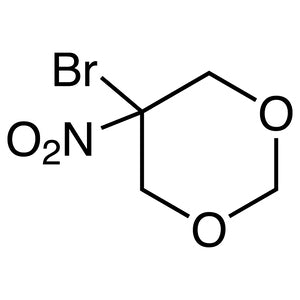
5-Bromo-5-nitro-1,3-dioxane TCI B3156
Regular price Rp 2.359.350,00Regular price -
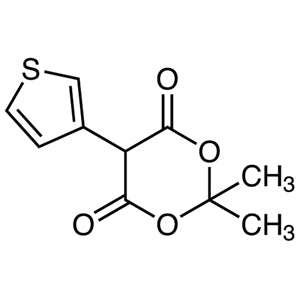
2,2-Dimethyl-5-(3-thienyl)-1,3-dioxane-4,6-dione TCI D3759
Regular price Rp 4.797.450,00Regular price -
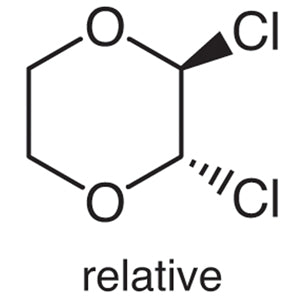
trans-2,3-Dichloro-1,4-dioxane TCI D2279
Regular price Rp 2.730.000,00Regular price -
2,4-Dimethyl-1,3-dioxane TCI D0708
Regular price From Rp 3.155.250,00Regular price -
2,2,5-Trimethyl-1,3-dioxane-5-carboxylicAcid TCI T3839
Regular price From Rp 2.809.800,00Regular price -
tert-Butyl(4R,6S)-6-(Hydroxymethyl)-2,2-dimethyl-1,3-dioxane-4-acetate TCI B4214
Regular price Rp 2.650.200,00Regular price -
5-Bromo-5-nitro-1,3-dioxane[forBiochemicalResearch] TCI B3769
Regular price Rp 1.696.800,00Regular price -
(2R,3R,5S,6S)-5,6-Bis(hydroxymethyl)-2,3-dimethoxy-2,3-dimethyl-1,4-dioxane TCI B3695
Regular price Rp 1.220.100,00Regular price


![30007-47-7 5-Bromo-5-nitro-1,3-dioxane [for Biochemical Research] - AMI Scientific](http://amiscientific.com/cdn/shop/files/TCI2510B3769.jpg?v=1767090329&width=533)
