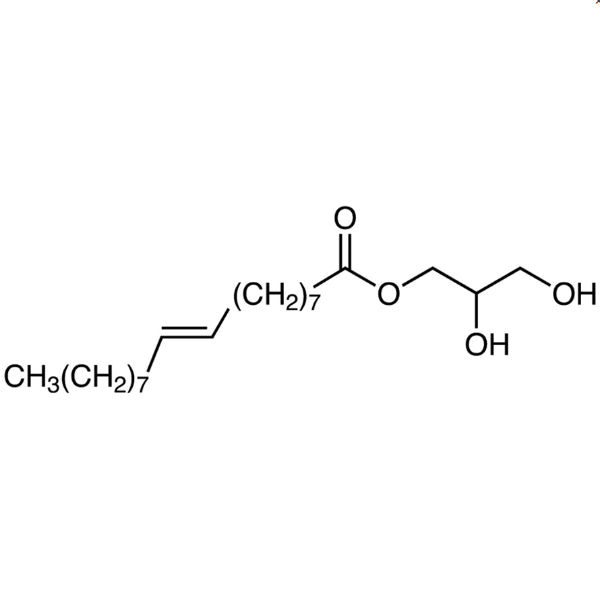
TCI M1075 is Monoelaidin, a monoglyceride formed from glycerol and elaidic acid, an eighteen-carbon fatty acid carrying a single double bond in the trans configuration. The compound belongs to the lipid class and is widely used in biochemical research and in the biophysical study of membranes. In the laboratory it serves as a model lipid with a clearly defined chain geometry, allowing researchers to examine how the shape of a lipid molecule governs phase arrangement, membrane curvature, and interfacial behaviour without the confounding compositional variability found in mixed natural lipids.
The distinguishing feature of monoelaidin lies in the trans configuration of its double bond. A trans acyl chain is markedly straighter than a kinked cis chain, so the molecules pack more tightly and the phase transition behaviour differs appreciably from that of cis analogues such as monoolein. This sharp and reproducible contrast is precisely what makes the material a valuable reference compound in studies of lipid polymorphism, mesophase formation, and the influence of geometric isomerism on the physical properties of lipids. The free hydroxyl groups on the glycerol backbone add amphiphilic character, making the molecule active at the water interface.
In Indonesian laboratories, monoelaidin is typically handled in academic biochemistry and biophysics groups, in university research centres working on membrane systems, and in institutional laboratories investigating lipid structure and behaviour. It is normally used at small analytical scale as a defined reference lipid, prepared alongside cis analogues so that the effect of double bond geometry can be compared directly under identical experimental conditions.
- Lipid polymorphism studies, where the well-defined trans chain geometry gives a reproducible reference point for mapping how molecular shape determines which lipid phase forms.
- Membrane biophysics research, because the single defined acyl chain lets investigators relate membrane curvature and packing behaviour directly to molecular geometry rather than to compositional variation.
- Mesophase formation experiments, since monoelaidin forms structured lipid phases whose behaviour can be compared systematically against cis analogues such as monoolein under matched conditions.
- Geometric isomerism comparison work, in which the trans isomer is run in parallel with its cis counterpart to isolate the physical consequences of double bond configuration alone.
- Interfacial behaviour investigations, where the free glycerol hydroxyl groups provide amphiphilic character that makes the compound active and measurable at the water interface.
| Brand | TCI (Tokyo Chemical Industry) |
|---|---|
| CAS number | 2716-53-2 |
| Molecular formula | — |
| Purity | — |
| Category | Life Science > Biochemicals and Reagents > Lipids |
| Pack sizes | available in standard research-scale catalogue pack sizes as supplied by the manufacturer |
| Physical form | — |
| Storage | store according to the conditions stated on the manufacturer's label and safety data sheet |
- Chemical name: Monoelaidin, a monoglyceride of glycerol and elaidic acid
Store the container tightly closed in a cool, dry place, following the storage conditions printed on the manufacturer's label and safety data sheet. As a lipid, the material should be protected from prolonged exposure to air, moisture, and light, and kept in its original container or in clean, chemically compatible glassware with a secure closure. Handle the compound in a well-ventilated area or fume hood, wearing a laboratory coat, safety glasses, and suitable gloves. Use clean, dry spatulas and glassware to avoid contamination, allow refrigerated material to reach room temperature before opening to prevent condensation, and reseal the container promptly after each use. Dispose of residues and contaminated consumables in accordance with institutional chemical waste procedures.
—
Produk Terkait
-
Tripalmitin TCI T3096
Regular price From Rp 1.458.450,00Regular price -
Trielaidin TCI T1392
Regular price Rp 3.683.400,00Regular price -
Tribehenin TCI T1391
Regular price From Rp 2.094.750,00Regular price -
Triarachidin TCI T1389
Regular price From Rp 2.809.800,00Regular price -
Trilinolein TCI T1388
Regular price From Rp 6.493.200,00Regular price -
Tricaproin TCI T0441
Regular price From Rp 2.916.900,00Regular price -
Tricaprin TCI T0413
Regular price From Rp 2.571.450,00Regular price -
Tricaprylin TCI T0365
Regular price Rp 795.900,00Regular price