

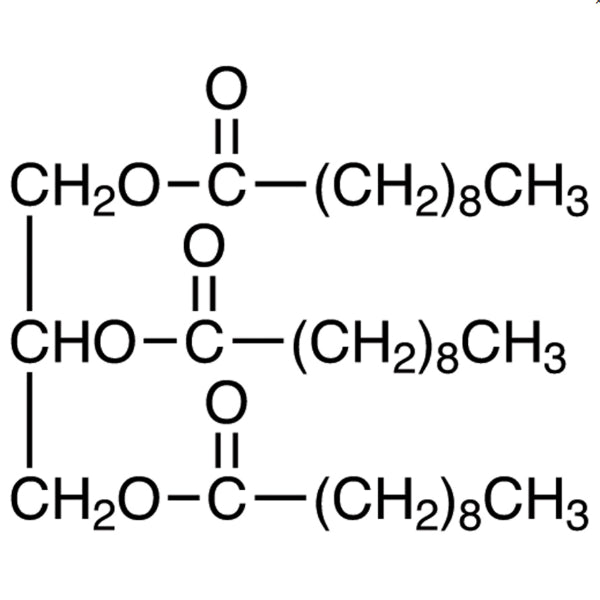
Tricaprin is a lipid compound widely used in biochemical experiments and scientific research. As a triglyceride composed of three caprylic acid molecules, it plays a vital role in various chemical reactions and biological analyses within the laboratory. Its chemical stability and versatility make it an essential component for researchers working on lipid metabolism, nutritional studies, and the functional analysis of lipids in the human body. This compound is frequently utilized as a starting material for the synthesis of other compounds or as a reagent in qualitative and quantitative assays.
Tricaprin is valued for its physical and chemical characteristics that make it a preferred choice in laboratory settings. It is colorless, solid in form, and has a relatively high melting point, ensuring stability under various experimental conditions. Its resistance to degradation allows for consistent performance in long-term studies and repeated use. Additionally, Tricaprin is free from harmful additives, making it safe for use in experiments requiring precision and cleanliness. These properties contribute to its reliability and effectiveness in diverse scientific applications.
In Indonesian laboratories, Tricaprin is commonly used in research related to nutrition, pharmacology, and biochemistry. Its role in studying lipid metabolism and biological functions has made it a key reagent in both academic and industrial research settings. Researchers rely on its stability and purity to ensure accurate results in their experiments, making it a standard component in many laboratory protocols.
TCI brochures (PDF)
- Lipids 2025-12-17 · p. 17
- Lipid Metabolism Studies: Tricaprin is used to investigate how lipids are processed in the body, offering insights into metabolic pathways and enzyme activity.
- Nutritional Research: It serves as a model compound for studying the effects of dietary fats on health and metabolism in human and animal models.
- Biochemical Synthesis: Tricaprin is a valuable starting material for the synthesis of other lipid-based compounds and derivatives.
- Qualitative and Quantitative Analysis: Its stability and purity make it suitable for use in analytical techniques such as chromatography and spectroscopy.
- Pharmacological Testing: It is used in drug development to assess the interaction of lipid-based compounds with biological systems and cellular responses.
| Brand | TCI |
|---|---|
| CAS number | 621-71-6 |
| Molecular formula | — |
| Purity | — |
| Category | Life Science > Biochemicals and Reagents > Lipids |
| Pack sizes | Available in various sizes as per supplier specifications |
| Physical form | Solid |
| Storage | Store in a cool, dry place away from light |
Tricaprin should be stored in a cool, dry place, away from direct light, to maintain its chemical stability and prevent degradation. It is recommended to use airtight containers to protect it from moisture and contaminants. Due to its solid form, it should be handled with care to avoid mechanical damage. In laboratory settings, it is important to ensure that it is stored separately from reactive or incompatible substances. Proper labeling and storage conditions are essential to maintain its integrity and ensure safe handling during experiments. Always follow standard laboratory safety protocols when working with this compound.
—
Produk Terkait
-
Trielaidin TCI T1392
Regular price Rp 3.735.900,00Regular priceRp 2.628.150,00Sale price Rp 3.735.900,00 -
Trilinolein TCI T1388
Regular price From Rp 6.493.200,00Regular priceRp 4.540.200,00Sale price From Rp 6.493.200,00 -
Tricaprylin TCI T0365
Regular price Rp 848.400,00Regular priceRp 609.000,00Sale price Rp 848.400,00 -
Tributyrin TCI T0364
Regular price From Rp 505.050,00Regular priceRp 352.800,00Sale price From Rp 505.050,00 -
Monomyristin TCI M1073
Regular price From Rp 2.121.000,00Regular priceRp 1.498.350,00Sale price From Rp 2.121.000,00 -
Tripalmitin TCI G0213
Regular price From Rp 2.279.550,00Regular priceRp 1.593.900,00Sale price From Rp 2.279.550,00 -
Tristearin TCI G0212
Regular price From Rp 1.008.000,00Regular priceRp 704.550,00Sale price From Rp 1.008.000,00 -
Triolein TCI G0089
Regular price From Rp 980.700,00Regular priceRp 685.650,00Sale price From Rp 980.700,00


