

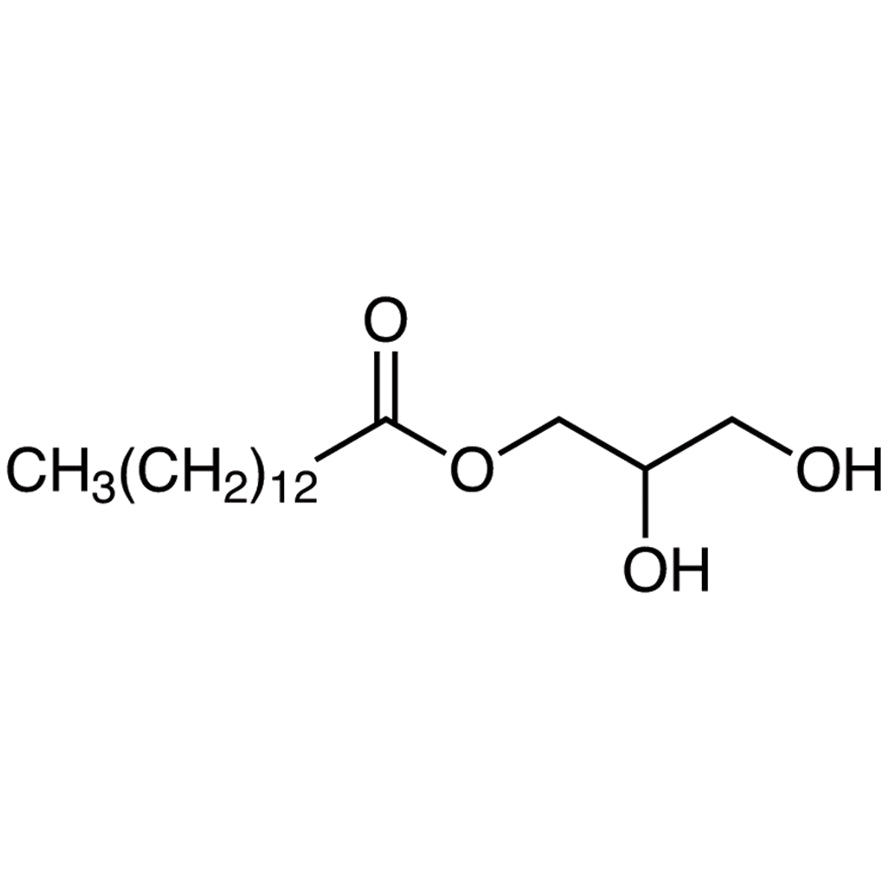
TCI M1073 is Monomyristin, a monoglyceride formed from glycerol and a single molecule of myristic acid, a fourteen-carbon fatty acid. Within materials science it is classified as a polymer additive, because long-chain monoglycerides are commonly used to improve the surface properties and processing behaviour of polymeric materials. In the laboratory its roles include service as an internal lubricant, a processing aid, an antistatic component, and equally as a model lipid in fundamental research into the behaviour of amphiphilic molecules at interfaces and within solid matrices.
The property that makes monomyristin a preferred choice is the length of its acyl chain, which is sufficient to confer strongly lipophilic character, while the two free hydroxyl groups on the glycerol backbone continue to supply a polar region. This combination allows monomyristin to migrate slowly toward a polymer surface and form a layer that reduces friction or limits the build-up of static charge. The C14 chain also produces a distinctive crystallisation behaviour, which makes the compound of interest for research into lipid polymorphism and phase transitions. As a molecule with a defined structure, monomyristin is more dependable as a research material than mixtures of variable composition.
In Indonesian laboratories this material is typically handled in polymer laboratories and materials science groups at universities and research institutes, as well as in the formulation and quality units of industry. It is used in trial compounding work, in studies of surface and interfacial behaviour, and in fundamental investigations of lipid systems. Because its structure is defined, it also serves well as a reference material when experimental results must be compared between different runs or different laboratories.
TCI brochures (PDF)
- Lipids 2025-12-17 · p. 16
- Reagents for Biological Research 2025-03-11 · p. 63
- Internal lubricant studies in polymer processing, where the lipophilic C14 chain allows the molecule to reduce friction between polymer chains during compounding and shaping trials.
- Antistatic additive research, since the free hydroxyl groups provide a polar region that helps dissipate accumulated static charge once the molecule migrates to the polymer surface.
- Surface and interfacial behaviour investigations, because the amphiphilic structure combining a long acyl chain and a polar glycerol head models how such molecules organise at interfaces.
- Lipid polymorphism and phase transition research, as the fourteen-carbon chain gives a distinctive crystallisation behaviour suitable for systematic study of solid-state lipid forms.
- Processing aid evaluation in formulation work, where a monoglyceride of defined structure gives more reproducible results than mixtures of variable and uncertain composition.
| Brand | TCI |
|---|---|
| CAS number | 589-68-4 |
| Molecular formula | — |
| Purity | — |
| Category | Materials Science > Polymer/Macromolecule Reagents > Polymer Additives |
| Pack sizes | available in the standard research pack sizes offered by TCI for this catalogue item |
| Physical form | — |
| Storage | store in a cool, dry place in a tightly closed container, following the manufacturer's stated conditions on the label |
- Product code: M1073
Store the container tightly closed in a cool, dry area away from direct sunlight, heat sources, and strong oxidising agents, and follow the storage conditions stated on the manufacturer's label. Keep the material in its original container or in a clean, chemically compatible, well-sealed vessel, since monoglycerides can absorb moisture and take up odours from the surrounding air. Handle in a well-ventilated laboratory space and wear the usual personal protective equipment, including gloves, safety glasses, and a laboratory coat. Avoid generating dust, allow the material to reach room temperature before opening a chilled container to prevent condensation, and close the container promptly after use so that sample quality is maintained across repeated sampling. Consult the manufacturer's safety data sheet before use and dispose of waste according to applicable laboratory and institutional procedures.
—
Produk Terkait
-
Monostearin TCI G0085
Regular price From Rp 477.750,00Regular price -
Monopalmitin TCI G0083
Regular price Rp 3.949.050,00Regular price -
Tributyrin TCI T0364
Regular price From Rp 505.050,00Regular price -
SodiumStearate TCI S0081
Regular price Rp 1.167.600,00Regular price -
Monoolein TCI G0082
Regular price From Rp 505.050,00Regular price -
Trielaidin TCI T1392
Regular price Rp 3.683.400,00Regular price -
Trilinolein TCI T1388
Regular price From Rp 6.493.200,00Regular price -
Tricaprin TCI T0413
Regular price From Rp 2.571.450,00Regular price


