

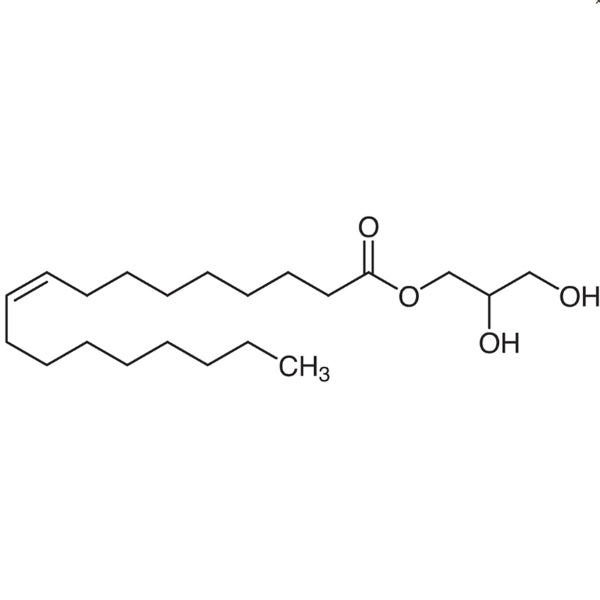
TCI G0082 Monoolein is a monoacylglycerol derived from oleic acid, consisting of a glycerol backbone esterified with a single eighteen-carbon unsaturated fatty acid chain bearing one double bond. Within this catalogue the compound is classified as a polymer additive, and in materials laboratories it is indeed employed as an internal lubricant, an antistatic agent, and a processing aid that improves the flow characteristics and surface quality of polymer products. Beyond that role, monoolein is also widely recognised in the life sciences as the cubic-phase-forming lipid that underpins membrane protein crystallisation.
The property that makes monoolein such a frequent choice is its rich lyotropic phase behaviour: in combination with water it forms stable structures ranging from lamellar through to bicontinuous cubic phases, a distinctive characteristic that few other lipids possess. The unsaturated oleate chain gives the material a relatively low melting point, so it is easily melted and blended, while at the same time imparting flexibility to the polymer matrix into which it is incorporated. Its amphiphilic character further makes it an efficient emulsifier and an attractive carrier for active-ingredient delivery systems.
In Indonesia this material is used by polymer and plastics technology laboratories that evaluate processing aids and surface behaviour in formulated resins, as well as by structural biology and pharmaceutical formulation groups working with lipidic phases. University research laboratories, government research institutes, and industrial R&D units typically order it in small research quantities for method development, formulation trials, and teaching work, where a well-characterised reference-grade lipid is required.
TCI brochures (PDF)
- Lipids 2025-12-17 · p. 16
- Reagents for Biological Research 2025-03-11 · p. 63
- Internal lubrication of polymer melts, where the amphiphilic monoacylglycerol reduces friction during processing and improves the flow of the resin through dies and moulds.
- Antistatic treatment of plastic articles, since the polar glycerol head group migrates to the surface and helps dissipate the static charge that accumulates on finished polymer parts.
- Processing aid formulation work, in which monoolein is blended into resin systems to improve surface finish and to assist consistent handling of the compounded material.
- Membrane protein crystallisation using the lipidic cubic phase, a technique that relies directly on the stable bicontinuous cubic structures monoolein forms when combined with water.
- Emulsion and delivery-system development, where the amphiphilic structure allows the compound to act as an efficient emulsifier and as a carrier matrix for active ingredients.
| Brand | TCI (Tokyo Chemical Industry) |
|---|---|
| CAS number | 111-03-5 |
| Molecular formula | — |
| Purity | — |
| Category | Materials Science > Polymer/Macromolecule Reagents > Polymer Additives |
| Pack sizes | available in standard TCI research pack sizes; please confirm the currently listed packaging when ordering |
| Physical form | — |
| Storage | — |
- Catalogue number: G0082
- Chemical class: monoacylglycerol of oleic acid (glycerol monooleate)
Store the container tightly closed in a cool, dry place away from direct sunlight, heat sources, and oxidising agents, following the storage conditions stated on the manufacturer's label and safety data sheet. Because the oleate chain is unsaturated, protection from prolonged exposure to air, light, and elevated temperature is advisable to preserve material quality. Use clean, dry glass or otherwise chemically compatible containers, and keep them well sealed to limit moisture uptake. Handle in a well-ventilated area or fume hood, wearing safety glasses, gloves, and a laboratory coat. Where the material is melted for blending, warm it gently and avoid unnecessary overheating. Label all working aliquots clearly and consult the manufacturer's safety data sheet before first use.
—
Produk Terkait
-
Tributyrin TCI T0364
Regular price From Rp 505.050,00Regular price -
Monomyristin TCI M1073
Regular price From Rp 2.068.500,00Regular price -
Monostearin TCI G0085
Regular price From Rp 477.750,00Regular price -
Monopalmitin TCI G0083
Regular price Rp 3.949.050,00Regular price -
Trielaidin TCI T1392
Regular price Rp 3.683.400,00Regular price -
Trilinolein TCI T1388
Regular price From Rp 6.493.200,00Regular price -
Tricaprin TCI T0413
Regular price From Rp 2.571.450,00Regular price -
Tricaprylin TCI T0365
Regular price Rp 795.900,00Regular price


