

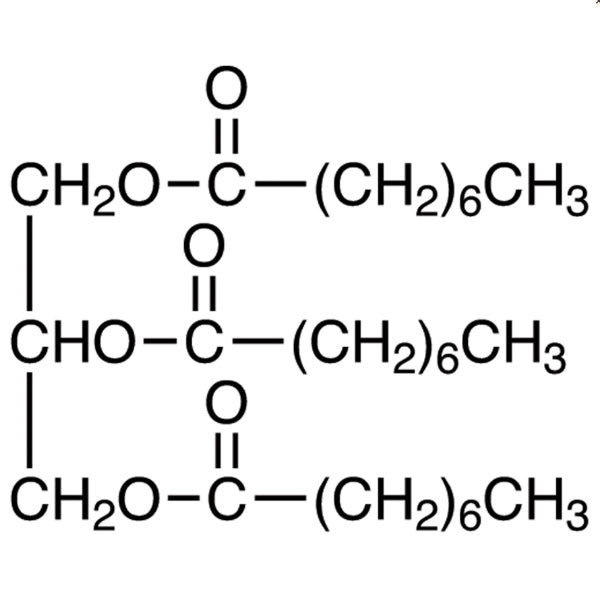
Tricaprylin, with CAS number 538-23-8, is a lipid compound widely used in biochemical laboratory experiments. As a naturally occurring triglyceride, it consists of three caprylic acid chains, making it a versatile reagent for various biochemical applications. Its non-polar nature allows it to function effectively as a solvent or auxiliary material in chemical reactions. This compound is commonly found in natural food fats, which makes it a valuable tool for nutritional and biochemical research. Its chemical stability and compatibility with organic solvents enhance its utility in diverse experimental settings.
Tricaprylin is preferred due to its solubility in organic solvents such as chloroform and ethyl acetate, which is essential for many laboratory procedures. Its stable boiling and melting points ensure consistent performance under varying experimental conditions. The compound’s purity and non-polar characteristics make it suitable for applications requiring minimal impurities. These properties contribute to its reliability in both research and industrial settings, ensuring accurate and reproducible results.
In Indonesian laboratories, Tricaprylin is frequently used in studies related to nutrition, pharmacology, and biochemistry. Its structural similarity to natural fats makes it ideal for simulating biological systems. Researchers rely on its stability and solubility properties to conduct experiments that require precise chemical behavior. Its widespread use in these fields highlights its importance as a fundamental reagent in biochemical research in Indonesia.
TCI brochures (PDF)
- Lipids 2025-12-17 · p. 17
- Nutritional research utilizes Tricaprylin to simulate natural fat structures and study lipid metabolism in biological systems.
- Pharmacological studies benefit from its use as a model compound for lipid-based drug delivery systems and bioavailability testing.
- Biochemical experiments often employ Tricaprylin as a solvent or emulsifier in reactions involving lipophilic compounds.
- Lipid analysis techniques, such as chromatography, use Tricaprylin as a standard for calibrating equipment and ensuring accurate measurements.
- Industrial applications in food science leverage Tricaprylin’s properties to develop stable emulsions and lipid-based formulations.
| Brand | TCI |
|---|---|
| CAS number | 538-23-8 |
| Molecular formula | — |
| Purity | — |
| Category | Life Science > Biochemicals and Reagents > Lipids |
| Pack sizes | — |
| Physical form | — |
| Storage | Store in a cool, dry place away from light |
Tricaprylin should be stored in a cool, dry place away from direct sunlight to maintain its chemical stability. It is recommended to use airtight containers to prevent moisture absorption and contamination. Due to its non-polar nature, it is advisable to handle it with appropriate personal protective equipment, such as gloves and safety goggles, to ensure laboratory safety. Avoid exposure to high temperatures or open flames, as it is a flammable substance. Proper labeling of containers is essential for safe handling and to prevent accidental misuse. Regular inspection of storage conditions ensures the compound remains in optimal condition for laboratory use.
—
Produk Terkait
-
Trielaidin TCI T1392
Regular price Rp 3.735.900,00Regular priceRp 2.628.150,00Sale price Rp 3.735.900,00 -
Trilinolein TCI T1388
Regular price From Rp 6.493.200,00Regular priceRp 4.540.200,00Sale price From Rp 6.493.200,00 -
Tricaprin TCI T0413
Regular price From Rp 2.623.950,00Regular priceRp 1.850.100,00Sale price From Rp 2.623.950,00 -
Tributyrin TCI T0364
Regular price From Rp 505.050,00Regular priceRp 352.800,00Sale price From Rp 505.050,00 -
Monomyristin TCI M1073
Regular price From Rp 2.121.000,00Regular priceRp 1.498.350,00Sale price From Rp 2.121.000,00 -
Tripalmitin TCI G0213
Regular price From Rp 2.279.550,00Regular priceRp 1.593.900,00Sale price From Rp 2.279.550,00 -
Tristearin TCI G0212
Regular price From Rp 1.008.000,00Regular priceRp 704.550,00Sale price From Rp 1.008.000,00 -
Triolein TCI G0089
Regular price From Rp 980.700,00Regular priceRp 685.650,00Sale price From Rp 980.700,00


