

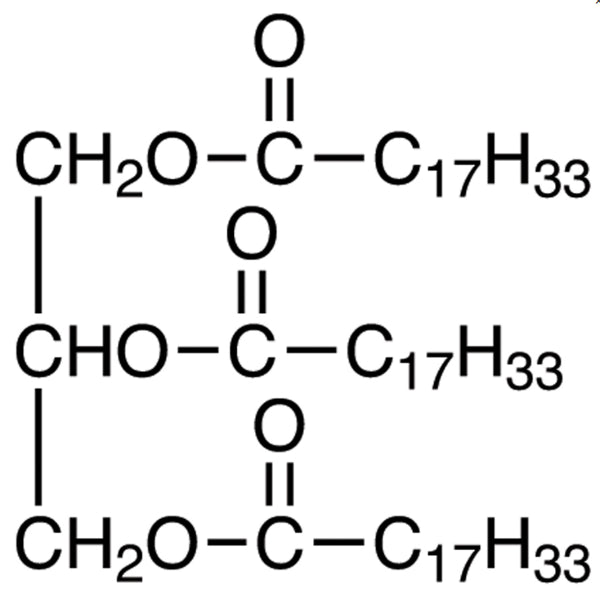
TCI G0089 Triolein is a triacylglycerol composed of glycerol esterified with three monounsaturated oleic acid chains. Because the cis double bond in each chain prevents tight crystalline packing, the compound exists as an oily liquid at room temperature, unlike saturated triglycerides, which are solid. In the laboratory, Triolein is the most representative model lipid for natural vegetable oils and the neutral fats of the body, which makes it a primary choice for studies of lipid metabolism, fat emulsions, and digestive enzyme testing.
The properties that make Triolein so widely used are its ability to form fine, stable fat emulsions together with phospholipids, and its liquid state, which allows the material to be taken up and measured volumetrically without any heating step. Its molecule provides three uniform ester bonds, so the kinetics of hydrolysis by lipase become easier to model. However, the unsaturated double bonds make it more sensitive to oxidation than saturated triglycerides, so correct storage and limited contact with air are decisive for the quality of experimental results.
In Indonesia, Triolein is used in biochemical nutrition research and in pharmacology, where a well-defined neutral fat is needed as a reference substrate or as the oil phase of a preparation. Its consistent composition allows university and institutional laboratories to compare results across runs, and its liquid handling makes it practical for routine bench work where a representative natural triglyceride is required.
TCI brochures (PDF)
- Lipids 2025-12-17 · p. 17
- Lipid metabolism studies: Triolein represents the neutral fats of the body closely, so metabolic pathways observed with it translate meaningfully to physiological triglyceride handling.
- Fat emulsion preparation: its capacity to form fine and stable emulsions together with phospholipids makes it a dependable oil phase for emulsion formulation and stability work.
- Digestive enzyme assays: the three uniform ester bonds give lipase hydrolysis predictable kinetics, allowing enzyme activity to be modelled and compared with far less interpretive ambiguity.
- Vegetable oil model systems: as the most representative model lipid for natural vegetable oils, it substitutes for compositionally variable oils when a defined reference material is required.
- Nutrition biochemistry and pharmacology research: it serves as a reference neutral fat or oil phase in Indonesian laboratory studies requiring consistent, well-characterised triglyceride behaviour.
| Brand | TCI |
|---|---|
| CAS number | 122-32-7 |
| Molecular formula | — |
| Purity | — |
| Category | Life Science > Biochemicals and Reagents > Lipids |
| Pack sizes | available in standard TCI catalogue pack sizes; please confirm the pack size when ordering |
| Physical form | oily liquid at room temperature |
| Storage | store correctly with contact with air limited, as the unsaturated double bonds make the material more sensitive to oxidation than saturated triglycerides |
Because the unsaturated chains of Triolein are more prone to oxidation than those of saturated triglycerides, proper storage and restricted exposure to air are essential to preserve experimental quality. Keep the material in a tightly closed original container, and reseal it promptly after each withdrawal to minimise headspace contact with air. Since the product is liquid at room temperature, portions can be withdrawn and measured volumetrically with clean, dry pipettes or syringes, with no heating step required; avoid introducing moisture or contaminants that could compromise subsequent assays. Observe standard laboratory practice, including appropriate personal protective equipment, and consult the manufacturer's safety data sheet before use.
—
Produk Terkait
-
Trielaidin TCI T1392
Regular price Rp 3.683.400,00Regular price -
Trilinolein TCI T1388
Regular price From Rp 6.493.200,00Regular price -
Tricaprin TCI T0413
Regular price From Rp 2.571.450,00Regular price -
Tricaprylin TCI T0365
Regular price Rp 795.900,00Regular price -
Tributyrin TCI T0364
Regular price From Rp 505.050,00Regular price -
Monomyristin TCI M1073
Regular price From Rp 2.068.500,00Regular price -
Tripalmitin TCI G0213
Regular price From Rp 2.279.550,00Regular price -
Tristearin TCI G0212
Regular price From Rp 1.008.000,00Regular price


