

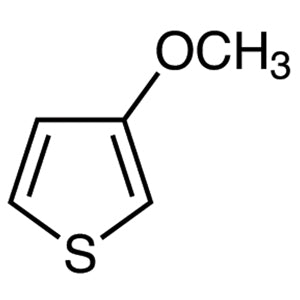
TCI M1093 3-Methoxythiophene is a thiophene derivative bearing a methoxy group at the three-position of the five-membered sulfur-containing ring. Although catalogued as a heterocyclic building block, this compound is best known in the laboratory as a monomer and monomer precursor for electrically conducting conjugated polymers. The thiophene ring forms the backbone of most organic semiconducting polymers, and adding a methoxy group at the three-position fundamentally alters the electronic character of the ring, opening a route to polymers whose band gaps and oxidation potentials differ from those of ordinary polythiophene.
The property that drives its selection is the strong electron-donating effect of the methoxy group bound directly to an already electron-rich ring. This donation of electron density lowers the oxidation potential of the monomer, so that both electrochemical and chemical polymerisation can proceed at lower applied potentials, and the resulting polymers tend to show narrower band gaps together with better stability in the doped state. Substitution at the three-position also leaves the two- and five-positions free, and those are precisely the positions required for a polymer chain to grow in a regular, head-to-tail fashion rather than through random coupling.
In Indonesian laboratories this material is typically found in university and institute research groups working on organic electronics, conducting polymer films, and electrochemical sensing, as well as in synthetic chemistry groups that use substituted thiophenes as intermediates toward larger heterocyclic targets. It is normally purchased in small research quantities rather than process volumes, handled inside a fume hood on a standard synthetic bench, and used in conjunction with electrochemical workstations or inert-atmosphere polymerisation setups.
Related TCI products
- Electrochemical polymerisation studies, where the lowered oxidation potential conferred by the methoxy group allows conducting polymer films to be grown onto electrodes at milder applied potentials.
- Synthesis of low band gap conjugated polymers, since the electron-donating methoxy substituent narrows the band gap of the resulting polymer relative to unsubstituted polythiophene.
- Preparation of regioregular polymer chains, because substitution only at the three-position leaves the two- and five-positions open for ordered head-to-tail chain growth.
- Organic semiconductor and organic electronics research, where thiophene-based backbones are the standard material platform and substituent effects on electronic properties are systematically investigated.
- Heterocyclic building block chemistry, serving as a substituted thiophene intermediate for the construction of larger sulfur-containing heterocyclic target molecules in multi-step synthesis.
| Brand | TCI (Tokyo Chemical Industry) |
|---|---|
| CAS number | 17573-92-1 |
| Molecular formula | — |
| Purity | — |
| Category | Chemistry > Building Blocks > Heterocyclic Building Blocks |
| Pack sizes | research-scale packaging as listed by the manufacturer for this catalogue item |
| Physical form | — |
| Storage | keep in the original tightly closed container as directed on the manufacturer label |
- Chemical name: 3-Methoxythiophene
- Product code: M1093
Store the container tightly closed in a cool, dry, well-ventilated place away from heat, open flame, and sources of ignition, and keep it separated from strong oxidising agents. The original manufacturer-supplied bottle is the most suitable container, as substituted thiophenes are best protected from prolonged air and light exposure; transfer only into clean, compatible, properly labelled glassware when a portion is required. All handling should take place inside a working fume hood, with safety glasses, chemical-resistant gloves, and a laboratory coat worn at all times. Consult the manufacturer safety data sheet before first use, and dispose of residues and contaminated materials through the laboratory's chemical waste stream rather than the drain.
—
Produk Terkait
-
2-Methoxythiophene TCI M1030
Regular price From Rp 2.147.250,00Regular price -
3,4-Dimethoxythiophene TCI D2728
Regular price From Rp 1.565.550,00Regular price -
2-Methoxythiazole TCI M1753
Regular price From Rp 717.150,00Regular price -
2-Ethoxythiazole TCI E0669
Regular price From Rp 928.200,00Regular price -
N4-Benzoyl-5'-O-(4,4'-dimethoxytrityl)-2'-deoxycytidine TCI B3087
Regular price From Rp 2.016.000,00Regular price -
5-MethoxytryptamineHydrochloride TCI M3563
Regular price Rp 1.298.850,00Regular price -
6-Methoxytryptamine TCI M3162
Regular price From Rp 2.889.600,00Regular price -
5-Methoxytryptamine TCI M0131
Regular price From Rp 477.750,00Regular price


