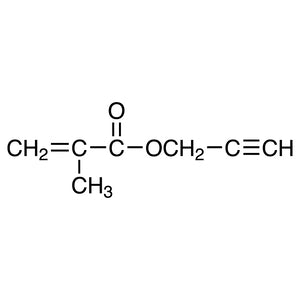
Propargyl Methacrylate is an organic monomer compound belonging to the methacrylate ester class, carrying a propargyl (alkyne) functional group at the terminal end of its molecule. In the laboratory, this compound serves as a building block and synthesis raw material of considerable importance, particularly in the fields of polymer chemistry and materials chemistry. The presence of two distinct functional groups within a single molecule makes it a bridge connecting radical polymerization with click chemistry, allowing researchers to design functional polymers with controlled molecular architecture. This product is marketed by TCI under code P3043 and is supplied with an MEHQ stabilizer so that it remains safe during storage and shipping.
The main advantage of Propargyl Methacrylate lies in its bifunctional nature. The methacrylate group can undergo radical polymerization as well as copolymerization with a variety of vinyl monomers, providing flexibility in constructing polymer backbones. At the same time, the terminal alkyne group is highly reactive toward azide-alkyne cycloaddition, the characteristic click chemistry reaction, enabling convenient post-polymerization functionalization. This combination gives researchers precise control over polymer architecture, supporting the preparation of well-defined copolymers, graft structures, and crosslinked networks. The MEHQ stabilizer keeps the monomer chemically stable during storage and transport, preserving its reactivity and quality for downstream laboratory work.
In Indonesia, this compound is commonly used by university research laboratories, materials research centers, and the fine chemical industry as a base material for the preparation of specialty polymers. Its dual reactivity supports a wide range of research themes, from surface modification and functional material design to the synthesis of advanced polymer systems. For research groups focused on polymer science and materials innovation, Propargyl Methacrylate offers a practical route to introduce clickable handles into polymer structures, making it a dependable choice for both academic and industrial laboratory applications.
- Radical Polymerization and Copolymerization: The methacrylate group readily undergoes radical polymerization or copolymerizes with various vinyl monomers, enabling the construction of polymer backbones with tailored composition and properties.
- Click Chemistry Functionalization: The terminal alkyne group participates efficiently in azide-alkyne cycloaddition, allowing researchers to attach functional moieties, labels, or crosslinkers onto polymers under mild conditions.
- Synthesis of Functional Polymers: The bifunctional design permits the preparation of well-defined functional polymers with controlled molecular architecture, supporting advanced studies in polymer and materials chemistry.
- Building Block for Specialty Materials: As a non-heterocyclic building block, it serves as a versatile raw material for designing specialty polymers used in coatings, adhesives, and advanced material development.
- Research in Academic Laboratories: The compound is well suited to university and research center laboratories in Indonesia, where it supports studies in polymer chemistry, materials science, and fine chemical synthesis.
| Brand | TCI |
|---|---|
| CAS number | 13861-22-8 |
| Molecular formula | — |
| Purity | — |
| Category | Chemistry > Building Blocks > Non-Heterocyclic Building Blocks |
| Pack sizes | — |
| Physical form | — |
| Storage | — |
- Product code: P3043
- Product name: Propargyl Methacrylate (stabilized with MEHQ)
- Stabilizer: MEHQ, added to ensure stability during storage and shipping
This product is supplied with MEHQ as a stabilizer to keep it safe during storage and transport. For routine laboratory use, store the container tightly closed in a cool, dry, well-ventilated area, protected from heat, direct sunlight, and sources of ignition. Since the material is a reactive monomer, avoid prolonged storage and keep it away from polymerization initiators, strong oxidizing agents, and other incompatible substances. Always handle the compound in a fume hood while wearing appropriate personal protective equipment such as chemical-resistant gloves and safety goggles. Follow standard laboratory hygiene practices and consult the supplier's documentation before use.
—
Produk Terkait
-
TCI B5774 5,10-Bis(4,4,5,5-tetramethyl-1,3,2-dioxaborolan-2-yl)naphtho[1,2-c:5,6-c']bis([1,2,5]oxadiazole)
Regular price Rp 11.420.850,00Regular price -
3-Bromo-5-methylaniline TCI B6015
Regular price From Rp 3.927.000,00Regular price -
TCI B6321 2,6-Bis(acetamido)-2,6-dideoxy-D-mannose
Regular price Rp 4.044.600,00Regular price -
BTP3-Neu5AcNa TCI B6529
Regular price Rp 4.251.450,00Regular price -
Dihydroiodide TCI B6569
Regular price From Rp 2.155.650,00Regular price -
Biotin-PEG3-Dz TCI B6572
Regular price From Rp 5.904.150,00Regular price -
Biotin-PEG3-PhN3 TCI B6585
Regular price From Rp 5.371.800,00Regular price -
Trifluoromethanesulfonate TCI B7003
Regular price From Rp 2.155.650,00Regular price
![5,10-Bis(4,4,5,5-tetramethyl-1,3,2-dioxaborolan-2-yl)naphtho[1,2-c:5,6-c']bis([1,2,5]oxadiazole) - TCI B5774 - AMI Scientific](http://amiscientific.com/cdn/shop/files/TCI2510B5774.jpg?v=1769180228&width=533)