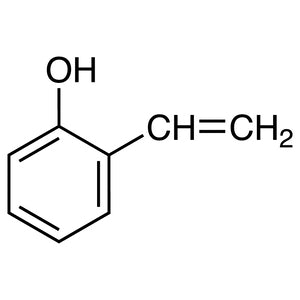
2-Vinylphenol (CAS 695-84-1) is an organic compound belonging to the phenol family that carries a vinyl group, giving it a dual role as both a phenol and a reactive unsaturated monomer. In the laboratory, this compound is widely employed as a building block in organic synthesis, primarily for constructing more complex chemical structures through polymerization, copolymerization, and a range of functional group transformations. Because the vinyl group polymerizes readily, the product is supplied stabilized with TBC (tert-butylcatechol) to keep it safe and stable during storage and use. For laboratories active in organic, materials, or polymer chemistry, 2-vinylphenol provides a practical route to functional monomers that can later be assembled into polymers with specific, desirable properties.
The key advantage of 2-vinylphenol lies in its bifunctional structure, which combines a phenolic hydroxyl group with a vinyl double bond. This combination makes it an attractive and versatile reactant in synthetic chemistry, as the two reactive sites can be addressed independently or sequentially. The phenolic moiety offers opportunities for hydrogen bonding, surface anchoring, and further derivatization, while the vinyl group readily participates in addition and free-radical polymerization. This dual reactivity distinguishes it from monofunctional monomers, allowing researchers to introduce phenolic functionality directly into polymer backbones or pendant chains with relative ease. The stabilized formulation further enhances its practical value by minimizing the risk of premature polymerization during handling and long-term storage.
In Indonesian laboratories, particularly those working in organic chemistry, materials chemistry, and polymer chemistry, 2-vinylphenol opens up opportunities for preparing functional monomers that can later be assembled into polymers with tailored properties. These include polymers bearing phenol groups that are useful for surface modification, biological binding, or as precursors for resin systems. Academic research groups and industrial R&D facilities alike can employ this building block in method development, monomer screening, and structure–property studies, thereby supporting the continued growth of polymer and functional materials research within the country.
- Organic synthesis: As a bifunctional building block, 2-vinylphenol enables the construction of complex molecules through selective reactions at either the phenolic hydroxyl group or the reactive vinyl double bond.
- Polymerization and copolymerization: Its reactive vinyl group participates readily in free-radical polymerization, allowing researchers to prepare homopolymers and copolymers with controlled phenol content for tailored material properties.
- Functional polymer preparation: The phenolic hydroxyl group can be carried into polymer chains, providing reactive sites for surface modification, cross-linking, or conjugation with biologically relevant molecules.
- Resin precursor studies: As a phenolic vinyl monomer, it serves as a useful starting material for developing resin-type systems whose phenol functionality supports curing and network-forming chemistry.
- Materials and polymer chemistry research: In both academic and industrial laboratories, it supports monomer screening, method development, and structure–property investigations that advance functional materials research.
| Brand | TCI |
|---|---|
| CAS number | 695-84-1 |
| Molecular formula | — |
| Purity | — |
| Category | Chemistry > Building Blocks > Non-Heterocyclic Building Blocks |
| Pack sizes | as listed in the TCI catalog; storage as recommended in the Handling and Storage section below |
| Physical form | — |
| Storage | — |
- Catalog reference: V0213
- Stabilization: supplied stabilized with TBC (tert-butylcatechol) to prevent premature polymerization
Store 2-vinylphenol in its original, tightly closed container in a cool, dry, and well-ventilated area, protected from light, heat, and ignition sources. Because the product is stabilized with TBC, avoid distillation or purification steps that might remove the stabilizer unless appropriate precautions are taken. Use containers made of materials compatible with phenolic compounds, and reseal the bottle promptly after each use to limit exposure to air and moisture. Wear appropriate personal protective equipment, including gloves and safety glasses, work in a fume hood, and avoid skin contact, as phenolic compounds can be irritating. Keep the material away from polymerization initiators, strong oxidizing agents, and open flames, and follow standard chemical hygiene and waste disposal practices in the laboratory.
—
Produk Terkait
-
TCI B5774 5,10-Bis(4,4,5,5-tetramethyl-1,3,2-dioxaborolan-2-yl)naphtho[1,2-c:5,6-c']bis([1,2,5]oxadiazole)
Regular price Rp 11.420.850,00Regular price -
3-Bromo-5-methylaniline TCI B6015
Regular price From Rp 3.927.000,00Regular price -
TCI B6321 2,6-Bis(acetamido)-2,6-dideoxy-D-mannose
Regular price Rp 4.044.600,00Regular price -
BTP3-Neu5AcNa TCI B6529
Regular price Rp 4.251.450,00Regular price -
Dihydroiodide TCI B6569
Regular price From Rp 2.155.650,00Regular price -
Biotin-PEG3-Dz TCI B6572
Regular price From Rp 5.904.150,00Regular price -
Biotin-PEG3-PhN3 TCI B6585
Regular price From Rp 5.371.800,00Regular price -
Trifluoromethanesulfonate TCI B7003
Regular price From Rp 2.155.650,00Regular price
![5,10-Bis(4,4,5,5-tetramethyl-1,3,2-dioxaborolan-2-yl)naphtho[1,2-c:5,6-c']bis([1,2,5]oxadiazole) - TCI B5774 - AMI Scientific](http://amiscientific.com/cdn/shop/files/TCI2510B5774.jpg?v=1769180228&width=533)