
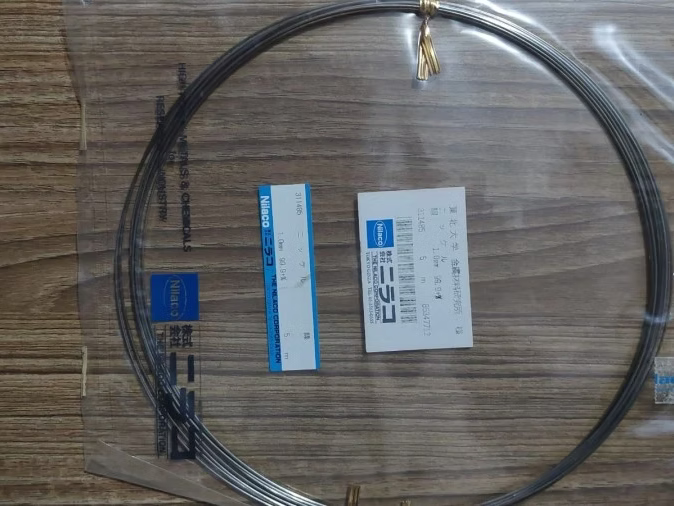
Nickel Wire - Corrosion and Acid Resistant Wire!
Bagikan
Nickel is a highly sought-after material because it is the main component for battery production. Indonesia has abundant nickel reserves, reaching 4.5 million metric tons. One application of nickel is nickel wire. This material is widely used in various industries for electronic equipment due to its corrosion resistance.
Is that all? Let's look at the following discussion.
What is Nickel?
Nickel is a metallic element characterized by its shiny, silvery-white appearance.
This material is one of the five metallic elements commonly found in the Earth's crust.
Nickel has a thermal conductivity value of 90.9 W, a boiling point of 3003 °K, and a melting point of 1728 °K.
As one of the metallic elements commonly found in the Earth's crust, nickel consists of 60% laterite and 40% sulfide deposits. Currently, there are 74 million metric tons of nickel reserves worldwide, with Indonesia possessing 4.5 million metric tons of nickel.
What is Nickel Wire?
Nickel is a material used to make wires because it can withstand chemical corrosion such as air and water oxidation. Nickel alloys are resistant to acids and alkalis.
The resistant wire is used in components that contain high levels of electricity or heat (2,600 °F). The material is magnetic as long as its temperature is below 350 °F; above that, it loses its magnetic properties.
Types of Nickel Wire
There are various types of nickel wires currently available, as follows:
a. Pure Nickel Wire
Pure nickel is chosen for its fatigue resistance and flexibility. Pure nickel wire can stretch, allowing it to break other metals.
In addition, pure nickel wire is a good conductor of heat and electricity. Therefore, it is widely used in the aerospace and medical industries.
b. Copper-Nickel Wire
The composition of copper-nickel wire consists of ⅔ nickel, ⅓ copper, and small amounts of iron, carbon, silicon, and manganese.
Nickel is chosen to enhance strength, corrosion resistance, and high-temperature tolerance. Copper is selected for its ability to conduct heat, with a thermal conductivity value of 386 W/mK.
Copper wire is widely used in chemical processing applications in various industries.
c. Nichrome
Nichrome is also known as nickel-chromium. This alloy of nickel and chromium has varying metal content, depending on the code used.
The Nichrome type number indicates the proportion of nickel to chromium. For example, Nichrome 60 consists of 60% nickel and 40% chromium.
The advantage of Nichrome is its effectiveness against heat and oxidation. This wire functions as a heating element in household appliances such as toasters.
Ceramic sculptors, glassmakers, construction workers, and laboratories use nichrome to heat objects.
Advantages of Nickel Wire
Nickel wire has many advantages, as follows:
-
Corrosion resistant
-
High temperature resistant
-
Electrical conductivity
-
Resistant to oxidation in saltwater
-
Resistant to acids, alkalis, and dry gases
-
Possesses excellent mechanical strength
Applications of Nickel Wire
Nickel wire can be used in various settings due to its high-temperature and corrosion resistance. Below are examples of nickel wire applications.
a. Electronic Equipment
Electronic devices use nickel wire because it is conductive and has good corrosion resistance. You can find it in products from PCBs to resistors.
Its conductivity is ideal for use in solar cells, wind turbines, and other renewable energy sources. Therefore, this material is very important for industrial applications.
b. Mechanical Equipment
Nickel wire has good strength and flexibility for the manufacturing industry. This material is used as springs or screws in precision machinery. Its flexibility also allows it to be bent into any shape, much better than steel or brass.
c. Jewelry Making
Nickel wire is also popular for making attractive jewelry with good flexibility. Jewelry made from nickel wire can be easily shaped into various patterns, giving it a creative and beautiful appearance.
For your information, nickel wire is relatively inexpensive compared to gold, making it suitable for those who want to make jewelry on a tight budget.