
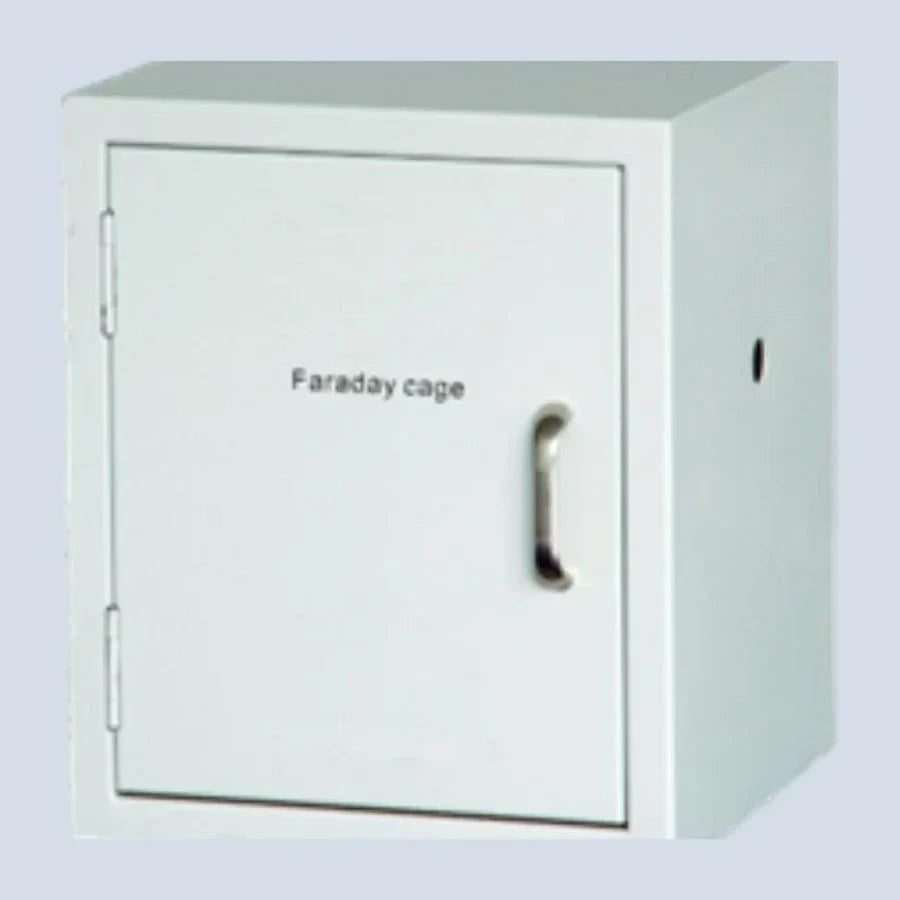
Faraday Cage - Components, How It Works, and Its Applications
Bagikan
A Faraday cage is an object used to protect humans from electromagnetic charges. Historically, this object was created to control the electricity received by humans. This is to prevent it from endangering humans at work.
Before buying a Faraday cage, there are three important things to consider, such as entry points, conductor materials, and continuity. This article will discuss these points.
What is a Faraday Cage?
A Faraday cage aims to protect objects from electromagnetic radiation. This is because when an electromagnetic field hits an electrical conductor, the charge remains on the outside of the conductor and does not move inside it.
The function of a Faraday cage is to ward off unwanted electromagnetic radiation. The danger of electromagnetic radiation can disrupt health if exposed to it for a long period.
The Faraday cage was discovered by Michael Faraday in the 19th century. This invention was designed to control electricity and reduce the risk of human exposure to electromagnetic radiation.
Components of a Faraday Cage
There are three important components you should consider before buying a Faraday cage.
First is the entry point for cables, also known as cage fractures. This part causes the potential for external electromagnetic field penetration. The thickness of the conductor and the size of the holes affect the penetration of electromagnetic radiation.
The opening of a Faraday cage must be smaller than 1/10 of the blocked wavelength. For example, to block an electromagnetic field with a frequency of 10 GHz, use a cage opening smaller than 3 mm.
Second is the long-term discontinuity of the conductor material. Access to a Faraday cage through a cover creates a real possibility of discontinuity. If one side is discontinuous, even if conducted, the charge will not be well distributed, and the cancellation effect will not exist inside the cage.
Using cables to connect junctions helps with low frequencies but is not sufficient for experiments requiring higher frequencies and operations.
Third is short conductivity. This is rarely an issue when the cage size is small, but it's a different story when the cage size increases. The more resistive the conductive layer, the slower the charge redistribution, resulting in an uncancelable field.
How a Faraday Cage Works and its Physical Principles
A Faraday cage works based on how electricity operates in conductors. Initially, metal objects like aluminum are conductors and have electrons moving within them. When there is no electrical charge, conductors have positive and negative particles mixed together.
If an external charged object approaches a conductor, the positive and negative particles will separate. Electrons with charges opposite to the external charge are attracted to the external object. Electrons with the same charge as the external object will repel each other. This redistribution of charge is called electrostatic induction.
In the presence of an external charged object, positive and negative particles end up on opposite sides of the conductor. The resulting opposing electric field cancels out the charge of the object outside the metal conductor.
Even though there are no charges inside the conductor, the electric field protects the interior from static electricity and electromagnetic radiation. This is the primary function of a Faraday cage.
The effectiveness of this protection depends on the cage's construction. Variations in the conductivity of different metals affect the cage's function. The size of the holes in the mesh alters the cage's capability and can be adjusted to the frequency and wavelength of the electromagnetic radiation emitted from inside the cage.
Benefits/Applications of a Faraday Cage
In principle, a Faraday cage is used to reduce the effects of electromagnetic radiation. You can find it in daily use such as microwaves and MRIs.
a. Microwave
The metal shell in a microwave oven functions as a Faraday cage. It prevents microwaves inside the oven from leaking into the environment.
b. EMI Shielding for Electronic Devices
Electromagnetic radiation comes from other units in the environment. EMI shielding is used to protect your devices from electromagnetic radiation.
Coaxial cables in televisions generally consist of a braided copper shield under a PVC jacket as a Faraday cage. Its purpose is to protect the internal conductor from electrical noise and prevent RF leakage.
c. Workwear
Protective clothing for employees working in hazardous environments also uses Faraday cage elements. Its use can protect against electric shocks when working near high-voltage power lines, such as PLN officers.
d. MRI (Magnetic Resonance Imaging)
MRI imaging uses a Faraday cage to prevent distortion from external radio frequency signals. Such interference would disrupt data collection and patient examination processes.
e. Lightning Rod
Faraday cages are used to protect planes or cars from lightning strikes, ensuring passengers are safe from external electrical charges from the environment.
Get Quality Faraday Cages at AMI Scientific!
A Faraday cage is a tool to reduce the risk of electromagnetic radiation that is harmful to humans. Applications of Faraday cages are found in microwaves, MRIs, and even lightning rods.