

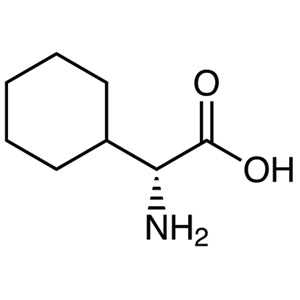
D-2-Cyclohexylglycine is a chemical compound widely used in laboratory experiments across chemical and biochemical research fields. As a key component in peptide chemistry, it plays a vital role in the synthesis of peptides and the study of molecular interactions. This compound is particularly valued for its unique structural features, which enable it to participate in various chemical reactions, making it a versatile reagent in synthetic processes. Its chemical stability allows it to be used in a range of applications where precise control over molecular structure is essential.
The compound's chemical properties, including its solubility in organic solvents and its ability to undergo reactions such as condensation, substitution, and hydrolysis, make it a preferred choice for researchers. These characteristics allow it to be incorporated into complex synthesis pathways with predictable outcomes. Its stability under controlled laboratory conditions ensures consistent performance, which is critical for reproducible results in scientific research. This reliability enhances its utility in both academic and industrial settings.
In Indonesian laboratories, D-2-Cyclohexylglycine is commonly used by researchers in universities, research institutions, and pharmaceutical companies. Its relevance spans across biochemical and pharmacological studies, supporting advancements in drug development and molecular biology. Its availability through suppliers like AMI Scientific ensures that it remains a key resource for scientific inquiry in the region.
- Peptide Synthesis: D-2-Cyclohexylglycine is ideal for synthesizing peptides due to its structural compatibility with amino acid derivatives and its ability to form stable intermediates.
- Molecular Interaction Studies: Its unique chemical structure allows it to be used in studying molecular interactions, providing insights into protein-ligand binding and other biochemical processes.
- Organic Synthesis Reactions: The compound's reactivity in condensation and substitution reactions makes it a valuable reagent in organic synthesis, enabling the creation of complex molecular structures.
- Biochemical Research: It is frequently used in biochemical experiments to investigate enzyme activity and metabolic pathways, offering a reliable tool for studying biological systems.
- Pharmaceutical Development: Its role in drug development is significant, as it can be used to model and test the behavior of potential therapeutic compounds in controlled environments.
| Brand | TCI |
|---|---|
| CAS number | 14328-52-0 |
| Molecular formula | — |
| Purity | — |
| Category | Chemistry > Chemical Biology > Peptide Chemistry |
| Pack sizes | Available in various quantities as per supplier specifications |
| Physical form | Solid or crystalline, depending on the batch |
| Storage | Store in a cool, dry place away from light and moisture |
D-2-Cyclohexylglycine should be stored in a cool, dry environment to maintain its chemical stability and prevent degradation. It is recommended to keep the compound in airtight containers to minimize exposure to moisture and air, which can affect its integrity. Suitable storage conditions include a controlled room temperature (typically between 15°C and 25°C) with low humidity levels. When handling, it is important to use appropriate personal protective equipment such as gloves and safety goggles to ensure laboratory safety. The compound should be kept away from incompatible substances to avoid any potential chemical reactions. Proper labeling of containers is essential for safe handling and to prevent accidental misuse in laboratory settings.
—
Produk Terkait
-
1,4-PhenyleneBis(4-aminobenzoate) TCI B6311
Regular price From Rp 2.923.200,00Regular price -
tert-Butyl3-Aminopropanoate TCI B6504
Regular price From Rp 2.303.700,00Regular price -
4-Chloro-DL-phenylalanine TCI C0253
Regular price From Rp 709.800,00Regular price -
trans-1,2-CyclohexanediaminetetraaceticAcidMonohydrate TCI C0473
Regular price From Rp 1.830.150,00Regular price -
L-CysteicAcid TCI C0514
Regular price From Rp 1.151.850,00Regular price -
DL-2-(4-Chlorophenyl)glycine TCI C1401
Regular price From Rp 532.350,00Regular price -
Nalpha-Carbobenzoxy-L-lysine TCI C1728
Regular price Rp 2.155.650,00Regular price -
4-Chloro-D-phenylalanineHydrochloride TCI C2016
Regular price Rp 5.164.950,00Regular price


