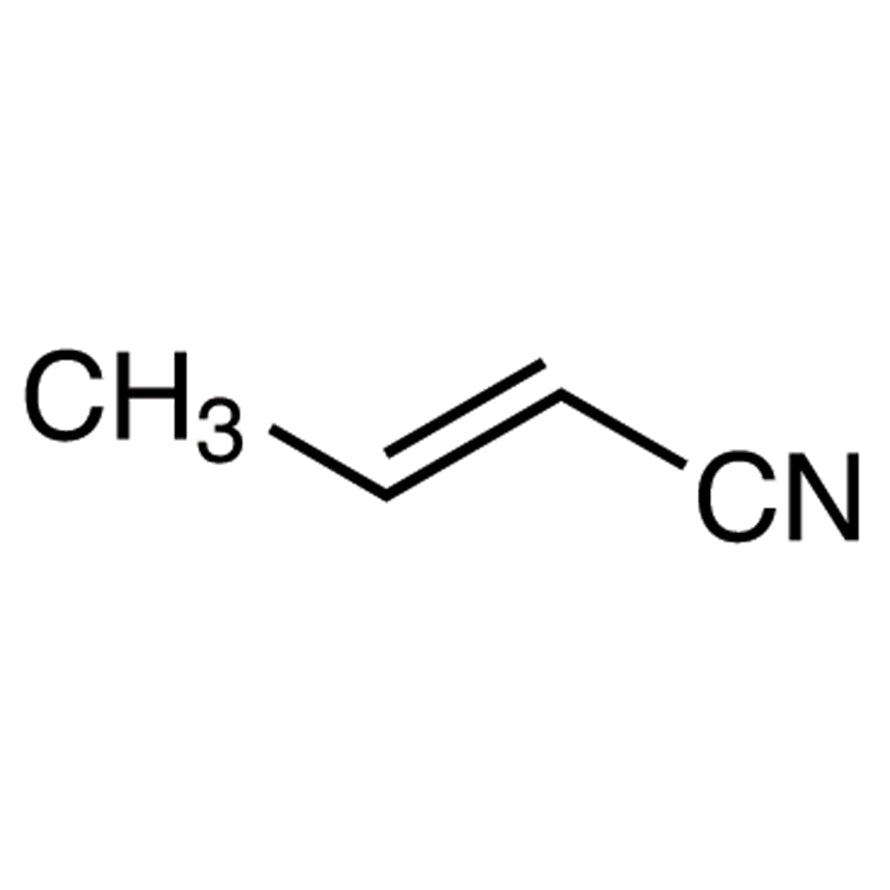
TCI C3132 trans-Crotononitrile is an α,β-unsaturated nitrile with a four-carbon chain, supplied as an isomeric mixture in which the trans isomer is the principal component accompanied by approximately twenty percent of the cis isomer. The compound serves as a versatile non-heterocyclic building block in organic synthesis laboratories because it combines two important structural elements within a single small molecule: a carbon–carbon double bond and a nitrile group. The presence of both features side by side makes crotononitrile an economical starting material for constructing new carbon chains while simultaneously introducing a functional group that is readily transformed further.
The principal property that makes this compound a preferred choice is its character as a reactive Michael acceptor. The nitrile group withdraws electrons strongly, rendering the beta carbon electrophilic and ready to accept attack from nucleophiles such as amines, thiols, carbanions, and stabilised dicarbonyl compounds. In addition, the double bond can participate in cycloaddition, metathesis, and hydrofunctionalisation reactions, while the nitrile group can be hydrolysed to a carboxylic acid or amide, reduced to a primary amine, and converted into further derivatives. This combination of reactivity within one inexpensive small molecule gives synthetic chemists considerable flexibility.
In Indonesian laboratories the material is typically used in university research groups, institutional synthesis laboratories, and industrial research and development units working on organic synthesis. It is generally applied at bench scale for the preparation of intermediates, for methodology development, and for teaching advanced synthetic techniques. Because it is supplied by TCI as a catalogued building block, it fits routine procurement workflows for laboratories that require consistent, well-documented reagents for repeated synthetic work.
- Michael addition chemistry — the electron-poor beta carbon readily accepts nucleophiles such as amines, thiols, and stabilised carbanions, allowing straightforward carbon–carbon and carbon–heteroatom bond formation under mild laboratory conditions.
- Cycloaddition reactions — the activated carbon–carbon double bond participates as a dienophile or dipolarophile, giving synthetic chemists direct access to ring systems from a small, readily handled starting material.
- Olefin metathesis — the terminal unsaturation allows the four-carbon nitrile fragment to be incorporated into larger frameworks, extending carbon chains while retaining the nitrile handle for later transformation.
- Nitrile transformation studies — the cyano group can be hydrolysed to carboxylic acids or amides and reduced to primary amines, making the compound a convenient substrate for functional group interconversion work.
- Building block for multistep synthesis — the coexistence of two reactive centres in one small molecule lets research groups introduce chain extension and a transformable functional group in a single economical step.
| Brand | TCI |
|---|---|
| CAS number | 627-26-9 |
| Molecular formula | — |
| Purity | — |
| Category | Chemistry > Building Blocks > Non-Heterocyclic Building Blocks |
| Pack sizes | available in the standard catalogue pack sizes offered by TCI; please confirm the required size when ordering |
| Physical form | — |
| Storage | store in a tightly closed container in a cool, well-ventilated area away from heat and ignition sources |
- Product code: C3132
- Composition: trans isomer as the principal component, containing approximately 20% cis isomer
Store trans-Crotononitrile in a tightly closed original container in a cool, dry, well-ventilated area, away from heat, sparks, open flames, and direct sunlight. Keep the material separated from strong oxidising agents, strong acids, and strong bases. Use only chemically compatible containers with secure closures, and keep containers upright in a designated chemical store or flammables cabinet in accordance with laboratory policy. All handling, including transfers and reaction setup, should take place inside a functioning fume hood, since nitriles are toxic and their vapours must not be inhaled. Wear safety goggles, chemically resistant gloves, and a laboratory coat, avoid skin and eye contact, and ensure eyewash and safety shower facilities are accessible. Consult the manufacturer's safety data sheet before use, and dispose of residues and contaminated materials through approved chemical waste channels.
—
Produk Terkait
-
3-Aminocrotononitrile TCI A0944
Regular price From Rp 743.400,00Regular price -
cis-3,3,5-Trimethylcyclohexanol(containsca.20%trans-isomer) TCI T2693
Regular price From Rp 584.850,00Regular price -
3,7-Diamino-2,8-dimethyldibenzothiopheneSulfone(contains2,6-Dimethylisomer) TCI T1419
Regular price Rp 5.274.150,00Regular price -
o-ToluenesulfonylChloride(containsca23%isomer) TCI T0284
Regular price From Rp 1.140.300,00Regular price -
Potassium7-Hydroxy-1-naphthalenesulfonate(containsisomer) TCI N0075
Regular price Rp 1.936.200,00Regular price -
SodiumHydrogen4-Chlorophthalate(containsisomerandPhthalicAcid) TCI C0265
Regular price Rp 743.400,00Regular price -
4-NitrophenylIsocyanate(containsvaryingamountsofpolymers) TCI I0129
Regular price From Rp 1.458.450,00Regular price -
Fumaronitrile TCI F0072
Regular price From Rp 980.700,00Regular price