

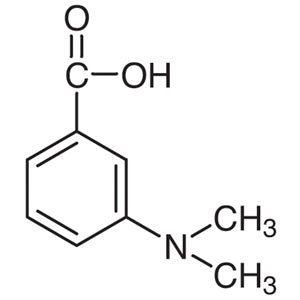
3-(Dimethylamino)benzoic Acid is a chemical compound widely used as a foundational building block in various chemical reactions. It plays a crucial role in laboratory settings by serving as a versatile intermediate in the synthesis of complex organic compounds. This compound is particularly valuable in the development of pharmaceuticals and industrial chemicals due to its ability to undergo multiple chemical transformations. Its presence in organic synthesis allows researchers to create a wide range of derivatives, making it an essential tool for chemists working in both academic and industrial environments.
The compound is known for its chemical stability and reactivity, which makes it an ideal candidate for use in a variety of reaction conditions. It readily reacts with acids, bases, and organic solvents, enabling the formation of new chemical structures through substitution and condensation reactions. The simplicity of its molecular structure further enhances its utility, as it can be easily modified to suit specific synthetic needs. These properties make it a preferred choice for researchers aiming to explore new chemical pathways and develop novel compounds.
In Indonesian laboratories, 3-(Dimethylamino)benzoic Acid is commonly utilized in pharmacological, food chemistry, and environmental chemistry research. Its application spans from the development of new pharmaceutical compounds to the study of chemical interactions in natural systems. Researchers in Indonesia frequently rely on this compound to advance their work in drug discovery, food safety, and environmental monitoring, highlighting its significance in both academic and applied scientific fields.
- Drug synthesis applications benefit from this compound’s ability to form complex organic structures, aiding in the development of new pharmaceuticals.
- Pharmaceutical research utilizes it as a building block for creating active pharmaceutical ingredients through tailored chemical reactions.
- Food chemistry studies use it to investigate the behavior of organic compounds in food systems and their potential impact on nutritional properties.
- Environmental analysis incorporates it to study the fate and transformation of organic pollutants in various environmental matrices.
- Chemical research in Indonesia relies on it for exploring new synthetic pathways and understanding molecular reactivity in diverse chemical environments.
| Brand | TCI |
|---|---|
| CAS number | 99-64-9 |
| Molecular formula | — |
| Purity | — |
| Category | Chemistry > Building Blocks > Non-Heterocyclic Building Blocks |
| Pack sizes | Available in various quantities as per standard laboratory supply |
| Physical form | Solid powder |
| Storage | Store in a cool, dry place away from direct sunlight and moisture |
This compound should be stored in a cool, dry environment to maintain its chemical integrity. It is recommended to keep it in airtight containers to prevent exposure to moisture and air, which could lead to degradation. Due to its reactivity with acids and bases, it should be handled in a well-ventilated area, ideally with appropriate personal protective equipment. Storage away from incompatible substances is essential to ensure safety. Regular inspection of storage conditions is advised to maintain optimal laboratory safety standards.
—
Produk Terkait
-
1,4-PhenyleneBis(4-aminobenzoate) TCI B6311
Regular price From Rp 2.923.200,00Regular price -
tert-Butyl3-Aminopropanoate TCI B6504
Regular price From Rp 2.303.700,00Regular price -
4-Chloro-DL-phenylalanine TCI C0253
Regular price From Rp 709.800,00Regular price -
trans-1,2-CyclohexanediaminetetraaceticAcidMonohydrate TCI C0473
Regular price From Rp 1.830.150,00Regular price -
L-CysteicAcid TCI C0514
Regular price From Rp 1.151.850,00Regular price -
DL-2-(4-Chlorophenyl)glycine TCI C1401
Regular price From Rp 532.350,00Regular price -
Nalpha-Carbobenzoxy-L-lysine TCI C1728
Regular price Rp 2.155.650,00Regular price -
4-Chloro-D-phenylalanineHydrochloride TCI C2016
Regular price Rp 5.164.950,00Regular price


