

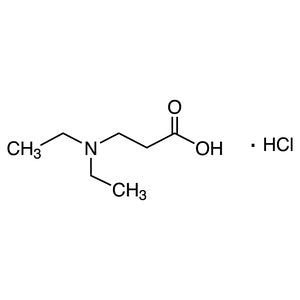
3-(Diethylamino)propionic Acid Hydrochloride is a chemical compound widely used as a foundational building block in organic synthesis. This material plays a crucial role in the development of complex molecules, particularly in the formation of amide or ester functional groups. Its simple yet versatile structure makes it an essential component in various chemical reactions, supporting research in pharmacology, organic chemistry, and the synthesis of bioactive compounds. Due to its reactivity and stability, it is highly valued in laboratory settings for its ability to participate in a wide range of chemical transformations.
The compound is known for its chemical stability and reactivity, making it a preferred choice for laboratory use. It can easily undergo substitution or reduction reactions, allowing researchers to modify its structure for various applications. Its compatibility with a wide range of reagents enhances its utility in synthetic pathways. Additionally, its straightforward molecular framework simplifies the process of functional group manipulation, which is essential in drug development and chemical innovation. These properties make it a reliable and flexible material for chemical synthesis.
In Indonesian laboratories, 3-(Diethylamino)propionic Acid Hydrochloride is commonly used by researchers and students in diverse projects. It is particularly relevant in organic chemistry and pharmaceutical research, especially in the development of new drugs and the modification of active compounds. Its availability and ease of use make it a staple in both academic and industrial research environments, supporting a wide range of scientific investigations.
- Organic synthesis is a key application where this compound is used to build complex molecules, especially in the formation of amide and ester functionalities, due to its reactivity and structural versatility.
- Pharmaceutical research benefits from its use in the development of bioactive compounds, as it allows for the modification of functional groups to enhance drug efficacy and selectivity.
- Academic research in chemistry often incorporates this compound for teaching and experimentation, providing students with hands-on experience in synthetic chemistry techniques.
- Drug discovery projects utilize this compound to explore new molecular structures that may lead to the development of novel therapeutics, leveraging its flexibility in chemical transformations.
- Analytical chemistry applications may involve this compound as a standard or reagent, supporting the calibration of instruments and the accuracy of chemical analyses.
| Brand | TCI |
|---|---|
| CAS number | 15674-67-6 |
| Molecular formula | — |
| Purity | — |
| Category | Chemistry > Building Blocks > Non-Heterocyclic Building Blocks |
| Pack sizes | Available in various quantities as per standard laboratory supply |
| Physical form | Solid powder |
| Storage | Store in a cool, dry place away from moisture and direct sunlight |
This compound should be stored in a cool, dry environment to maintain its chemical stability and prevent degradation. It is recommended to use airtight containers to protect it from moisture and contaminants. Due to its reactivity, it should be handled with appropriate personal protective equipment, such as gloves and safety goggles, to ensure laboratory safety. Avoid exposure to strong acids or bases, as it may react vigorously under certain conditions. Proper labeling and storage in designated chemical cabinets are essential to prevent accidental use or contamination. Always follow standard laboratory safety protocols when working with this compound to ensure a safe and efficient research environment.
—
Produk Terkait
-
1,4-PhenyleneBis(4-aminobenzoate) TCI B6311
Regular price From Rp 2.923.200,00Regular price -
tert-Butyl3-Aminopropanoate TCI B6504
Regular price From Rp 2.303.700,00Regular price -
4-Chloro-DL-phenylalanine TCI C0253
Regular price From Rp 709.800,00Regular price -
trans-1,2-CyclohexanediaminetetraaceticAcidMonohydrate TCI C0473
Regular price From Rp 1.830.150,00Regular price -
L-CysteicAcid TCI C0514
Regular price From Rp 1.151.850,00Regular price -
DL-2-(4-Chlorophenyl)glycine TCI C1401
Regular price From Rp 532.350,00Regular price -
Nalpha-Carbobenzoxy-L-lysine TCI C1728
Regular price Rp 2.155.650,00Regular price -
4-Chloro-D-phenylalanineHydrochloride TCI C2016
Regular price Rp 5.164.950,00Regular price


