

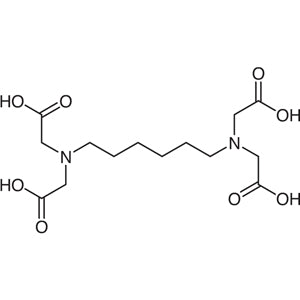
1,6-Diaminohexane-N,N,N',N'-tetraacetic Acid (DTPA) is a chelating agent widely used in chemical reactions and complexation processes within laboratories. It plays a crucial role in the analysis of metal ions by forming stable complexes with various metallic elements. This compound is essential in both qualitative and quantitative analysis due to its ability to bind metal ions effectively. Its unique molecular structure allows it to interact with multiple metal ions, making it a versatile reagent in chemical synthesis and analytical procedures.
DTPA is preferred for its high affinity for metal ions such as iron, copper, and lead. Its four carboxylate groups enable it to form strong, stable complexes with a wide range of metal ions. This property makes it highly effective in applications requiring selective metal binding or precipitation. Additionally, its chemical stability and solubility in aqueous solutions enhance its utility in laboratory settings. These characteristics ensure that DTPA remains a reliable and efficient reagent in various analytical and synthetic processes.
In Indonesian laboratories, DTPA is commonly used in chemical research, environmental analysis, and biomedical studies. It supports the development of accurate and reliable analytical methods, particularly in academic and research institutions. Its role in metal ion complexation is vital for ensuring the precision of analytical techniques. As a key reagent, DTPA contributes to the advancement of scientific research and quality control in laboratory environments.
- Environmental analysis for the detection and quantification of heavy metals in water and soil samples.
- Analytical chemistry for the selective precipitation of metal ions in qualitative and quantitative analysis.
- Biomedical research for the study of metal ion interactions in biological systems and drug development.
- Synthetic chemistry for the preparation of metal complexes and coordination compounds in laboratory synthesis.
- Quality control in industrial processes where metal ion binding and complexation are required for process optimization.
| Brand | TCI |
|---|---|
| CAS number | 1633-00-7 |
| Molecular formula | — |
| Purity | — |
| Category | Chemistry > Synthetic Reagents > Chelation/Complexation Compounds |
| Pack sizes | Available in various quantities as per supplier specifications |
| Physical form | Solid powder |
| Storage | Store in a cool, dry place away from direct sunlight and moisture |
DTPA should be stored in a cool, dry environment to maintain its chemical stability and prevent degradation. It is recommended to keep the compound in a sealed container to avoid exposure to moisture and air, which could affect its effectiveness. Proper labeling of storage containers is essential for safe handling and identification. Laboratory personnel should wear appropriate personal protective equipment, such as gloves and safety goggles, when handling this reagent. Due to its chelating properties, it is important to ensure that DTPA is stored separately from incompatible substances to prevent any potential chemical reactions. Regular inspection of storage conditions ensures the reagent remains in optimal condition for laboratory use.
—
Produk Terkait
-
1,4-PhenyleneBis(4-aminobenzoate) TCI B6311
Regular price From Rp 2.923.200,00Regular price -
tert-Butyl3-Aminopropanoate TCI B6504
Regular price From Rp 2.303.700,00Regular price -
4-Chloro-DL-phenylalanine TCI C0253
Regular price From Rp 709.800,00Regular price -
trans-1,2-CyclohexanediaminetetraaceticAcidMonohydrate TCI C0473
Regular price From Rp 1.830.150,00Regular price -
L-CysteicAcid TCI C0514
Regular price From Rp 1.151.850,00Regular price -
DL-2-(4-Chlorophenyl)glycine TCI C1401
Regular price From Rp 532.350,00Regular price -
Nalpha-Carbobenzoxy-L-lysine TCI C1728
Regular price Rp 2.155.650,00Regular price -
4-Chloro-D-phenylalanineHydrochloride TCI C2016
Regular price Rp 5.164.950,00Regular price


