

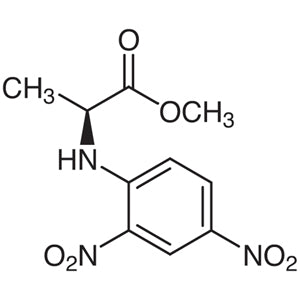
TCI D2135 N-(2,4-Dinitrophenyl)-L-alanine Methyl Ester is an amino acid derivative in which the amino group has been labelled with a 2,4-dinitrophenyl group and the carboxylic acid group has been converted into a methyl ester. The compound belongs to the family of reagents and reference materials used in peptide chemistry and amino acid analysis, where dinitrophenyl labelling has long been employed to make compounds easier to detect by spectrophotometric means. In the laboratory, having a pre-labelled compound of this type on hand is particularly helpful when researchers need to confirm the identity of an analytical peak or validate a derivatisation method under development.
The properties that make this compound a preferred choice begin with the dinitrophenyl group itself, which absorbs strongly in the ultraviolet-visible region and therefore allows the compound to be detected readily with a UV detector in liquid chromatography. Its defined L configuration means it can also serve as a stereochemical comparison standard, which matters when a method must distinguish between enantiomers. The methyl ester form of the carboxyl group improves solubility in organic solvents and makes the compound better suited to both reversed-phase and normal-phase chromatographic systems. As a stable coloured solid, it is straightforward to weigh out and prepare as a solution.
In Indonesian laboratories, materials of this kind are typically found in university research groups, analytical chemistry service laboratories, and institutional facilities working on peptide chemistry or amino acid determination. They are commonly used during method development and method validation work, where a well-characterised labelled compound is needed as a point of reference. Availability of a TCI-brand reference compound also supports laboratories that need consistent, documented material across repeated analytical campaigns.
- Reference standard for amino acid analysis, where the defined L configuration and known structure allow analysts to confirm peak identity with confidence during routine determinations.
- Validation of derivatisation methods, since the compound already carries the dinitrophenyl label that a derivatisation procedure is intended to produce, providing a direct comparison point.
- HPLC method development, because the strongly UV-absorbing dinitrophenyl group gives reliable detector response and helps analysts establish retention behaviour and system suitability.
- Peptide chemistry research, where a labelled and esterified amino acid derivative serves as a well-defined model compound for studying protection, coupling, and labelling chemistry.
- Stereochemical comparison work, in which the defined L configuration provides the reference against which chromatographic separation of enantiomeric forms can be assessed and documented.
| Brand | TCI (Tokyo Chemical Industry) |
|---|---|
| CAS number | 10420-63-0 |
| Molecular formula | — |
| Purity | — |
| Category | Chemistry > Chemical Biology > Peptide Chemistry |
| Pack sizes | Available in catalogue pack sizes; please contact us to confirm the size required |
| Physical form | Coloured solid |
| Storage | Store in a closed container in a cool, dry place away from light |
- Chemical Name: N-(2,4-Dinitrophenyl)-L-alanine Methyl Ester
Store the product in its original tightly closed container, in a cool and dry area protected from direct light, and keep the container sealed between uses to limit exposure to moisture and air. Amber glass or the supplied original packaging is suitable for storage, and prepared solutions should be kept in clearly labelled, chemically compatible closed vessels. Handle the solid in a well-ventilated area or fume hood, wearing safety glasses, gloves, and a laboratory coat, and avoid generating dust during weighing. Use clean, dry spatulas to prevent contamination of the stock material, and dispose of residues and solutions in accordance with the laboratory's chemical waste procedures. Always consult the manufacturer's safety data sheet before use.
—
Produk Terkait
-
1,4-PhenyleneBis(4-aminobenzoate) TCI B6311
Regular price From Rp 2.923.200,00Regular price -
tert-Butyl3-Aminopropanoate TCI B6504
Regular price From Rp 2.303.700,00Regular price -
4-Chloro-DL-phenylalanine TCI C0253
Regular price From Rp 709.800,00Regular price -
trans-1,2-CyclohexanediaminetetraaceticAcidMonohydrate TCI C0473
Regular price From Rp 1.830.150,00Regular price -
L-CysteicAcid TCI C0514
Regular price From Rp 1.151.850,00Regular price -
DL-2-(4-Chlorophenyl)glycine TCI C1401
Regular price From Rp 532.350,00Regular price -
Nalpha-Carbobenzoxy-L-lysine TCI C1728
Regular price Rp 2.155.650,00Regular price -
4-Chloro-D-phenylalanineHydrochloride TCI C2016
Regular price Rp 5.164.950,00Regular price


