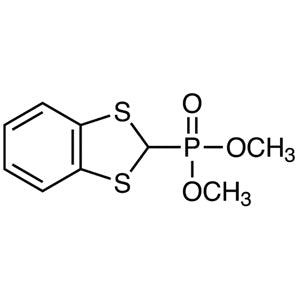
TCI D3992 Dimethyl 1,3-Benzodithiol-2-ylphosphonate (CAS 62217-35-0) is a phosphonate reagent that combines a dimethyl phosphonate group and a 1,3-benzodithiole ring on a single carbon atom. This combination makes it a characteristic Horner-Wadsworth-Emmons type carbon–carbon bond forming reagent: once deprotonated by a strong base, the resulting carbanion attacks an aldehyde or ketone group and delivers a cyclic ketene dithioacetal product. In synthetic organic laboratories this transformation is highly valuable, because the product serves both as a protected carbonyl group and as a precursor toward esters, thioesters, and carboxylic acids.
The property that makes this reagent a preferred choice is its layered carbanion stabilisation. The phosphorus atom stabilises the negative charge through the phosphonate group, while the two sulfur atoms of the benzodithiole ring add further stabilisation and at the same time direct the olefination reaction. As a result, the reagent can work on a diverse range of carbonyl substrates with relatively clean olefination outcomes and product groups that are easy to manipulate further, for example through hydrolysis or alcoholysis to reopen the carbonyl. The lipophilic character of the benzodithiole group also assists handling of the resulting products.
In Indonesian laboratories, a reagent of this type is normally used in university and research-institute organic synthesis groups, in natural product and medicinal chemistry work, and in method development where a carbonyl group must be converted into a protected, synthetically flexible functionality. It is typically ordered as a specialty synthetic reagent in small research quantities, drawn from the TCI catalogue of C-C bond formation reagents, and stored alongside other moisture-sensitive organophosphorus building blocks used for multi-step synthesis.
- Horner-Wadsworth-Emmons olefination — after deprotonation with a strong base the stabilised carbanion attacks aldehydes and ketones to form the new carbon–carbon double bond directly.
- Cyclic ketene dithioacetal synthesis — the benzodithiole ring is transferred intact to the carbonyl carbon, giving the ketene dithioacetal product in a single olefination step.
- Carbonyl group protection strategies — the ketene dithioacetal product acts as a masked carbonyl that can be reopened later by hydrolysis when the synthetic sequence allows it.
- Ester and thioester precursor chemistry — the product group can be converted onward toward esters and thioesters, making the reagent useful for building acyl-level functionality.
- Carboxylic acid route development — alcoholysis or hydrolysis of the dithioacetal product provides access to carboxylic acid targets from simple aldehyde or ketone starting materials.
| Brand | TCI (Tokyo Chemical Industry) |
|---|---|
| CAS number | 62217-35-0 |
| Molecular formula | — |
| Purity | — |
| Category | Chemistry > Synthetic Reagents > C-C Bond Formation [Synthetic Reagents] |
| Pack sizes | available in research-scale catalogue pack sizes; please confirm the currently offered packaging when ordering |
| Physical form | — |
| Storage | keep in a cool, dry place in the tightly closed original container, away from moisture |
- Chemical name: Dimethyl 1,3-Benzodithiol-2-ylphosphonate
Store the reagent in a cool, dry, well-ventilated place inside its tightly closed original container, protected from moisture and from direct sunlight or heat sources. Organophosphorus reagents of this class are best kept sealed and dry, since exposure to atmospheric humidity can degrade performance in base-mediated olefination reactions. Transfer only in a fume hood using clean, dry glassware and dry solvents, and handle with safety glasses, gloves, and a laboratory coat. Keep the reagent away from strong oxidising agents and from incompatible materials, and always consult the manufacturer's safety data sheet before use, weighing, or disposal.
—
Produk Terkait
-
Dimethyl2-(1,3-Dithiole)phosphonate TCI D3981
Regular price From Rp 5.910.450,00Regular price -
Diethyl(1,3-Dithian-2-yl)phosphonate TCI D4074
Regular price Rp 4.056.150,00Regular price -
3H-1,2-Benzodithiol-3-one1,1-Dioxide TCI B3125
Regular price From Rp 1.988.700,00Regular price -
1,3-BenzodithiolyliumTetrafluoroborate[Hydroxyl-ProtectingAgent] TCI B1151
Regular price Rp 2.782.500,00Regular price -
Diethyl1-Pyrrolidinemethylphosphonate TCI P1258
Regular price Rp 1.193.850,00Regular price -
Dimethyl1,3-Dithiole-2-thione-4,5-dicarboxylate TCI D2127
Regular price From Rp 2.121.000,00Regular price -
Di-tert-butylPhosphonate TCI D5814
Regular price From Rp 848.400,00Regular price -
Tributyl(1,3-dioxolan-2-ylmethyl)phosphoniumBromide TCI T2718
Regular price Rp 4.081.350,00Regular price


![57842-27-0 1,3-Benzodithiolylium Tetrafluoroborate [Hydroxyl-Protecting Agent] - AMI Scientific](http://amiscientific.com/cdn/shop/files/TCI2510B1151.jpg?v=1769141579&width=533)