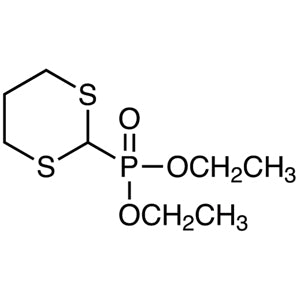
TCI D4074 Diethyl (1,3-Dithian-2-yl)phosphonate is a synthetic reagent that combines a 1,3-dithiane ring with a diethyl phosphonate group at the 2-position. This combination makes it a characteristic reagent for carbon–carbon bond formation through the Horner–Wadsworth–Emmons approach. In the laboratory, the compound is used to convert aldehydes and ketones into ketene dithioacetals, that is, alkene products carrying two sulfur atoms on a single carbon. That structure can subsequently be hydrolysed to give a carbonyl group that has been shifted by one carbon atom, so the reagent functions as an effective homologation strategy for chain extension work.
The characteristic that leads chemists to select this reagent is the umpolung behaviour it brings to a synthesis. The carbon at the 2-position of the dithiane ring, which is naturally electrophilic in its carbonyl form, here behaves as a nucleophile once it has been deprotonated by a strong base. The phosphonate anion that forms is sufficiently stable and reacts with carbonyl compounds to give alkenes, releasing a phosphate salt that is easily separated during the final work-up stage. The dithiane group also serves as a carbonyl protecting group that withstands many reaction conditions and can afterwards be reopened.
In Indonesian laboratories, a reagent of this type is normally handled within university research groups, institutional synthetic chemistry facilities, and industrial research units engaged in multi-step organic synthesis. It is typically used in small-scale reactions on the bench under anhydrous conditions, where a defined carbon–carbon bond-forming step or a carbonyl homologation sequence is required. Because it is supplied as a catalogue reagent under the TCI brand, it fits routine procurement for research programmes that rely on well-characterised building blocks.
TCI brochures (PDF)
- Carbon Homologation / Degradation Reagents 2021-09-09 · p. 2
- Horner-Emmons Reagents 2026-01-09 · p. 2
- Titanium Reagents Julia-Kocienski Olefination Reagents Peterson Reaction Reagents Z-Selective Horner-Wadsworth-Emmons Reagents 2025-03-28 · p. 8
Related TCI products
- TCI D3981 133113-76-5 Dimethyl 2-(1,3-Dithiole)phosphonate
- TCI P1258 51868-96-3 Diethyl 1-Pyrrolidinemethylphosphonate
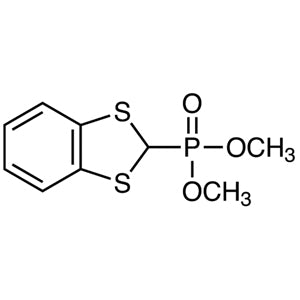
- TCI D3992 62217-35-0 Dimethyl 1,3-Benzodithiol-2-ylphosphonate
- TCI D4208 55727-23-6 3-(1,3-Dithian-2-ylidene)-2,4-pentanedione
- TCI D5814 13086-84-5 Di-tert-butyl Phosphonate
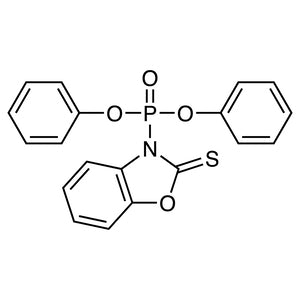
- TCI D2038 111160-56-6 Diphenyl (2,3-Dihydro-2-thioxo-3-benzoxazolyl)phosphonate
- Horner–Wadsworth–Emmons olefination: the diethyl phosphonate group forms a stabilised anion on deprotonation that reacts cleanly with carbonyl compounds to deliver the alkene product.
- Ketene dithioacetal preparation: reaction with aldehydes and ketones installs an alkene bearing two sulfur atoms on one carbon, giving direct access to this structural motif.
- One-carbon homologation of carbonyl compounds: the ketene dithioacetal formed can be hydrolysed to a carbonyl group shifted by one carbon along the chain.
- Umpolung-based carbon–carbon bond construction: the dithiane 2-position acts as a nucleophile rather than an electrophile, allowing disconnections that normal carbonyl reactivity does not permit.
- Carbonyl protection during multi-step synthesis: the dithiane ring tolerates many reaction conditions and can be reopened later, so it protects the masked carbonyl through intermediate steps.
From the TCI brochure
- One-carbon homologation of aldehydes to one-carbon homologated carboxylic esters: nBuLi, THF, -78 °C, then deprotection and R'OH
| Brand | TCI |
|---|---|
| CAS number | 62999-73-9 |
| Molecular formula | — |
| Purity | — |
| Category | Chemistry > Synthetic Reagents > C-C Bond Formation [Synthetic Reagents] |
| Pack sizes | available in standard TCI catalogue pack sizes; please confirm the required size when ordering |
| Physical form | — |
| Storage | keep tightly closed in a cool, dry, well-ventilated place away from moisture |
- Chemical name: Diethyl (1,3-Dithian-2-yl)phosphonate
- Catalogue code: D4074
Data from the TCI brochure
| Kemasan | 5g |
|---|
Source: TCI brochure RR038 (2021-09-09)
Store the reagent in its original tightly closed container in a cool, dry and well-ventilated area, away from moisture and from direct sunlight or other heat sources. Because the compound is used in reactions that require strong bases and anhydrous conditions, keep the container sealed between uses and avoid unnecessary exposure to atmospheric humidity. Handle it inside a fume hood, since organosulfur reagents commonly carry a persistent odour, and wear a laboratory coat, chemical-resistant gloves and safety goggles. Transfer with clean, dry glassware or syringes, keep it separated from strong oxidising agents, and follow the manufacturer's safety data sheet together with your institutional chemical waste procedures.
—
Produk Terkait
-
Dimethyl2-(1,3-Dithiole)phosphonate TCI D3981
Regular price From Rp 5.910.450,00Regular price -
Diethyl1-Pyrrolidinemethylphosphonate TCI P1258
Regular price Rp 1.193.850,00Regular price -
Dimethyl1,3-Benzodithiol-2-ylphosphonate TCI D3992
Regular price Rp 3.976.350,00Regular price -
3-(1,3-Dithian-2-ylidene)-2,4-pentanedione TCI D4208
Regular price From Rp 2.306.850,00Regular price -
Di-tert-butylPhosphonate TCI D5814
Regular price From Rp 848.400,00Regular price -
Diphenyl(2,3-Dihydro-2-thioxo-3-benzoxazolyl)phosphonate TCI D2038
Regular price Rp 2.704.800,00Regular price -
DiethylCyanophosphonate TCI C1242
Regular price From Rp 1.696.800,00Regular price -
Tributyl(1,3-dioxolan-2-ylmethyl)phosphoniumBromide TCI T2718
Regular price Rp 4.081.350,00Regular price