

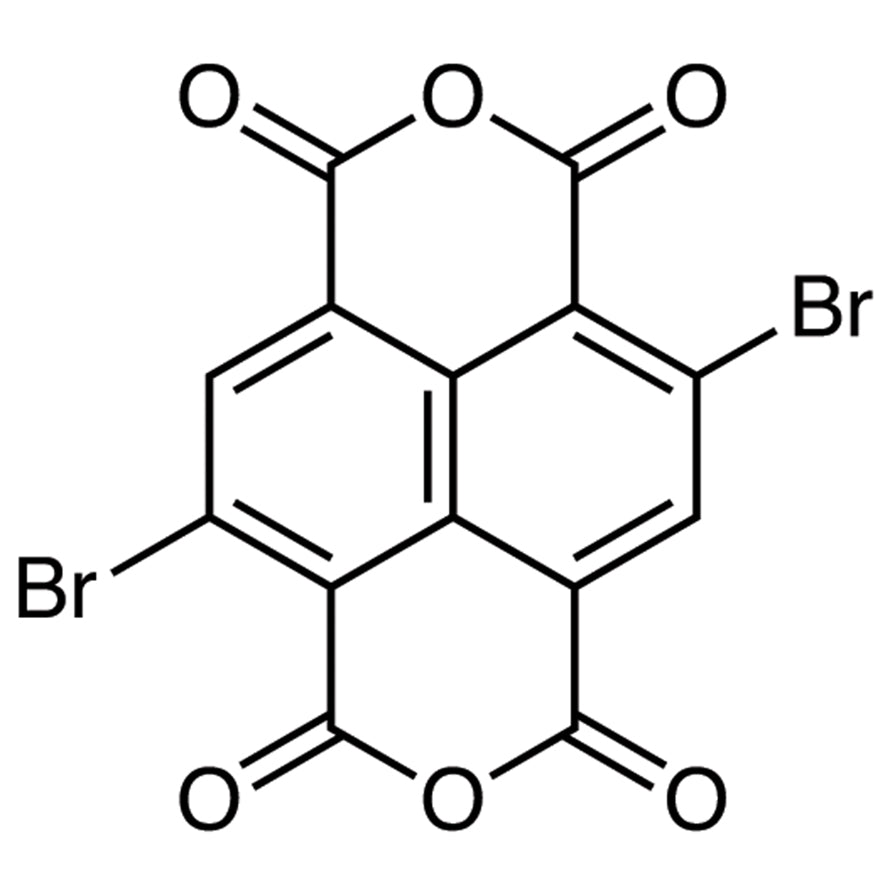
TCI D4339 2,6-Dibromonaphthalene-1,4,5,8-tetracarboxylic Dianhydride is a material building block designed for organic semiconductor research. Its molecule consists of a naphthalene core carrying two anhydride groups at both ends together with two bromine atoms at core positions. In the laboratory, this compound serves as a primary precursor for the preparation of naphthalene diimides, a family of dyes and semiconductors of considerable importance in the development of organic transistors, organic solar cells, and charge-storage materials. Reaction with primary amines converts the anhydride groups into imides directly and efficiently.
The principal advantage of this compound is the presence of the two bromine atoms on the naphthalene core. This core substitution gives researchers additional control over the electronic properties of the resulting material, because the bromine atoms can be replaced through cross-coupling reactions, nucleophilic aromatic substitution, or reactions with sulfur and nitrogen nucleophiles in order to install donor or acceptor groups. In this way, orbital energy levels, band gap, solubility, and colour of the material can be tuned systematically. The naphthalene diimide core itself is known to be electron-poor, which makes it one of the reference scaffolds for n-type organic semiconductor design.
In Indonesian laboratories, this building block is typically used in university and institutional research groups working on organic electronics, functional dyes, and macromolecular materials. It is generally handled at the synthesis bench in small research-scale quantities, where the dianhydride is condensed with selected amines and the brominated positions are subsequently functionalised. Supplied under the TCI brand with catalogue code D4339, it fits synthesis programmes that require a defined, reproducible starting material for building larger semiconductor structures.
Advantages (TCI brochure)
- Bromo-substituted 1,4,5,8-NTCDA allows introduction of substituents on the naphthalene ring
TCI brochures (PDF)
- Naphthalene Tetracarboxylic Acid Dianhydride Derivatives 2025-07-16 · p. 1
- Monomers 2025-05-28 · p. 38
- Building Blocks for Organic Semiconductor 2026-03-24 · p. 8
Related TCI products
- TCI T2698 738-90-9 Tricyclo[6.4.0.0(2,7)]dodecane-1,8:2,7-tetracarboxylic Dianhydride
- TCI B1770 17309-39-6 meso-Butane-1,2,3,4-tetracarboxylic Dianhydride
- TCI B1317 1719-83-1 Bicyclo[2.2.2]oct-7-ene-2,3,5,6-tetracarboxylic Dianhydride
- TCI N0755 81-30-1 Naphthalene-1,4,5,8-tetracarboxylic Dianhydride (purified by sublimation)
- TCI N0369 81-30-1 Naphthalene-1,4,5,8-tetracarboxylic Dianhydride
- TCI D5723 122640-83-9 Dicyclohexyl-3,4,3',4'-tetracarboxylic Dianhydride
- Naphthalene diimide synthesis: the two anhydride groups react directly and efficiently with primary amines, giving laboratories a straightforward route to imide products without additional activation chemistry.
- Organic transistor material development: the electron-poor naphthalene diimide core derived from this compound is a reference scaffold for designing n-type organic semiconductors used in transistor research.
- Organic solar cell research: derivatives prepared from this dianhydride belong to the dye and semiconductor family applied in the development of organic photovoltaic devices and acceptor materials.
- Cross-coupling and substitution chemistry: the two core bromine atoms can be replaced by cross-coupling, nucleophilic aromatic substitution, or reaction with sulfur and nitrogen nucleophiles to attach donor or acceptor groups.
- Electronic property tuning studies: core substitution through the bromine positions allows researchers to adjust orbital energy levels, band gap, solubility, and colour of the resulting material systematically.
| Brand | TCI, catalogue code D4339 |
|---|---|
| CAS number | 83204-68-6 |
| Molecular formula | — |
| Purity | — |
| Category | Materials Science > Material Building Blocks > Polymer/Macromolecule Semiconductor Building Blocks |
| Pack sizes | research-scale packaging as offered by TCI for this catalogue code; please confirm the available size when ordering |
| Physical form | — |
| Storage | keep in the original tightly closed container as indicated on the manufacturer's label |
- Chemical class: brominated naphthalene tetracarboxylic dianhydride, precursor to naphthalene diimides
Store the container tightly closed in a cool, dry, and well-ventilated area, away from moisture, since anhydride functional groups are sensitive to hydrolysis. Keep the material in its original manufacturer container or in a chemically compatible, clearly labelled alternative, and reseal immediately after weighing. Handle in a fume hood using gloves, safety glasses, and a laboratory coat, and avoid generating or inhaling dust during transfer. Keep the compound separate from amines and other reactive nucleophiles except during intended synthesis steps. Always consult the manufacturer's safety data sheet before use, and follow institutional procedures for waste collection and disposal.
—
Product Categories
- Material Building BlocksPolymer/Macromolecule Semiconductor Building BlocksAcceptors [Polymer/Macromolecule Semiconductor Building Blocks]
- Material Building BlocksSmall Molecule Semiconductor Building BlocksNaphthalenes [Small Molecule Semiconductor Building Blocks]
- Polymer/Macromolecule ReagentsMonomersTetracarboxylic Dianhydride Monomers
Produk Terkait
-
Tricyclo[6.4.0.0(2,7)]dodecane-1,8:2,7-tetracarboxylicDianhydride TCI T2698
Regular price From Rp 6.704.250,00Regular priceRp 4.688.250,00Sale price From Rp 6.704.250,00 -
meso-Butane-1,2,3,4-tetracarboxylicDianhydride TCI B1770
Regular price From Rp 1.749.300,00Regular priceRp 1.239.000,00Sale price From Rp 1.749.300,00 -
Bicyclo[2.2.2]oct-7-ene-2,3,5,6-tetracarboxylicDianhydride TCI B1317
Regular price From Rp 1.140.300,00Regular priceRp 796.950,00Sale price From Rp 1.140.300,00 -
Naphthalene-1,4,5,8-tetracarboxylicDianhydride(purifiedbysublimation) TCI N0755
Regular price From Rp 2.227.050,00Regular priceRp 1.557.150,00Sale price From Rp 2.227.050,00 -
Naphthalene-1,4,5,8-tetracarboxylicDianhydride TCI N0369
Regular price From Rp 2.439.150,00Regular priceRp 1.705.200,00Sale price From Rp 2.439.150,00 -
Dicyclohexyl-3,4,3',4'-tetracarboxylicDianhydride TCI D5723
Regular price From Rp 2.942.100,00Regular priceRp 2.056.950,00Sale price From Rp 2.942.100,00 -
Bicyclo[2.2.2]octane-2,3,5,6-tetracarboxylic2,3:5,6-Dianhydride TCI B6198
Regular price From Rp 2.995.650,00Regular priceRp 2.094.750,00Sale price From Rp 2.995.650,00 -
2-Bromonaphthalene-1,4,5,8-tetracarboxylic1,8:4,5-Dianhydride TCI B5756
Regular price From Rp 5.300.400,00Regular priceRp 3.706.500,00Sale price From Rp 5.300.400,00
![738-90-9 Tricyclo[6.4.0.0(2,7)]dodecane-1,8:2,7-tetracarboxylic Dianhydride - AMI Scientific](http://amiscientific.com/cdn/shop/files/TCI2510T2698.jpg?v=1769143660&width=533)

![1719-83-1 Bicyclo[2.2.2]oct-7-ene-2,3,5,6-tetracarboxylic Dianhydride - AMI Scientific](http://amiscientific.com/cdn/shop/files/TCI2510B1317.jpg?v=1768815163&width=533)


![Bicyclo[2.2.2]octane-2,3,5,6-tetracarboxylic 2,3:5,6-Dianhydride (CAS 2754-40-7) - TCI B6198 - AMI Scientific](http://amiscientific.com/cdn/shop/files/TCI2510B6198.jpg?v=1768816002&width=533)
