

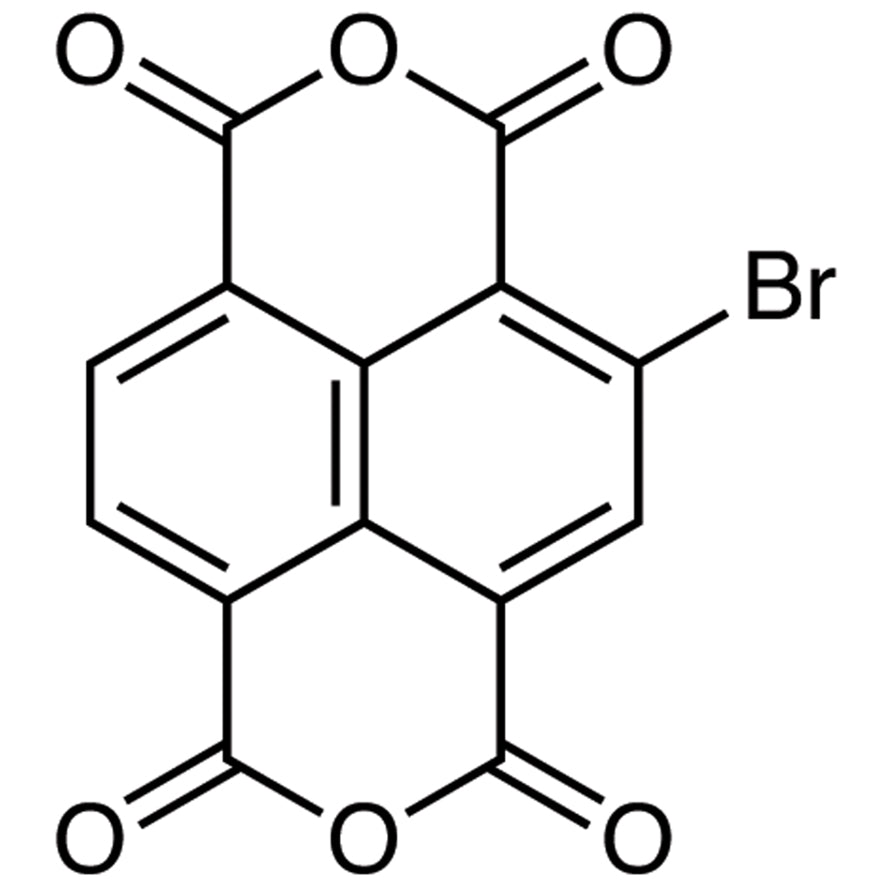
2-Bromonaphthalene-1,4,5,8-tetracarboxylic 1,8:4,5-Dianhydride is a complex chemical compound widely used in materials science research. It plays a crucial role in the development of advanced materials, particularly in the synthesis of semiconductors and conductive polymers. This compound is essential for creating molecular structures with unique electronic and optical properties, making it a valuable resource in modern laboratory settings. Its versatility allows it to be integrated into various synthetic pathways, supporting innovation in both academic and industrial research environments.
The compound is favored for its stable chemical structure and its ability to undergo highly specific chemical reactions. Its anhydride functionality enables efficient polymerization and molecular modification processes, which are critical for developing new materials with tailored properties. The compound’s solubility in organic solvents further enhances its usability in laboratory synthesis, ensuring ease of handling and integration into complex reaction schemes. These properties make it a preferred choice for researchers aiming to design advanced materials with precise functional characteristics.
In Indonesian laboratories, this compound is commonly used in semiconductor material research, conductive polymer development, and the creation of advanced composite materials. Its role is vital in supporting scientific innovation across various academic and research institutions in Indonesia. The compound’s reliability and performance contribute to the advancement of material science in the region, making it a key component in cutting-edge research projects.
Advantages (TCI brochure)
- Bromo-substituted 1,4,5,8-NTCDA allows introduction of substituents on the naphthalene ring
TCI brochures (PDF)
- Naphthalene Tetracarboxylic Acid Dianhydride Derivatives 2025-07-16 · p. 1
- Building Blocks for Organic Semiconductor 2026-03-24 · p. 7
Related TCI products
- TCI D4339 83204-68-6 2,6-Dibromonaphthalene-1,4,5,8-tetracarboxylic Dianhydride
- TCI T2698 738-90-9 Tricyclo[6.4.0.0(2,7)]dodecane-1,8:2,7-tetracarboxylic Dianhydride
- TCI B1770 17309-39-6 meso-Butane-1,2,3,4-tetracarboxylic Dianhydride
- TCI B1317 1719-83-1 Bicyclo[2.2.2]oct-7-ene-2,3,5,6-tetracarboxylic Dianhydride
- TCI N0755 81-30-1 Naphthalene-1,4,5,8-tetracarboxylic Dianhydride (purified by sublimation)
- TCI N0369 81-30-1 Naphthalene-1,4,5,8-tetracarboxylic Dianhydride
- Semiconductor material synthesis due to its ability to form stable molecular structures with unique electronic properties.
- Conductive polymer development as it enables efficient polymerization and molecular modification processes.
- Advanced composite material creation because of its compatibility with various organic solvents and chemical reactivity.
- Optical material research due to its potential for tuning electronic and optical characteristics in synthetic pathways.
- Molecular engineering applications where precise chemical reactions and structural modifications are required.
| Brand | TCI |
|---|---|
| CAS number | 846-20-8 |
| Molecular formula | — |
| Purity | — |
| Category | Materials Science > Material Building Blocks > Small Molecule Semiconductor Building Blocks |
| Pack sizes | Available in standard laboratory quantities as per supplier specifications |
| Physical form | Solid, crystalline appearance |
| Storage | Store in a cool, dry place away from moisture and direct sunlight |
This compound should be stored in a cool, dry environment to maintain its chemical stability. It is recommended to use airtight containers to prevent exposure to moisture and air, which could affect its reactivity. Due to its chemical nature, it should be handled in a well-ventilated laboratory setting to ensure safety. Avoid contact with incompatible materials such as strong acids or bases. Always use appropriate personal protective equipment, including gloves and safety goggles, when handling this compound. Proper storage and handling are essential to preserve its integrity and ensure safe laboratory operations.
—
Produk Terkait
-
2,6-Dibromonaphthalene-1,4,5,8-tetracarboxylicDianhydride TCI D4339
Regular price From Rp 6.042.750,00Regular priceRp 4.225.200,00Sale price From Rp 6.042.750,00 -
Tricyclo[6.4.0.0(2,7)]dodecane-1,8:2,7-tetracarboxylicDianhydride TCI T2698
Regular price From Rp 6.704.250,00Regular priceRp 4.688.250,00Sale price From Rp 6.704.250,00 -
meso-Butane-1,2,3,4-tetracarboxylicDianhydride TCI B1770
Regular price From Rp 1.749.300,00Regular priceRp 1.239.000,00Sale price From Rp 1.749.300,00 -
Bicyclo[2.2.2]oct-7-ene-2,3,5,6-tetracarboxylicDianhydride TCI B1317
Regular price From Rp 1.140.300,00Regular priceRp 796.950,00Sale price From Rp 1.140.300,00 -
Naphthalene-1,4,5,8-tetracarboxylicDianhydride(purifiedbysublimation) TCI N0755
Regular price From Rp 2.227.050,00Regular priceRp 1.557.150,00Sale price From Rp 2.227.050,00 -
Naphthalene-1,4,5,8-tetracarboxylicDianhydride TCI N0369
Regular price From Rp 2.439.150,00Regular priceRp 1.705.200,00Sale price From Rp 2.439.150,00 -
Dicyclohexyl-3,4,3',4'-tetracarboxylicDianhydride TCI D5723
Regular price From Rp 2.942.100,00Regular priceRp 2.056.950,00Sale price From Rp 2.942.100,00 -
Bicyclo[2.2.2]octane-2,3,5,6-tetracarboxylic2,3:5,6-Dianhydride TCI B6198
Regular price From Rp 2.995.650,00Regular priceRp 2.094.750,00Sale price From Rp 2.995.650,00


