

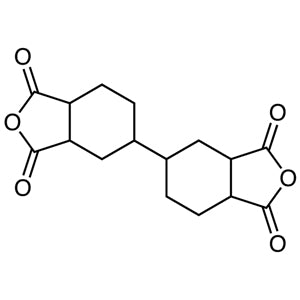
Dicyclohexyl-3,4,3',4'-tetracarboxylic Dianhydride (DCTDA) is a chemical compound widely used in laboratory settings as a building block for the synthesis of complex organic molecules. Its anhydride structure enables it to react with various functional groups such as amines and alcohols, making it a versatile reagent in polymer chemistry and organic synthesis. This compound is essential for creating polymeric materials and other organic compounds, contributing to the development of new materials and chemical products.
DCTDA is valued for its chemical stability under controlled conditions and its high melting point, which facilitates ease of handling and storage. Its reactivity and ability to form carbon-carbon and carbon-oxygen bonds make it a preferred choice in experimental setups requiring precise chemical reactions. Additionally, its high density contributes to its practicality in laboratory applications, ensuring consistency and reliability in chemical processes.
In Indonesian laboratories, DCTDA is commonly used in research and development projects focused on polymer synthesis, coating formulations, and industrial chemical production. Its reactivity and stability make it a key component in experiments requiring the formation of complex chemical structures. The compound’s properties align well with the needs of modern chemical research, supporting both academic and industrial applications.
TCI brochures (PDF)
- Raw Materials for Polyimide Synthesis 2026-05-11 · p. 2
Related TCI products
- TCI N1128 3711-01-1 2,3,6,7-Naphthalenetetracarboxylic 2,3:6,7-Dianhydride
- TCI C2842 4415-87-6 1,2,3,4-Cyclobutanetetracarboxylic Dianhydride (purified by sublimation)
- TCI C2262 4415-87-6 1,2,3,4-Cyclobutanetetracarboxylic Dianhydride
- TCI T2698 738-90-9 Tricyclo[6.4.0.0(2,7)]dodecane-1,8:2,7-tetracarboxylic Dianhydride
- TCI B1770 17309-39-6 meso-Butane-1,2,3,4-tetracarboxylic Dianhydride
- TCI B1317 1719-83-1 Bicyclo[2.2.2]oct-7-ene-2,3,5,6-tetracarboxylic Dianhydride
- Polymer synthesis where DCTDA serves as a diacid for forming high-performance polyamides and polyesters due to its reactivity and stability.
- Coating formulation applications where DCTDA contributes to the creation of durable and heat-resistant surface treatments.
- Organic synthesis experiments requiring the formation of carbon-carbon and carbon-oxygen bonds through its anhydride functionality.
- Industrial chemical production processes that rely on DCTDA’s ability to react with amines and alcohols to produce functional materials.
- Research and development projects focused on developing new materials with tailored properties using DCTDA as a building block.
| Brand | TCI |
|---|---|
| CAS number | 122640-83-9 |
| Molecular formula | — |
| Purity | — |
| Category | Chemistry > Building Blocks > Non-Heterocyclic Building Blocks |
| Pack sizes | Available in various quantities as per standard laboratory supply |
| Physical form | Solid |
| Storage | Store in a cool, dry place away from moisture and air exposure |
DCTDA should be stored in a cool, dry environment to maintain its chemical stability and prevent degradation. It is recommended to use airtight containers to minimize exposure to moisture and air, which can affect its reactivity and shelf life. Due to its sensitivity to humidity, it is important to ensure that storage conditions are controlled and monitored. Proper labeling of containers is essential for safety and identification. In laboratory settings, handling should be done with appropriate personal protective equipment to ensure safe usage and prevent any potential chemical exposure.
—
Product Categories
Produk Terkait
-
2,3,6,7-Naphthalenetetracarboxylic2,3:6,7-Dianhydride TCI N1128
Regular price From Rp 4.161.150,00Regular price -
1,2,3,4-CyclobutanetetracarboxylicDianhydride(purifiedbysublimation) TCI C2842
Regular price From Rp 1.908.900,00Regular price -
1,2,3,4-CyclobutanetetracarboxylicDianhydride TCI C2262
Regular price From Rp 1.803.900,00Regular price -
Tricyclo[6.4.0.0(2,7)]dodecane-1,8:2,7-tetracarboxylicDianhydride TCI T2698
Regular price From Rp 6.704.250,00Regular price -
meso-Butane-1,2,3,4-tetracarboxylicDianhydride TCI B1770
Regular price From Rp 1.696.800,00Regular price -
Bicyclo[2.2.2]oct-7-ene-2,3,5,6-tetracarboxylicDianhydride TCI B1317
Regular price From Rp 1.140.300,00Regular price -
Naphthalene-1,4,5,8-tetracarboxylicDianhydride(purifiedbysublimation) TCI N0755
Regular price From Rp 2.227.050,00Regular price -
Naphthalene-1,4,5,8-tetracarboxylicDianhydride TCI N0369
Regular price From Rp 2.439.150,00Regular price


![738-90-9 Tricyclo[6.4.0.0(2,7)]dodecane-1,8:2,7-tetracarboxylic Dianhydride - AMI Scientific](http://amiscientific.com/cdn/shop/files/TCI2510T2698.jpg?v=1769143660&width=533)

![1719-83-1 Bicyclo[2.2.2]oct-7-ene-2,3,5,6-tetracarboxylic Dianhydride - AMI Scientific](http://amiscientific.com/cdn/shop/files/TCI2510B1317.jpg?v=1768815163&width=533)

