

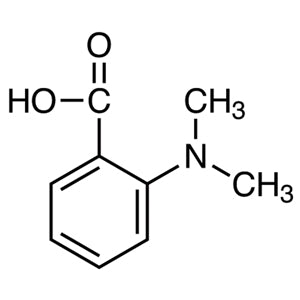
2-(Dimethylamino)benzoic Acid is a chemical compound widely used in laboratory settings as a building block for the synthesis of complex molecules. It plays a crucial role in organic chemistry by serving as a versatile starting material for various reactions. Its ability to participate in multiple chemical transformations makes it indispensable in both academic and industrial research environments. This compound is commonly utilized in the development of pharmaceuticals, specialty chemicals, and other organic compounds. Its structural versatility allows chemists to modify its properties through functional group manipulations, making it a fundamental reagent in synthetic pathways.
The compound is known for its stability and reactivity under a range of reaction conditions. Its good solubility in organic solvents facilitates efficient purification and isolation of target products. Additionally, its chemical inertness in certain environments ensures that it maintains its integrity during prolonged storage and use. These properties make it a preferred choice for researchers who require reliable and consistent results in their experiments. The compound’s predictable behavior and compatibility with various reaction conditions further enhance its utility in the laboratory.
In Indonesian laboratories, 2-(Dimethylamino)benzoic Acid is frequently used in organic chemistry research, particularly in universities and research institutions. It is a key component in the development of new chemical compounds and is often employed in synthetic processes that require high reactivity and structural modification. Its availability and reliability make it a staple in both teaching and research laboratories across Indonesia.
- Organic synthesis reactions benefit from this compound’s reactivity and structural versatility, enabling the creation of complex molecules with high precision.
- Pharmaceutical research utilizes it as a building block for drug development, contributing to the synthesis of active pharmaceutical ingredients.
- Industrial chemical production relies on its stability and solubility, making it suitable for large-scale synthesis processes.
- Academic research in universities employs it for teaching and experimental purposes, supporting both undergraduate and graduate studies.
- Analytical chemistry applications take advantage of its chemical stability, ensuring accurate and reproducible results in various analytical techniques.
| Brand | TCI |
|---|---|
| CAS number | 610-16-2 |
| Molecular formula | — |
| Purity | — |
| Category | Chemistry > Building Blocks > Non-Heterocyclic Building Blocks |
| Pack sizes | Available in various quantities as per supplier specifications |
| Physical form | Solid |
| Storage | Store in a cool, dry place away from direct sunlight and moisture |
This compound should be stored in a cool, dry environment to maintain its chemical stability. It is recommended to keep it in a tightly sealed container to prevent exposure to moisture and air. Suitable storage containers include glass or high-density polyethylene (HDPE) bottles to ensure chemical integrity. Due to its reactivity in certain conditions, it should be handled with care, using appropriate personal protective equipment such as gloves and safety goggles. Avoid contact with strong acids or bases to prevent unwanted chemical interactions. Regular inspection of storage conditions is advised to ensure long-term usability and safety in the laboratory.
—
Produk Terkait
-
1,4-PhenyleneBis(4-aminobenzoate) TCI B6311
Regular price From Rp 2.923.200,00Regular price -
tert-Butyl3-Aminopropanoate TCI B6504
Regular price From Rp 2.303.700,00Regular price -
4-Chloro-DL-phenylalanine TCI C0253
Regular price From Rp 709.800,00Regular price -
trans-1,2-CyclohexanediaminetetraaceticAcidMonohydrate TCI C0473
Regular price From Rp 1.830.150,00Regular price -
L-CysteicAcid TCI C0514
Regular price From Rp 1.151.850,00Regular price -
DL-2-(4-Chlorophenyl)glycine TCI C1401
Regular price From Rp 532.350,00Regular price -
Nalpha-Carbobenzoxy-L-lysine TCI C1728
Regular price Rp 2.155.650,00Regular price -
4-Chloro-D-phenylalanineHydrochloride TCI C2016
Regular price Rp 5.164.950,00Regular price


