

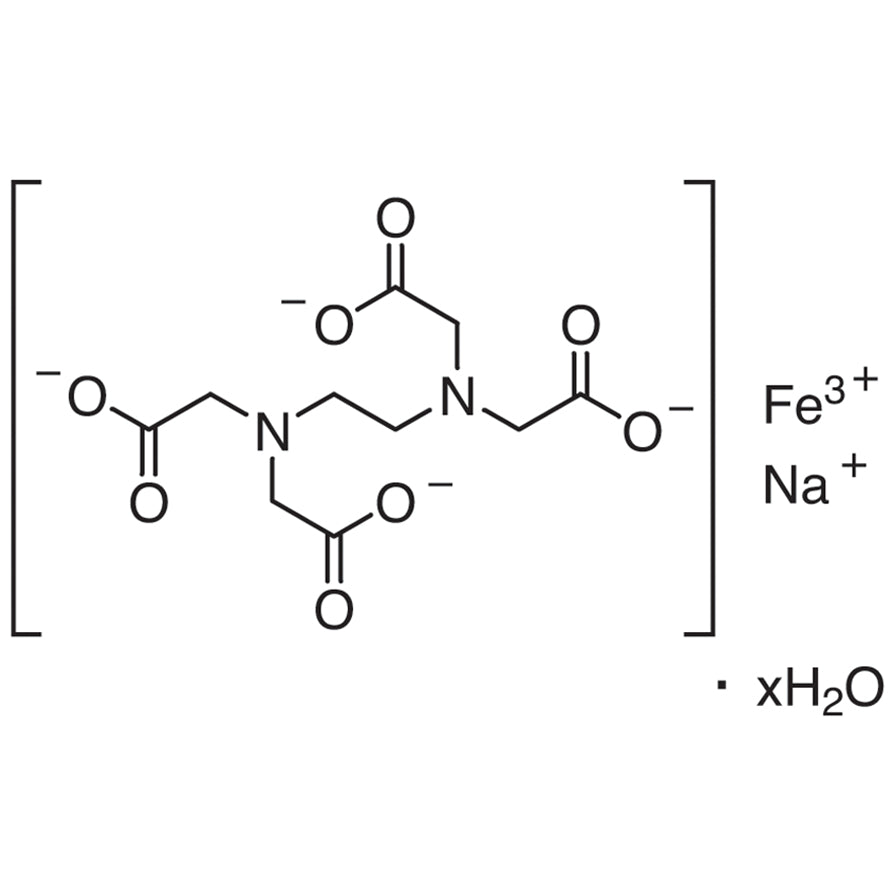
TCI E0092 Ethylenediaminetetraacetic Acid Monosodium Ferric Salt Hydrate is a ferric chelate complex in which an EDTA ligand binds iron(III), accompanied by a single sodium ion that balances the overall charge, and it is supplied in hydrated form. The product belongs to the chemistry category covering catalysis and inorganic chemistry, within the transition elements group. Commonly abbreviated as NaFeEDTA, this compound delivers iron(III) in a chelated, water-soluble state — a form that is highly sought after because free ferric iron hydrolyses readily and precipitates as iron hydroxide as soon as solution acidity shifts toward neutrality.
The characteristics that make this material valuable are the high stability of the iron–EDTA complex across a wide acidity range together with its good solubility. With the iron held tightly inside the ligand cage, solutions remain clear without turbidity or sediment, and the iron stays available in a dissolved form that biological systems can absorb and that chemical reactions can exploit. The hydrated solid is yellowish to light brown in colour and is easy to weigh out, so preparing stock solutions is a straightforward operation. This combination of stability, solubility, and iron availability is precisely why the compound is so widely studied as a functional form of iron.
In Indonesian laboratories the material is typically handled as a routine bench reagent for preparing aqueous iron(III) stock solutions. Analysts weigh the hydrated solid directly, dissolve it in water, and use the resulting clear solution wherever a soluble, non-precipitating source of ferric iron is required. Because the chelate resists hydrolysis over a broad acidity range, it suits work in university research laboratories, institutional analytical facilities, and industrial quality control benches alike.
- Preparation of soluble iron(III) stock solutions — the chelated form dissolves cleanly in water and stays in solution, so working standards can be diluted without turbidity or hydroxide sediment forming in the flask.
- Iron availability and fortification studies — because NaFeEDTA holds iron in a chelated yet absorbable state, it is widely studied as a functional form of iron for investigations into biological uptake.
- Catalysis and inorganic chemistry research — as a transition element complex it supplies ferric iron to reaction systems in a defined, soluble form rather than as an unstable free ion prone to hydrolysis.
- Buffered and near-neutral reaction media — the high stability of the iron–EDTA complex across a wide acidity range keeps iron dissolved where an unchelated ferric salt would immediately precipitate out.
- Teaching and demonstration of coordination chemistry — the compound provides a clear, practical example of how a chelating ligand cage stabilises a metal centre that is otherwise difficult to keep in solution.
| Brand | TCI |
|---|---|
| CAS number | 149022-26-4 |
| Molecular formula | — |
| Purity | — |
| Category | Chemistry > Catalysis and Inorganic Chemistry > Transition Elements [Catalysis and Inorganic Chemistry] |
| Pack sizes | available in the standard TCI catalogue packaging for this item; please confirm the size required when ordering |
| Physical form | hydrated solid, yellowish to light brown in colour |
| Storage | keep the container tightly closed in a cool, dry place away from moisture |
Store the hydrated solid in its original tightly closed container in a cool, dry place, protected from moisture and direct sunlight, since hydrated salts can take up or lose water when left exposed to ambient air. Glass or chemically compatible plastic containers with well-sealing caps are suitable for both storage and any prepared stock solutions. Handle the material in a well-ventilated area using standard laboratory personal protective equipment — safety glasses, gloves, and a lab coat — and avoid generating or inhaling dust while weighing. Use clean, dry spatulas to prevent contamination of the bulk material, close the container promptly after each use, and label all prepared solutions clearly with contents and preparation date.
—
Produk Terkait
-
1,4-PhenyleneBis(4-aminobenzoate) TCI B6311
Regular price From Rp 2.923.200,00Regular price -
tert-Butyl3-Aminopropanoate TCI B6504
Regular price From Rp 2.303.700,00Regular price -
4-Chloro-DL-phenylalanine TCI C0253
Regular price From Rp 709.800,00Regular price -
trans-1,2-CyclohexanediaminetetraaceticAcidMonohydrate TCI C0473
Regular price From Rp 1.830.150,00Regular price -
L-CysteicAcid TCI C0514
Regular price From Rp 1.151.850,00Regular price -
DL-2-(4-Chlorophenyl)glycine TCI C1401
Regular price From Rp 532.350,00Regular price -
Nalpha-Carbobenzoxy-L-lysine TCI C1728
Regular price Rp 2.155.650,00Regular price -
4-Chloro-D-phenylalanineHydrochloride TCI C2016
Regular price Rp 5.164.950,00Regular price


