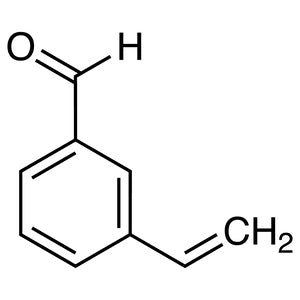
3-Vinylbenzaldehyde (CAS 19955-99-8) is an organic compound belonging to the non-heterocyclic building blocks group, combining two reactive functional groups within a single molecular framework: an aromatic aldehyde group and a vinyl group. In the laboratory, this compound serves as a highly valuable intermediate for assembling more complex organic molecules, whether through carbon-carbon bond-forming reactions such as aldol condensation and the Wittig reaction, or through vinyl polymerization to produce functional materials. The aldehyde group can be converted into alcohols, carboxylic acids, imines, or amine derivatives, while the vinyl group opens up opportunities for addition reactions, copolymerization, and cross-linking. In this way, it acts as a bridge between synthetic chemistry and materials chemistry within one compact molecule.
The main advantage of this compound lies in its bifunctional nature, which allows researchers to design molecules with two reactive sites at once without having to go through long and complicated synthetic steps. This dual reactivity makes it a preferred choice for chemists working on step-efficient syntheses, where a single compact intermediate can serve as a branching point toward multiple target structures. The presence of the TBC stabilizer (tert-butylcatechol) is especially important because the vinyl group on an aromatic aldehyde is prone to premature polymerization; the stabilizer keeps the material stable during storage and handling, ensuring consistent performance when the compound is used in sensitive reactions and providing reliable, reproducible results across repeated experiments.
In Indonesian laboratories, this material is typically used as a synthetic intermediate in organic chemistry research, particularly in universities, research institutes, and pharmaceutical or chemical development facilities exploring new molecular architectures. Researchers commonly employ it in aldol condensations, Wittig reactions, and free-radical or controlled vinyl polymerizations to build functional monomers, cross-linkers, or polymer precursors. Its compact structure and dual functionality make it a practical starting point for developing new materials, catalysts, or biologically relevant compounds, supporting both fundamental studies and applied research projects across the country.
- Aldol condensation: The aromatic aldehyde group participates readily in aldol condensations, enabling the construction of α,β-unsaturated carbonyl frameworks that are valuable intermediates in multi-step organic synthesis.
- Wittig reaction: The aldehyde moiety serves as a suitable electrophilic partner in Wittig reactions, allowing chemists to extend carbon chains and create conjugated alkene systems with predictable stereochemistry.
- Vinyl polymerization: The vinyl group undergoes free-radical or controlled polymerization, making this compound a useful functional monomer for producing polymers with pendant aldehyde groups available for further modification.
- Copolymerization and cross-linking: The bifunctional structure enables copolymerization with other monomers and cross-linking reactions, yielding functional networks or resins that carry aldehyde functionalities for post-polymerization derivatization.
- Derivatization of the aldehyde group: The aldehyde can be converted into alcohols, carboxylic acids, imines, or amine derivatives, giving researchers a flexible platform for generating diverse compound libraries from a single scaffold.
| Brand | TCI |
|---|---|
| CAS number | 19955-99-8 |
| Molecular formula | — |
| Purity | — |
| Category | Chemistry > Building Blocks > Non-Heterocyclic Building Blocks |
| Pack sizes | — |
| Physical form | — |
| Storage | — |
- Product code: E1574
- Product name: 3-Vinylbenzaldehyde (stabilized with TBC)
- Stabilizer: TBC (tert-butylcatechol); pack sizes and physical form are not specified in the product data, so please confirm these details with the supplier before ordering.
Store the product in a cool, dry, and well-ventilated area, protected from light and away from sources of heat and ignition. Keep the container tightly closed when not in use to prevent evaporation and contamination. Use containers made of materials compatible with organic solvents and reactive aldehydes, such as glass, and avoid prolonged exposure to air. Since the vinyl group is stabilized with TBC, take care not to remove or deplete the stabilizer through excessive purification or heating. Wear appropriate personal protective equipment, including gloves and safety goggles, and work in a fume hood when handling the compound to minimize inhalation or skin contact.
—
Produk Terkait
-
Benzene-1,3,5-tricarbaldehyde TCI B6003
Regular price From Rp 1.961.400,00Regular price -
[1,1'-Biphenyl]-2-carboxaldehyde TCI B6334
Regular price From Rp 3.021.900,00Regular price -
Bourgeonal TCI B6829
Regular price From Rp 1.035.300,00Regular price -
trans-Cinnamaldehyde TCI C0352
Regular price From Rp 477.750,00Regular price -
Cyclohexanecarboxaldehyde TCI C0880
Regular price From Rp 1.988.700,00Regular price -
3-Cyclohexene-1-carboxaldehyde TCI C0881
Regular price Rp 1.087.800,00Regular price -
Cyclopropanecarboxaldehyde TCI C1707
Regular price From Rp 795.900,00Regular price -
Cyclopentanecarboxaldehyde(stabilizedwithHQ) TCI C3019
Regular price From Rp 1.220.100,00Regular price

![[1,1'-Biphenyl]-2-carboxaldehyde (CAS 1203-68-5) - TCI B6334 - AMI Scientific](http://amiscientific.com/cdn/shop/files/TCI2510B6334.jpg?v=1768816032&width=533)