

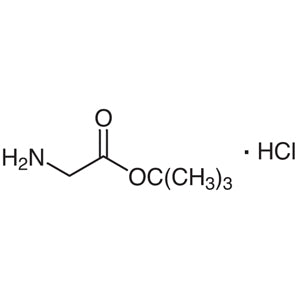
Glycine tert-Butyl Ester Hydrochloride is the hydrochloride salt of the tert-butyl ester of glycine, an amino acid derivative in which the carboxyl group is protected as a tert-butyl ester. In peptide synthesis, the tert-butyl protecting group belongs to the acid-labile class of protecting groups, so it can be removed with trifluoroacetic acid without disturbing base-labile protecting groups such as Fmoc. This orthogonal character is precisely what makes the compound an important building block in multi-level protection strategies for the construction of peptide chains and peptidomimetics.
The property that makes this material a widely preferred choice is its resistance to basic and nucleophilic conditions, which allows a variety of chemical transformations to be carried out on other parts of the molecule while the carboxyl group remains safely protected. The steric hindrance of the tert-butyl group also suppresses side reactions such as diketopiperazine formation or nucleophilic attack on the ester carbonyl. The hydrochloride salt form makes the solid more stable for storage and weighing, while the free amine is readily generated using a tertiary base such as diisopropylethylamine immediately before the coupling reaction.
In Indonesian laboratories, this reagent is typically used in university and institutional research groups working on peptide chemistry, medicinal chemistry, and chemical biology, as well as in the research and development units of pharmaceutical companies. Because glycine carries no side chain that requires additional protection, it is often chosen as a starting point for method development, for training new researchers in solution-phase coupling, and for the preparation of small peptide fragments and glycine-containing conjugates.
- Peptide chain construction: the acid-labile tert-butyl ester serves as a carboxyl-terminal protecting group that survives repeated basic Fmoc-removal steps and is cleaved cleanly at the end of the sequence with trifluoroacetic acid.
- Orthogonal protection strategy development: because tert-butyl esters and base-labile groups such as Fmoc are removed under entirely different conditions, this compound allows chemists to design and validate multi-level protection schemes on a simple substrate.
- Peptidomimetic synthesis: the protected glycine unit can be incorporated into non-natural backbone architectures while the carboxyl group remains masked, letting modification chemistry proceed selectively at the amine or at other positions.
- Solution-phase coupling and fragment preparation: the free amine is liberated in situ with a tertiary base such as diisopropylethylamine, giving a reactive nucleophile for amide bond formation with activated carboxylic acid partners immediately before use.
- Side-reaction suppression in dipeptide chemistry: the steric bulk of the tert-butyl group limits diketopiperazine formation and nucleophilic attack on the ester carbonyl, which improves yields in sequences where cyclisation is otherwise a competing pathway.
| Brand | TCI |
|---|---|
| CAS number | 27532-96-3 |
| Molecular formula | — |
| Purity | — |
| Category | Chemistry > Chemical Biology > Peptide Chemistry |
| Pack sizes | available in the pack sizes listed by the manufacturer for this catalogue number; please confirm the required size when ordering |
| Physical form | solid (hydrochloride salt) |
| Storage | — |
- Catalogue number: G0254
Store the material in a tightly closed original container in a cool, dry place, protected from moisture and away from direct sunlight, since the hydrochloride salt is hygroscopic in character and the ester group should not be exposed to humid air for extended periods. Keep the container away from strong acids and strong bases, as acidic conditions will cleave the tert-butyl protecting group. Handle the solid in a well-ventilated area or fume hood using appropriate personal protective equipment, including gloves, safety glasses, and a laboratory coat. Weigh out only the quantity required and reseal the container promptly to limit uptake of atmospheric moisture. Always consult the manufacturer's safety data sheet before use.
—
Produk Terkait
-
1,4-PhenyleneBis(4-aminobenzoate) TCI B6311
Regular price From Rp 2.923.200,00Regular price -
tert-Butyl3-Aminopropanoate TCI B6504
Regular price From Rp 2.303.700,00Regular price -
4-Chloro-DL-phenylalanine TCI C0253
Regular price From Rp 709.800,00Regular price -
trans-1,2-CyclohexanediaminetetraaceticAcidMonohydrate TCI C0473
Regular price From Rp 1.830.150,00Regular price -
L-CysteicAcid TCI C0514
Regular price From Rp 1.151.850,00Regular price -
DL-2-(4-Chlorophenyl)glycine TCI C1401
Regular price From Rp 532.350,00Regular price -
Nalpha-Carbobenzoxy-L-lysine TCI C1728
Regular price Rp 2.155.650,00Regular price -
4-Chloro-D-phenylalanineHydrochloride TCI C2016
Regular price Rp 5.164.950,00Regular price


