


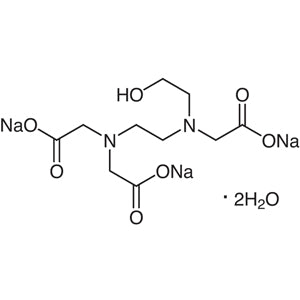
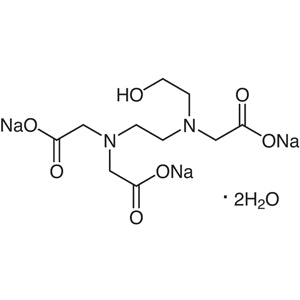
TCI H0047 Trisodium N-(2-Hydroxyethyl)ethylenediamine-N,N',N'-triacetate Dihydrate is the trisodium salt of HEDTA, an aminopolycarboxylic acid widely used as a chelating agent. The material works by binding polyvalent metal ions into stable, soluble complexes, so that those ions are no longer free to interfere with a reaction. In the laboratory, it is used to mask interfering metal ions during analysis, to keep solutions stable, and to supply a controlled source of dissolved metal in biological and agricultural experiments. Because it is already supplied as the trisodium salt, it is ready to use without any additional neutralisation step.
The main characteristic of this product lies in the HEDTA structure, which carries one hydroxyethyl group in place of one of the acetate groups found in EDTA. This difference allows HEDTA to retain strong chelating power while generally offering better solubility in the high pH range than comparable EDTA salts. That property is particularly valuable in alkaline formulations or alkaline washing solutions, where other chelating agents are prone to precipitating out. As a hydrated trisodium salt, the material is easy to weigh out, dissolves quickly in water, and yields a stable solution.
In Indonesian laboratories, this chelating agent fits naturally into routine analytical and preparative work. It is used where trace metal contamination must be suppressed before measurement, where buffer and reagent solutions need to stay clear and stable over time, and where plant or microbial growth media require metal ions held in a soluble, available form. Its ready-to-use trisodium form and rapid dissolution make it convenient for teaching laboratories, quality control benches, and research groups alike.
- Masking of interfering metal ions in analysis — the reagent binds polyvalent metals into stable complexes so they no longer disturb the reaction being measured, improving the reliability of results.
- Stabilisation of reagent and buffer solutions — by sequestering trace metal ions that would otherwise catalyse decomposition, it helps prepared solutions remain clear and usable over extended working periods.
- Controlled supply of soluble metal in biological experiments — the complex holds metal ions in a dissolved, available form, allowing measured delivery of micronutrients to cultures and growth media.
- Agricultural and plant nutrition studies — its ability to keep polyvalent metal ions soluble makes it suitable for preparing nutrient solutions where free metal ions would otherwise precipitate and become unavailable.
- Alkaline formulations and alkaline washing solutions — HEDTA's generally better solubility at high pH compared with similar EDTA salts prevents the precipitation that limits other chelating agents in basic media.
| Brand | TCI |
|---|---|
| CAS number | 139-89-9 |
| Molecular formula | — |
| Purity | — |
| Category | Chemistry > Synthetic Reagents > Chelation/Complexation Compounds |
| Pack sizes | available in standard TCI catalogue pack sizes; please confirm the required size when ordering |
| Physical form | — |
| Storage | keep in a tightly closed container in a cool, dry place away from moisture |
- Chemical form: trisodium salt of HEDTA, supplied as the dihydrate
Store the product in its original tightly closed container in a cool, dry, well-ventilated area, protected from moisture so that the hydrated salt does not absorb additional water and cake during storage. Glass or chemically compatible plastic containers with secure closures are suitable for both the bulk material and any prepared solutions. Handle the powder in a manner that avoids dust generation, using standard laboratory personal protective equipment such as gloves, safety glasses, and a laboratory coat. Weigh and transfer the material with clean, dry spatulas to prevent contamination, close the container immediately after use, and label all prepared solutions clearly with contents and preparation date.
—
Produk Terkait
-
1,4-PhenyleneBis(4-aminobenzoate) TCI B6311
Regular price From Rp 2.923.200,00Regular price -
tert-Butyl3-Aminopropanoate TCI B6504
Regular price From Rp 2.303.700,00Regular price -
4-Chloro-DL-phenylalanine TCI C0253
Regular price From Rp 709.800,00Regular price -
trans-1,2-CyclohexanediaminetetraaceticAcidMonohydrate TCI C0473
Regular price From Rp 1.830.150,00Regular price -
L-CysteicAcid TCI C0514
Regular price From Rp 1.151.850,00Regular price -
DL-2-(4-Chlorophenyl)glycine TCI C1401
Regular price From Rp 532.350,00Regular price -
Nalpha-Carbobenzoxy-L-lysine TCI C1728
Regular price Rp 2.155.650,00Regular price -
4-Chloro-D-phenylalanineHydrochloride TCI C2016
Regular price Rp 5.164.950,00Regular price


