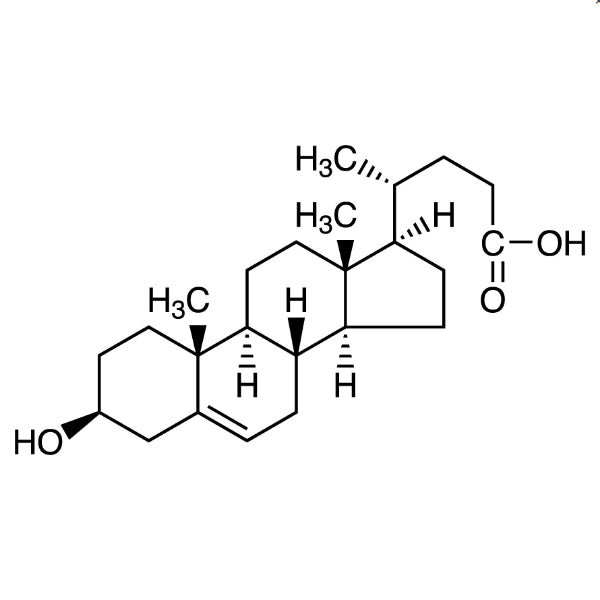
TCI H0521 3beta-Hydroxy-DELTA5-cholenic Acid is a steroid compound built on a sterol core skeleton that carries a hydroxyl group at the 3-beta position, a double bond at position five, and a side chain terminating in a carboxylic acid group. This arrangement places it as a compound closely related to the bile acid biosynthetic pathway, in which cholesterol is progressively converted into bile acids through a series of hydroxylations and side-chain shortening steps. In the laboratory, the compound serves as a biochemical reference material and as a building block for steroid synthesis.
The properties that make it a preferred choice are the presence of two complementary functional groups. The hydroxyl group on the A ring can be esterified, sulfated, or glucuronidated to mimic metabolic processes, while the carboxylic acid group on the side chain allows amide formation with glycine or taurine, exactly as bile acids are conjugated within the body. The double bond at position five provides an additional reaction site while also acting as a structural marker that distinguishes this compound from saturated bile acids. The material is supplied as a solid that can be dissolved in organic solvents or dilute alkaline solution as required.
In Indonesian laboratories, this compound is typically handled in research and analytical settings where steroid and bile acid chemistry is studied. It is weighed out in small quantities, dissolved in a suitable solvent system, and used either as a comparison standard or as a starting material for further synthetic modification. Because it is a defined steroid structure with two reactive handles, it fits routine bench workflows in biochemistry, organic synthesis, and instrumental analysis groups.
- Bile acid biosynthesis research: the structure sits directly on the pathway from cholesterol to bile acids, making it a relevant compound for studying hydroxylation and side-chain shortening steps.
- Biochemical reference material: as a defined steroid with a known CAS identity, it serves as a comparison substance when identifying or confirming related steroid species in analytical work.
- Steroid synthesis building block: the sterol core with two independently addressable functional groups gives synthetic chemists a practical starting point for preparing modified steroid derivatives.
- Conjugation chemistry studies: the side-chain carboxylic acid forms amides with glycine or taurine, allowing laboratories to reproduce the natural bile acid conjugation reactions found in the body.
- Metabolic mimicry experiments: the 3-beta hydroxyl group can be esterified, sulfated, or glucuronidated, letting researchers prepare analogues that imitate common phase II metabolic transformations.
| Brand | TCI |
|---|---|
| CAS number | 5255-17-4 |
| Molecular formula | — |
| Purity | — |
| Category | Life Science > Biochemicals and Reagents > Steroids |
| Pack sizes | available in standard TCI research-scale packaging; please confirm the size required when ordering |
| Physical form | solid, soluble in organic solvents or dilute alkaline solution |
| Storage | keep in the original closed container under the conditions stated on the product label |
Store the container tightly closed in a cool, dry place away from direct sunlight, heat sources, and strong oxidising agents, following the conditions indicated on the product label. Keep the material in its original supplier container, or transfer it to a clean, chemically compatible glass vial with a secure closure to prevent moisture uptake and contamination. Weigh the solid in a well-ventilated area or fume hood using clean, dry spatulas. Wear a laboratory coat, safety glasses, and suitable gloves when handling the compound, and avoid generating dust. Prepare solutions immediately before use where possible, label all working solutions clearly, and dispose of residues in accordance with local chemical waste procedures.
—
Produk Terkait
-
Butyl2-Hydroxyacetate TCI B6748
Regular price From Rp 1.220.100,00Regular price -
4-Chloro-DL-mandelicAcid TCI C0193
Regular price From Rp 1.035.300,00Regular price -
DeoxycholicAcid TCI C0315
Regular price From Rp 1.618.050,00Regular price -
SodiumDeoxycholate TCI C0316
Regular price From Rp 1.644.300,00Regular price -
CholicAcid TCI C0324
Regular price From Rp 1.353.450,00Regular price -
SodiumCholate TCI C0325
Regular price From Rp 1.724.100,00Regular price -
ChenodeoxycholicAcid TCI C0750
Regular price Rp 1.246.350,00Regular price -
Methyl(E)-4-Chloro-3-methoxy-2-butenoate TCI C1340
Regular price From Rp 1.908.900,00Regular price