

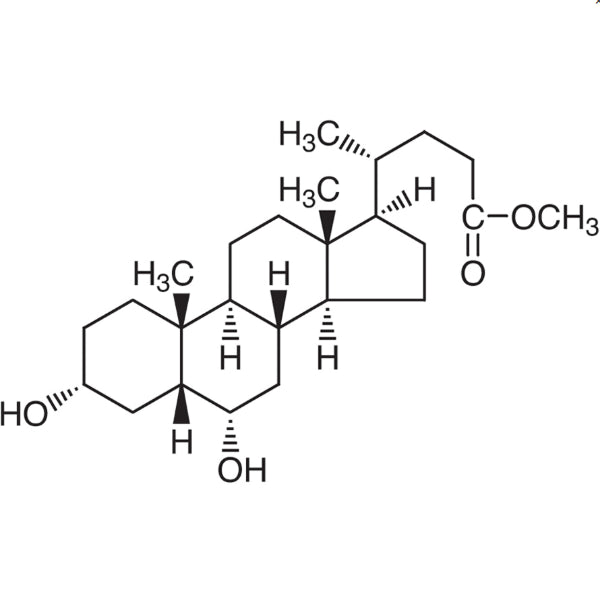
TCI H0529 Methyl Hyodeoxycholate is the methyl ester of hyodeoxycholic acid, a bile acid belonging to the family of naturally occurring steroids. The molecule retains the characteristic steroid nucleus of four fused rings, with hydroxyl groups at defined positions and a side chain that has been esterified to the corresponding methyl ester. In the laboratory, this material serves as a reference compound in bile acid analysis, as a synthetic intermediate for the preparation of steroid derivatives, and as a study substance in research on lipid metabolism and the function of the biliary system within the life sciences.
Esterification of the carboxylic acid group to a methyl ester confers several practical advantages that explain why this form is frequently selected. The ester is less polar than the corresponding free acid, which makes it more readily soluble in organic solvents, improves its chromatographic behaviour, and allows easier volatilisation in gas chromatographic analysis. The protected carboxyl group also permits researchers to carry out selective transformations on the hydroxyl groups of the steroid skeleton — acylation, oxidation, or stepwise protection, for example — without interference from the acidity of the side chain. The methyl ester can subsequently be hydrolysed back to the free acid when the parent structure is required.
In Indonesian laboratories, this material is typically used in academic and institutional research settings where bile acid chemistry, steroid synthesis, and lipid metabolism are studied. It supports analytical work in chromatography laboratories that require a well-defined reference substance, and it serves preparative groups building steroid derivatives from a bile acid starting framework. Its role is that of a specialised research-grade chemical rather than a routine bulk reagent, so it is generally ordered in small quantities for defined experimental programmes.
TCI brochures (PDF)
- Steroids 2026-07-28 · p. 6
- Bile acid reference standard in chromatographic analysis: the defined methyl ester structure provides a consistent, identifiable peak that supports identification and comparison of bile acid species in sample runs.
- Synthetic intermediate for steroid derivatives: the protected carboxyl group allows the intact four-ring steroid framework to be carried forward through multi-step preparations without competing reactions at the side chain.
- Selective hydroxyl group chemistry: with the acid function masked as an ester, acylation, oxidation, or stepwise protection can be performed on the ring hydroxyl groups under controlled, targeted conditions.
- Lipid metabolism research: as a bile acid derivative, the compound serves as a defined study substance for investigations into lipid handling, transport, and related metabolic pathways in life science work.
- Gas chromatographic sample work: the reduced polarity and improved volatility of the methyl ester relative to the free acid make it far better suited to gas chromatographic separation and detection.
| Brand | TCI |
|---|---|
| CAS number | 2868-48-6 |
| Molecular formula | — |
| Purity | — |
| Category | Life Science > Biochemicals and Reagents > Steroids |
| Pack sizes | supplied in standard TCI research quantities; please confirm the available pack size when ordering |
| Physical form | — |
| Storage | keep in the closed original container under the conditions stated on the manufacturer's label and safety data sheet |
- Chemical class: methyl ester of hyodeoxycholic acid, a steroid-family bile acid
Store the material in its tightly closed original container, protected from moisture, direct sunlight, and sources of heat, and follow the storage conditions specified on the manufacturer's label and safety data sheet. Amber glass or the supplied container is appropriate for keeping the compound sealed and shielded from light. Handle the substance in a well-ventilated area or fume hood, wearing a laboratory coat, safety glasses, and suitable chemical-resistant gloves. Avoid generating dust, avoid contact with skin and eyes, and use clean, dry spatulas when transferring material to prevent contamination of the stock. Label all working solutions clearly and dispose of residues in accordance with institutional chemical waste procedures.
—
Produk Terkait
-
SodiumDeoxycholate TCI C0316
Regular price From Rp 1.696.800,00Regular priceRp 1.202.250,00Sale price From Rp 1.696.800,00 -
SodiumChenodeoxycholate TCI S0941
Regular price Rp 1.060.500,00Regular priceRp 757.050,00Sale price Rp 1.060.500,00 -
SodiumGlycochenodeoxycholate TCI O0530
Regular price From Rp 1.458.450,00Regular priceRp 1.035.300,00Sale price From Rp 1.458.450,00 -
MethylChenodeoxycholate TCI M3485
Regular price From Rp 2.491.650,00Regular priceRp 1.757.700,00Sale price From Rp 2.491.650,00 -
HyodeoxycholicAcid TCI H0535
Regular price Rp 662.550,00Regular priceRp 478.800,00Sale price Rp 662.550,00 -
SodiumDeoxycholate[forElectrophoresis] TCI D1820
Regular price Rp 2.227.050,00Regular priceRp 1.572.900,00Sale price Rp 2.227.050,00 -
MethylDesoxycholate TCI M3904
Regular price From Rp 2.942.100,00Regular priceRp 2.072.700,00Sale price From Rp 2.942.100,00 -
DeoxycholicAcid TCI C0315
Regular price From Rp 1.670.550,00Regular priceRp 1.183.350,00Sale price From Rp 1.670.550,00

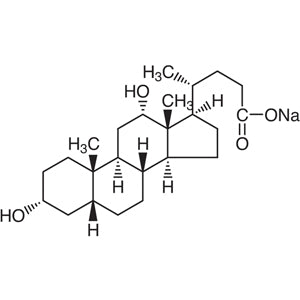


![TCI D1820 302-95-4 Sodium Deoxycholate [for Electrophoresis]](http://amiscientific.com/cdn/shop/files/TCI2510D1820_9b66fa0f-eb3b-4b41-8b17-c6b843cf04d5.jpg?v=1792637379&width=533)
![Sodium Deoxycholate [for Electrophoresis] (CAS 302-95-4) - TCI D1820 - AMI Scientific](http://amiscientific.com/cdn/shop/files/TCI2510D1820.jpg?v=1767103755&width=533)


