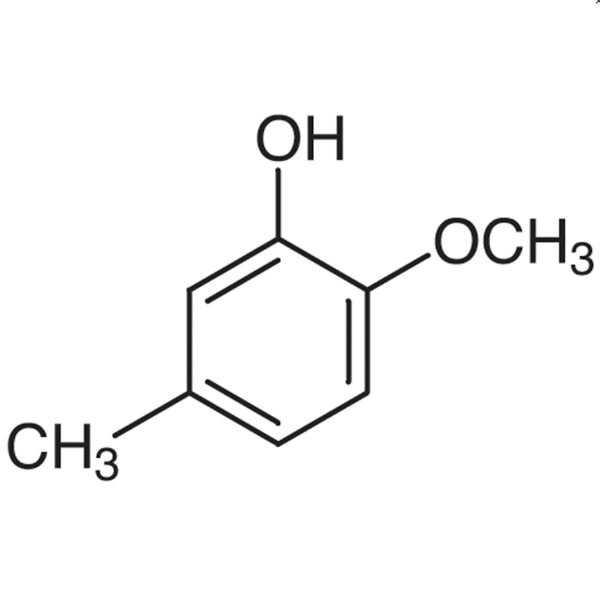
TCI H0624 2-Methoxy-5-methylphenol is a methylated guaiacol derivative carrying a phenolic hydroxyl group, an adjacent methoxy group, and a methyl group on the benzene ring. Compounds with this substitution pattern are well known in lignin chemistry, aroma chemistry, and organic synthesis because they mirror the structural units that appear when woody biomass breaks down. In the laboratory, this compound serves as a building block for constructing more elaborate aromatic molecules and, at the same time, as a model compound for studying cracking reactions, hydrodeoxygenation, and the catalytic conversion of lignin.
The characteristic that makes this material a preferred choice is the electron richness of its aromatic ring. The hydroxyl and methoxy groups are both electron-donating, so the ring becomes highly reactive toward electrophilic substitution at specific positions and readily accommodates halogenation, formylation, and directed coupling reactions. The phenolic hydroxyl group itself can be alkylated, acylated, or oxidized to a quinone, while the aryl–O–methyl bond is an attractive target in studies of catalytic bond cleavage. This phenolic character also confers free-radical quenching ability, which is why the compound is frequently of interest in that context as well.
In Indonesian laboratories, materials of this type are typically found in university research groups, government research institutes, and industrial R&D units working on biomass valorization, catalysis, and fine organic synthesis. It is normally handled at bench scale for reaction development, method optimization, and reference work, where a well-defined aromatic starting material is required. Because it is supplied by TCI as a catalogue building block, it fits routine synthetic workflows without the need for in-house preparation.
- Lignin model compound studies — its methoxy and hydroxyl substitution pattern reproduces the aromatic units released when woody biomass depolymerizes, making it a realistic stand-in for lignin fragments.
- Hydrodeoxygenation and catalytic conversion research — the aryl–O–methyl and phenolic C–O bonds provide well-defined cleavage targets for evaluating catalyst activity and selectivity under laboratory reaction conditions.
- Electrophilic aromatic substitution chemistry — the strongly electron-donating hydroxyl and methoxy groups activate the ring, allowing halogenation, formylation, and related transformations to proceed at predictable positions.
- Aromatic building block synthesis — the phenolic hydroxyl can be alkylated, acylated, or oxidized to a quinone, giving synthetic chemists several independent handles for elaborating more complex target molecules.
- Aroma and free-radical chemistry investigations — its phenolic character imparts radical-quenching behaviour, and this substitution pattern is long established in aroma chemistry, supporting both application areas.
| Brand | TCI |
|---|---|
| CAS number | 1195-09-1 |
| Molecular formula | — |
| Purity | — |
| Category | Chemistry > Building Blocks > Non-Heterocyclic Building Blocks |
| Pack sizes | available in the standard catalogue pack sizes offered by TCI for this item |
| Physical form | — |
| Storage | keep in the tightly closed original container as indicated on the manufacturer's label |
- Chemical name: 2-Methoxy-5-methylphenol (catalogue code H0624)
Store the container tightly closed in a cool, dry, well-ventilated area away from direct sunlight, heat sources, and strong oxidizing agents, following the conditions stated on the manufacturer's label and safety data sheet. Keep the material in its original supplier container or in a compatible, clearly labelled glass or approved chemical container, and close it promptly after each use to limit exposure to air and moisture. Handle the compound in a fume hood using safety glasses, chemical-resistant gloves, and a laboratory coat, since phenolic compounds can irritate the skin, eyes, and respiratory tract. Avoid generating dust or vapour, prevent contact with skin and eyes, and wash hands thoroughly after handling. Collect any residues and contaminated materials as chemical waste and dispose of them according to institutional and local regulations.
—
Produk Terkait
-
2-Methoxy-6-methylphenol TCI M3471
Regular price From Rp 903.000,00Regular price -
3-Methoxy-5-methylphenol TCI M0895
Regular price From Rp 1.405.950,00Regular price -
2-Methoxy-4-methylphenol TCI M0114
Regular price From Rp 1.353.450,00Regular price -
4-Triphenylmethylphenol TCI T1654
Regular price Rp 3.180.450,00Regular price -
2-Bromo-4,5-dimethylphenol TCI B5394
Regular price From Rp 3.127.950,00Regular price -
4-Bromo-3-methylphenol TCI B3658
Regular price From Rp 1.644.300,00Regular price -
4-Bromo-3,5-dimethylphenol TCI B2146
Regular price From Rp 1.087.800,00Regular price -
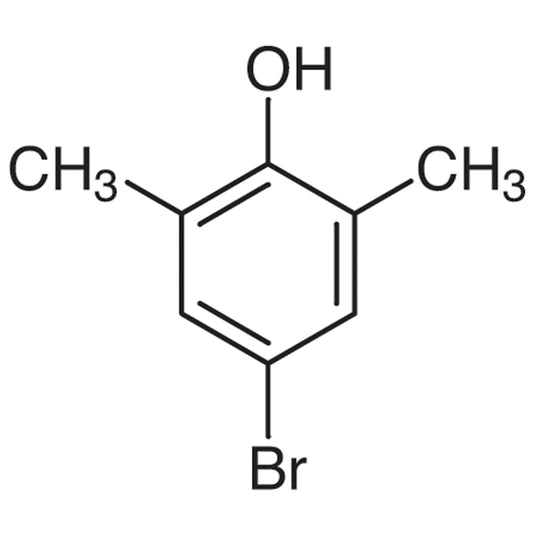
4-Bromo-2,6-dimethylphenol TCI B2060
Regular price From Rp 3.260.250,00Regular price