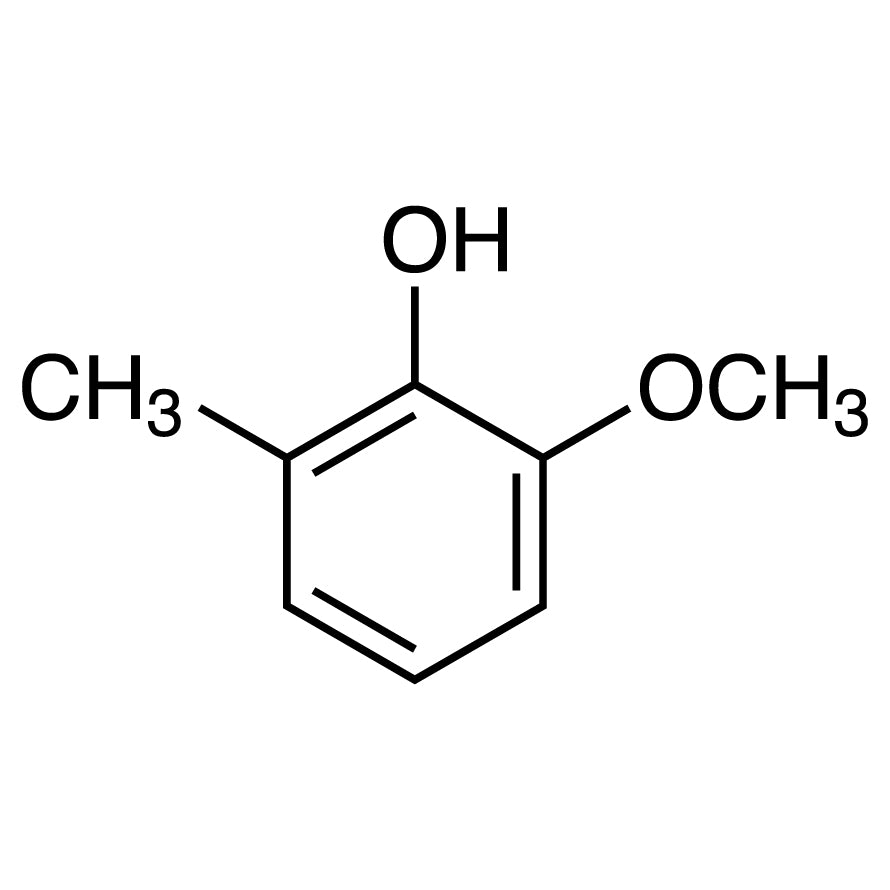
2-Methoxy-6-methylphenol is a chemical compound widely used in laboratory settings as a building block for the synthesis of complex molecules. It plays a crucial role in organic chemistry by serving as a versatile intermediate in various synthetic pathways. This compound is commonly utilized in research involving aromatic compounds and their derivatives, making it an essential tool for chemists working in both academic and industrial environments. Its ability to participate in multiple reaction types enhances its value in the development of new materials and pharmaceutical compounds.
The compound’s molecular structure is stable, and it exhibits moderate reactivity, which makes it suitable for substitution and oxidation reactions. These properties allow it to be employed in a range of experimental conditions, including reactions in solvents and under vacuum. Its chemical and physical characteristics ensure compatibility with different laboratory techniques, enabling researchers to manipulate it effectively for various applications. Due to its reactivity, careful handling and appropriate protective measures are necessary to ensure safe usage.
In Indonesian laboratories, 2-Methoxy-6-methylphenol is extensively used in both fundamental and applied chemical research. It is frequently employed in drug compound development, industrial raw material synthesis, and the study of new materials. Its reliability in chemical reactions makes it a sought-after reagent among researchers aiming to explore new synthetic strategies and applications in diverse scientific fields.
- Drug compound development: This compound is used in the synthesis of pharmaceuticals due to its reactivity and structural versatility, enabling the creation of complex drug molecules.
- Industrial raw material synthesis: It serves as a building block for the production of various industrial chemicals, contributing to the development of functional materials and specialty compounds.
- Material science research: Its chemical properties make it suitable for studies involving polymer synthesis and the creation of advanced materials with specific functional characteristics.
- Organic synthesis experiments: The compound’s ability to participate in substitution and oxidation reactions makes it ideal for a wide range of synthetic reactions in organic chemistry.
- Environmental chemistry studies: It is used in research focused on the behavior of aromatic compounds in different environmental conditions, aiding in the understanding of chemical degradation processes.
| Brand | TCI |
|---|---|
| CAS number | 2896-67-5 |
| Molecular formula | — |
| Purity | — |
| Category | Chemistry > Building Blocks > Non-Heterocyclic Building Blocks |
| Pack sizes | Available in various quantities to suit different research needs |
| Physical form | Solid or liquid, depending on the specific product variant |
| Storage | Store in a cool, dry place away from direct sunlight and incompatible materials |
This compound should be stored in a cool, dry environment, away from direct sunlight and sources of heat. It is recommended to use airtight containers made of materials that are chemically inert to prevent degradation. Due to its reactivity, it should be handled with appropriate personal protective equipment, including gloves and safety goggles. Storage should be in a well-ventilated area to minimize exposure to vapors. It is important to keep the compound away from incompatible substances such as strong oxidizing agents. Regular inspection of storage conditions is advised to ensure the integrity of the material remains intact.
—
Produk Terkait
-
3-Methoxy-5-methylphenol TCI M0895
Regular price From Rp 1.405.950,00Regular price -
2-Methoxy-4-methylphenol TCI M0114
Regular price From Rp 1.353.450,00Regular price -
2-Methoxy-5-methylphenol TCI H0624
Regular price From Rp 2.306.850,00Regular price -
4-Triphenylmethylphenol TCI T1654
Regular price Rp 3.180.450,00Regular price -
2-Bromo-4,5-dimethylphenol TCI B5394
Regular price From Rp 3.127.950,00Regular price -
4-Bromo-3-methylphenol TCI B3658
Regular price From Rp 1.644.300,00Regular price -
4-Bromo-3,5-dimethylphenol TCI B2146
Regular price From Rp 1.087.800,00Regular price -
4-Bromo-2,6-dimethylphenol TCI B2060
Regular price From Rp 3.260.250,00Regular price