


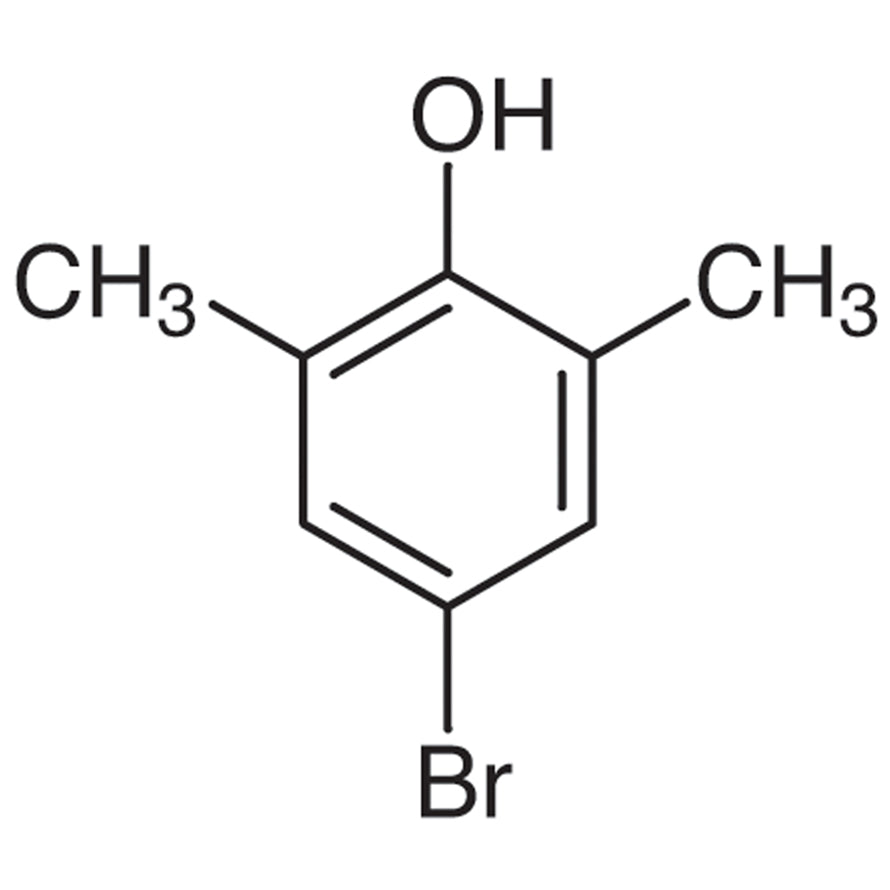
4-Bromo-2,6-dimethylphenol is a chemical compound with an aromatic structure featuring a bromo group and two methyl groups at positions 2 and 6. This compound plays a crucial role in laboratory settings, particularly in organic synthesis where it serves as a versatile building block. Its ability to participate in substitution and redox reactions makes it an essential reagent for researchers aiming to construct complex organic molecules. In both academic and industrial laboratories, this compound is widely used due to its chemical reactivity and compatibility with various functional groups.
The compound’s reactivity and functional group compatibility make it a preferred choice for chemical synthesis. Its stability under certain conditions ensures reliable performance during experiments, contributing to the accuracy and consistency of results. Additionally, its chemical structure allows for a wide range of modifications, making it adaptable to different synthetic strategies. These characteristics make it a valuable tool for chemists working on drug development, industrial chemical production, and pharmaceutical research.
In Indonesian laboratories, 4-Bromo-2,6-dimethylphenol is commonly used in educational institutions and research facilities. Its availability and cost-effectiveness make it a popular choice for students and researchers alike. The compound’s utility in both basic and advanced chemical experiments supports its widespread use in the scientific community. Its role in laboratory applications highlights its importance in advancing chemical research and development in Indonesia.
- Organic synthesis: This compound is ideal for creating complex organic molecules due to its reactivity and functional group compatibility.
- Pharmaceutical research: It is used in the development of new drugs and medicinal compounds through substitution and redox reactions.
- Industrial chemical production: Its versatility makes it suitable for manufacturing various industrial chemicals and intermediates.
- Educational experiments: It is commonly used in academic settings to teach fundamental principles of chemical synthesis and reactivity.
- Redox reaction studies: Its ability to participate in redox processes makes it a valuable reagent for studying electron transfer mechanisms.
| Brand | TCI |
|---|---|
| CAS number | 2374-05-2 |
| Molecular formula | — |
| Purity | — |
| Category | Chemistry > Building Blocks > Non-Heterocyclic Building Blocks |
| Pack sizes | Available in various quantities as per standard laboratory supply |
| Physical form | Solid |
| Storage | Store in a cool, dry place away from light and incompatible materials |
This compound should be stored in a cool, dry environment, away from direct sunlight and sources of heat. It is recommended to use airtight containers to prevent moisture absorption and contamination. Due to its chemical reactivity, it should be kept separate from strong oxidizing agents and incompatible substances. Proper labeling and secure storage are essential to ensure safety in the laboratory. Always use appropriate personal protective equipment when handling this material to minimize exposure risks. Regular inspection of storage conditions is advised to maintain the compound’s integrity and usability.
—
Produk Terkait
-
2-Bromo-4,5-dimethylphenol TCI B5394
Regular price From Rp 3.127.950,00Regular priceRp 2.187.150,00Sale price From Rp 3.127.950,00 -
4-Bromo-3,5-dimethylphenol TCI B2146
Regular price From Rp 1.087.800,00Regular priceRp 760.200,00Sale price From Rp 1.087.800,00 -
4-Triphenylmethylphenol TCI T1654
Regular price Rp 3.232.950,00Regular priceRp 2.276.400,00Sale price Rp 3.232.950,00 -
4-Bromo-3-methylphenol TCI B3658
Regular price From Rp 1.644.300,00Regular priceRp 1.149.750,00Sale price From Rp 1.644.300,00 -
2-tert-Butyl-4-ethylphenol TCI B1810
Regular price Rp 848.400,00Regular priceRp 609.000,00Sale price Rp 848.400,00 -
2-Amyl-5-methylphenol TCI A2710
Regular price From Rp 1.563.450,00Regular priceRp 1.108.800,00Sale price From Rp 1.563.450,00 -
2,3,6-Trimethylphenol TCI T0877
Regular price From Rp 717.150,00Regular priceRp 516.600,00Sale price From Rp 717.150,00 -
2,4,6-Trimethylphenol TCI T0486
Regular price From Rp 3.153.150,00Regular priceRp 2.220.750,00Sale price From Rp 3.153.150,00


