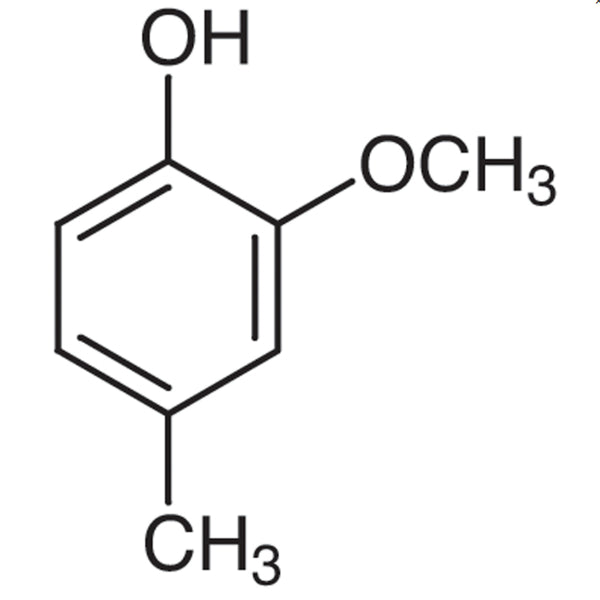
2-Methoxy-4-methylphenol (CAS No. 93-51-6) is a chemical compound widely used as a building block in organic synthesis. It serves as a fundamental component in the development of various organic compounds, playing a crucial role in laboratory settings where chemical reactions and molecular structures are being explored. This compound is particularly valued for its versatility and reactivity, making it a key player in the creation of aromatic compounds and their derivatives. Its presence in chemical reactions allows for the formation of a wide range of products, contributing to both academic and industrial research efforts.
The compound's stability and reactivity make it a preferred choice for chemists working in diverse fields. It can interact with acids, bases, and other organic reagents, enabling the synthesis of complex molecules with specific functional groups. Its chemical properties allow it to participate in a variety of reaction mechanisms, such as electrophilic substitution and oxidation, which are essential in the development of pharmaceuticals and industrial chemicals. These characteristics make it a reliable and flexible tool for researchers aiming to create new compounds or modify existing ones.
In Indonesian laboratories, 2-Methoxy-4-methylphenol is commonly used in chemical research, drug development, and the production of industrial chemicals. Its availability in liquid form simplifies handling and storage, making it a practical choice for both academic and industrial applications. Its stable nature and broad applicability have made it a sought-after material among chemists in educational institutions and research facilities across Indonesia.
- Synthesis of complex aromatic compounds for pharmaceutical research due to its reactivity and structural versatility.
- Development of new chemical intermediates in industrial applications because of its ability to participate in various chemical reactions.
- Creation of derivatives for medicinal chemistry studies as it provides a stable platform for functional group modifications.
- Support for organic synthesis experiments in academic settings due to its availability and ease of use in laboratory conditions.
- Use in the production of specialty chemicals where controlled chemical reactions are required for product development.
| Brand | TCI |
|---|---|
| CAS number | 93-51-6 |
| Molecular formula | — |
| Purity | — |
| Category | Chemistry > Building Blocks > Non-Heterocyclic Building Blocks |
| Pack sizes | Available in various quantities as per standard laboratory supply |
| Physical form | Liquid |
| Storage | Store in a cool, dry place away from direct sunlight |
This compound should be stored in a cool, dry place, away from direct sunlight and sources of heat. It is recommended to use airtight containers made of glass or polyethylene to prevent contamination and maintain its chemical integrity. Due to its reactivity, it should be handled with care, using appropriate personal protective equipment such as gloves and safety goggles. It is important to ensure proper ventilation in the laboratory when working with this substance to minimize exposure. Avoid contact with incompatible materials such as strong oxidizing agents. Always follow standard laboratory safety protocols to ensure safe handling and storage practices.
—
Produk Terkait
-
2-Methoxy-6-methylphenol TCI M3471
Regular price From Rp 903.000,00Regular price -
3-Methoxy-5-methylphenol TCI M0895
Regular price From Rp 1.405.950,00Regular price -
2-Methoxy-5-methylphenol TCI H0624
Regular price From Rp 2.306.850,00Regular price -
4-Triphenylmethylphenol TCI T1654
Regular price Rp 3.180.450,00Regular price -
2-Bromo-4,5-dimethylphenol TCI B5394
Regular price From Rp 3.127.950,00Regular price -
4-Bromo-3-methylphenol TCI B3658
Regular price From Rp 1.644.300,00Regular price -
4-Bromo-3,5-dimethylphenol TCI B2146
Regular price From Rp 1.087.800,00Regular price -
4-Bromo-2,6-dimethylphenol TCI B2060
Regular price From Rp 3.260.250,00Regular price