

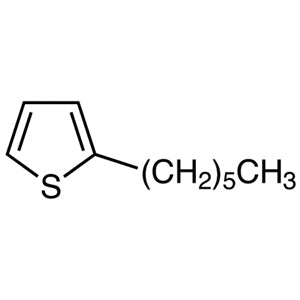
2-Hexylthiophene is a heterocyclic compound built around a five-membered thiophene ring containing a single sulfur atom, with a straight-chain hexyl group attached at the two position. The combination of an electron-rich aromatic ring and a long alkyl chain makes this compound an important building block in the field of organic electronics. In the laboratory it is commonly used as a monomer or starting material for constructing oligothiophenes and polythiophenes, the family of materials that forms the backbone of research into organic transistors, organic solar cells, and sensors based on conductive polymers.
The properties that make this compound a preferred choice come from the dual role played by its two structural parts. The thiophene ring is electron-rich and readily undergoes electrophilic substitution as well as directed halogenation, so it can be developed into halogenated or boronated derivatives that are ready for use in cross-coupling reactions. The hexyl chain, meanwhile, provides far better solubility in organic solvents than unsubstituted thiophene, which means the resulting polymers can be processed using solution techniques such as spin coating. This compound is a liquid, so transferring it is straightforward.
In Indonesian laboratories, 2-Hexylthiophene is typically encountered in organic synthesis and materials research groups working on conductive polymers and organic semiconductor devices. It serves as a starting point in multi-step synthetic routes, where it is first functionalised and then carried forward into polymerisation or coupling steps. Because it is supplied as a liquid, it fits easily into standard bench workflows using syringes and volumetric transfer, supporting both small trial reactions and larger preparative batches.
- Oligothiophene synthesis — the reactive two and five positions of the electron-rich thiophene ring allow controlled stepwise extension into defined oligomer chains for structure-property studies.
- Polythiophene preparation — used as a monomer or precursor whose hexyl chain confers the solubility needed to keep growing polymer chains in solution during and after polymerisation.
- Organic field-effect transistor materials — supplies the alkylated thiophene unit that underpins semiconducting polymers evaluated as active layers in organic transistor research.
- Organic photovoltaic research — provides a building block for donor polymers in organic solar cell studies, where solution processability such as spin coating is essential for device fabrication.
- Cross-coupling precursor chemistry — readily converted by directed halogenation or boronation into coupling partners suited to standard palladium-catalysed cross-coupling reaction schemes.
| Brand | TCI |
|---|---|
| CAS number | 18794-77-9 |
| Molecular formula | — |
| Purity | — |
| Category | Chemistry > Building Blocks > Heterocyclic Building Blocks |
| Pack sizes | available in the standard TCI pack sizes listed for this catalogue item |
| Physical form | liquid, allowing straightforward transfer and measurement |
| Storage | keep in a tightly closed original container in a cool, well-ventilated area |
- Catalogue code: H1350
Store the container tightly closed in a cool, dry, well-ventilated place away from heat sources, direct sunlight, and incompatible oxidising agents. The original supplier container is the most suitable vessel; if decanting is required, use clean, dry glassware that is chemically compatible and label it clearly. As an organic liquid, it should be handled inside a fume hood with the usual laboratory precautions: safety glasses, chemically resistant gloves, and a laboratory coat. Avoid breathing vapour, prevent skin and eye contact, and keep the working area free of ignition sources. Transfer using syringes or pipettes appropriate for volatile organic liquids, close the container immediately after use, and dispose of residues and contaminated materials through the laboratory's chemical waste stream. Always consult the manufacturer's safety data sheet before first use.
—
Produk Terkait
-
3-Hexylthiophene TCI H0756
Regular price From Rp 664.650,00Regular price -
3,4-Dihexylthiophene TCI D4202
Regular price From Rp 1.829.100,00Regular price -
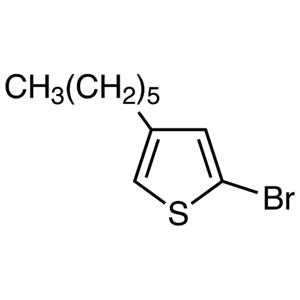
2-Bromo-4-hexylthiophene TCI B3985
Regular price Rp 4.240.950,00Regular price -
2-Bromo-5-hexylthiophene TCI B3812
Regular price Rp 4.028.850,00Regular price -
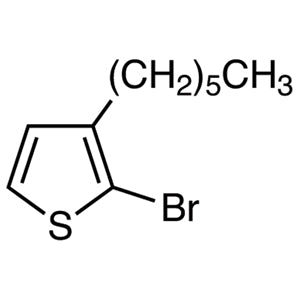
2-Bromo-3-hexylthiophene TCI B3507
Regular price From Rp 2.704.800,00Regular price -
2-Bromo-3-cyclohexylthiophene TCI B5420
Regular price From Rp 3.763.200,00Regular price -
Poly(3-hexylthiophene-2,5-diyl)(regioregular)[fororganicelectronics] TCI P2513
Regular price From Rp 4.056.150,00Regular price -
4-Hexylthiophene-2-carboxaldehyde TCI H1499
Regular price Rp 3.498.600,00Regular price




![110134-47-9 Poly(3-hexylthiophene-2,5-diyl) (regioregular) [for organic electronics] - AMI Scientific](http://amiscientific.com/cdn/shop/files/TCI2510P2513.jpg?v=1767136282&width=533)
