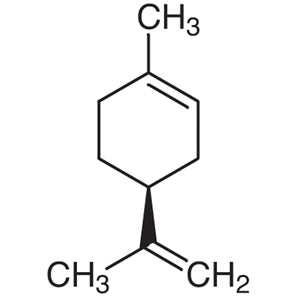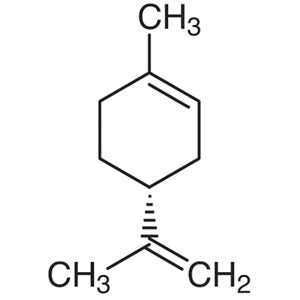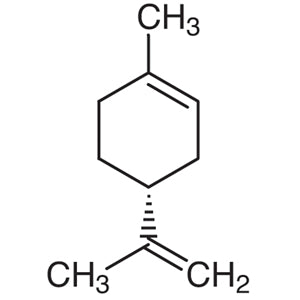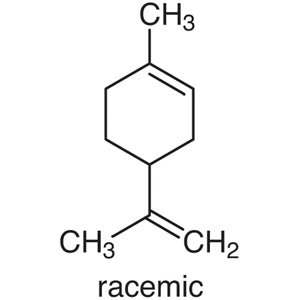
TCI L0046 (+/-)-Limonene is a cyclic monoterpene supplied as a liquid in its racemic form, meaning it contains a balanced mixture of the (+) and (−) enantiomers. The compound is the principal constituent of the essential oils found in citrus peel and is widely recognised for its characteristic citrus aroma. In the laboratory it plays a dual role: it serves as an organic synthesis building block carrying two reactive double bonds, and it functions as a renewable hydrocarbon solvent that is frequently evaluated as a replacement for conventional chlorinated and aromatic solvents.
The property that makes limonene particularly attractive is the presence of two double bonds with different degrees of substitution, one located within the ring and one on the isopropenyl side chain. This distinction allows selective reactions such as epoxidation, partial hydrogenation, hydroformylation, and electrophilic addition to be directed at the desired position. As a nonpolar hydrocarbon, limonene dissolves oils, fats, waxes, and a wide range of organic residues extremely well, which makes it useful both for cleaning laboratory equipment and for extraction work. The racemic form makes this material an economical choice whenever optical purity is not the deciding factor, for example in solvent applications and polymer research.
In Indonesian laboratories this grade fits naturally into academic, government, and industrial research settings where citrus-derived chemistry and green solvent substitution are active areas of interest. Groups working on organic synthesis, natural product chemistry, materials development, and analytical method work use the racemate where a reliable, well-characterised terpene starting material is needed. Because it is supplied by TCI, users receive a consistent catalogue item that can be reordered against the same specification across successive projects.
- Organic synthesis building block — the two double bonds of differing substitution allow chemists to functionalise the ring and the isopropenyl side chain selectively rather than indiscriminately.
- Selective transformation studies — epoxidation, partial hydrogenation, hydroformylation, and electrophilic addition can each be directed to a chosen position, making limonene a useful substrate for reaction development.
- Green solvent substitution research — as a renewable hydrocarbon, limonene is routinely tested as an alternative to conventional chlorinated and aromatic solvents in comparative solvent screening work.
- Extraction of nonpolar analytes — the nonpolar character of limonene dissolves oils, fats, waxes, and assorted organic residues very effectively, supporting extraction protocols that target lipophilic material.
- Laboratory equipment cleaning — the same dissolving power towards greases, waxes, and organic residues makes limonene practical for removing stubborn nonpolar contamination from glassware and apparatus.
| Brand | TCI (Tokyo Chemical Industry), catalogue number L0046 |
|---|---|
| CAS number | 138-86-3 |
| Molecular formula | — |
| Purity | — |
| Category | Chemistry > Building Blocks > Non-Heterocyclic Building Blocks |
| Pack sizes | available in the standard TCI catalogue pack sizes; please confirm the packaging option required when ordering |
| Physical form | liquid with a characteristic citrus odour |
| Storage | keep in a cool, dark place in a tightly closed container |
- Chemical class: cyclic monoterpene, supplied as the racemate (balanced mixture of (+) and (−) enantiomers)
Store (+/-)-Limonene in a cool, dark, and well-ventilated area, away from heat sources, open flames, oxidising agents, and direct sunlight. Keep the material in tightly closed containers of a material compatible with nonpolar hydrocarbons, such as the original supplier packaging or amber glass bottles with solvent-resistant closures, and reseal promptly after each use to limit evaporation and exposure to air. Handle the liquid in a fume hood using nitrile gloves, safety glasses, and a laboratory coat, and avoid skin contact and inhalation of vapour. Ground containers when transferring larger volumes, keep ignition sources away from the work area, and follow the manufacturer's safety data sheet together with your institution's chemical waste procedures for disposal.
—
Produk Terkait
-
(-)-Limonene TCI L0132
Regular price From Rp 505.050,00Regular price -
(+)-Limonene TCI L0105
Regular price From Rp 1.353.450,00Regular price -
(+)-Limonene TCI L0047
Regular price From Rp 452.550,00Regular price -
(+/-)-Menthol TCI M0321
Regular price From Rp 610.050,00Regular price -
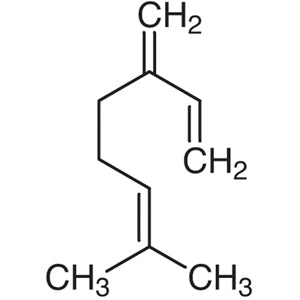
Myrcene(stabilizedwithBHT) TCI M0235
Regular price From Rp 505.050,00Regular price -
Hinokitiol TCI H0142
Regular price From Rp 689.850,00Regular price -
Terpinolene TCI T0817
Regular price Rp 689.850,00Regular price -
(-)-Perillaldehyde TCI P0866
Regular price From Rp 610.050,00Regular price