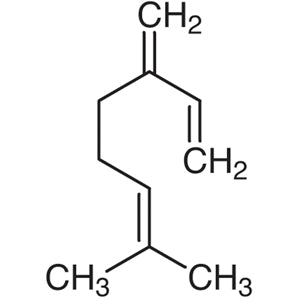
TCI M0235 Myrcene (stabilized with BHT) is an acyclic monoterpene belonging to the family of naturally occurring terpene hydrocarbons, widely found in the essential oils of a broad range of aromatic plants. The material is supplied already stabilized with BHT, an antioxidant added to suppress polymerization and oxidation during storage. It presents as an oily liquid with the characteristic terpene odour. In the laboratory, myrcene plays a dual role: it serves as a starting material for the synthesis of high-value fragrance compounds and terpenoids, and at the same time as a bio-based diene monomer for research into renewable elastomers and polymers, a field currently expanding rapidly.
The property that makes myrcene a preferred choice is the presence of both a conjugated diene system and one isolated double bond within a single molecule. That diene system renders it reactive toward Diels-Alder reactions, hydroformylation, hydroamination and polymerization, opening many transformation routes from one and the same starting material. Its terpene skeleton also makes myrcene a classical precursor for the synthesis of fragrance compounds such as terpenic alcohol derivatives. Precisely because of this high reactivity, however, myrcene readily self-polymerizes on exposure, which is why the stabilized grade is the practical form for laboratory work.
In Indonesian laboratories, this material fits naturally into synthetic organic chemistry work, essential-oil and natural-product research, and the development of bio-based polymers, areas of strong interest given the country's abundance of aromatic plant raw materials. It is used in university research groups, government research institutes and industrial R&D units working on fragrance chemistry and renewable materials, where a reliably stabilized terpene building block removes the uncertainty of working with freshly isolated material.
TCI brochures (PDF)
- Terpenes 2025-09-22 · p. 3
- Diels-Alder cycloaddition chemistry — the conjugated diene system reacts directly as the diene partner, giving access to cyclic frameworks from a single inexpensive, naturally derived starting material.
- Fragrance and terpenoid synthesis — the terpene skeleton is a classical precursor route to aroma compounds, including terpenic alcohol derivatives widely studied in flavour and fragrance chemistry.
- Bio-based polymer and elastomer research — as a renewable diene monomer, myrcene supports polymerization studies aimed at replacing petroleum-derived rubber and elastomer feedstocks.
- Hydroformylation studies — the multiple unsaturation sites allow investigation of catalyst selectivity and regiochemistry, making it a useful substrate for homogeneous catalysis research.
- Hydroamination and functionalization work — the combination of conjugated diene and isolated double bond lets researchers explore selective addition chemistry across chemically distinct alkene positions.
| Brand | TCI |
|---|---|
| CAS number | 123-35-3 |
| Molecular formula | — |
| Purity | — |
| Category | Chemistry > Building Blocks > Non-Heterocyclic Building Blocks |
| Pack sizes | available in the standard TCI catalogue pack sizes |
| Physical form | oily liquid with a characteristic terpene odour |
| Storage | supplied stabilized with BHT to suppress polymerization and oxidation during storage |
Store the container tightly closed in a cool, dark place, away from heat, direct sunlight and sources of ignition. Amber glass or the original supplier container is appropriate, since light and air accelerate oxidation and self-polymerization of the material. Do not remove or dilute the BHT stabilizer unless the experimental protocol specifically requires it. Handle in a fume hood, using gloves, safety glasses and a laboratory coat, and keep the material away from oxidizing agents. Minimize the time the container stays open, reseal promptly after dispensing, and consult the manufacturer's safety data sheet before first use.
—
Produk Terkait
-
Nerol TCI N0077
Regular price From Rp 823.200,00Regular price -
Linalool TCI L0048
Regular price From Rp 557.550,00Regular price -
(+/-)-Limonene TCI L0046
Regular price From Rp 980.700,00Regular price -
Geraniol TCI G0027
Regular price Rp 452.550,00Regular price -
Citral(cis-andtrans-mixture) TCI D0762
Regular price Rp 637.350,00Regular price -
CitronellicAcid TCI C1708
Regular price Rp 2.809.800,00Regular price -
beta-Citronellol TCI C0370
Regular price From Rp 530.250,00Regular price -
(+/-)-Citronellal TCI C3648
Regular price Rp 1.696.800,00Regular price