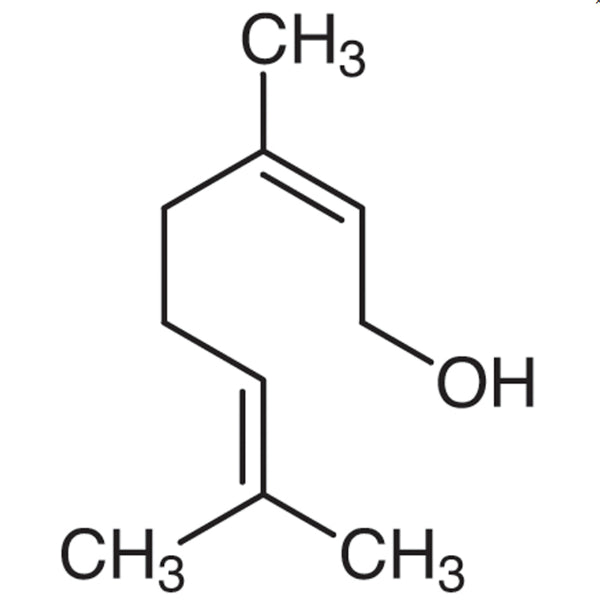
TCI N0077 Nerol is an acyclic monoterpene alcohol and the geometric isomer of geraniol, widely recognised for its soft, rose-like floral aroma. The compound occurs naturally in the essential oils of a range of aromatic plants, including lemongrass, rose, and neroli. In the laboratory, nerol serves as a reference standard for essential oil analysis by gas chromatography, as a starting material for terpenoid synthesis, and as a study compound in the development of fragrance and flavour formulations.
The property that makes nerol a preferred choice is its reactive primary allylic hydroxyl group, which is readily converted into aldehydes, esters, or other derivatives through controlled oxidation and esterification. Its double-bond configuration, which differs from that of geraniol, makes this pair of compounds a classic example for studying how stereochemistry influences both aroma and reactivity. Presented as a colourless to pale yellow liquid with a characteristic odour, nerol is practically insoluble in water yet mixes well with ethanol and common organic solvents, making it straightforward to formulate across a variety of research solvent systems.
Laboratories in Indonesia working on essential oils have a substantial need for well-characterised terpene reference compounds, and nerol occupies a recurring place in that work. It is used in institutional and university laboratories that profile local aromatic plant oils, in synthesis groups preparing terpenoid derivatives, and in applied research on fragrance and flavour formulation, where the compound supports both identification work and preparative chemistry.
- Gas chromatography reference standard: nerol provides a defined comparison peak for identifying and confirming terpene alcohol components during the chromatographic profiling of essential oils.
- Essential oil composition analysis: as a naturally occurring constituent of lemongrass, rose, and neroli oils, it supports the characterisation of plant-derived aromatic extracts in routine analytical work.
- Terpenoid synthesis starting material: the reactive primary allylic hydroxyl group allows controlled conversion into aldehydes, esters, and further derivatives through oxidation and esterification routes.
- Stereochemistry teaching and research: paired with its geometric isomer geraniol, nerol illustrates how double-bond configuration influences both odour character and chemical reactivity in monoterpenes.
- Fragrance and flavour formulation studies: its soft rose-like aroma and good miscibility with ethanol and organic solvents suit it to exploratory formulation and sensory development work.
| Brand | TCI |
|---|---|
| CAS number | 106-25-2 |
| Molecular formula | — |
| Purity | — |
| Category | Chemistry > Building Blocks > Non-Heterocyclic Building Blocks |
| Pack sizes | available in standard TCI research packaging; please refer to the pack size options listed on this page |
| Physical form | colourless to pale yellow liquid with a characteristic odour |
| Storage | keep in a tightly closed container, protected from light and stored in a cool, well-ventilated area |
Store nerol in a tightly closed container in a cool, dry, and well-ventilated area, away from direct sunlight, heat sources, and ignition sources. Amber glass bottles or the original supplier packaging are suitable, since they limit light exposure and help preserve the characteristic aroma profile of the compound. Handle in a fume hood and wear appropriate personal protective equipment, including gloves, safety goggles, and a laboratory coat. Avoid contact with skin, eyes, and inhalation of vapour. Keep the container closed when not in use to reduce evaporation and prevent contamination, and consult the supplier safety data sheet before any handling, transfer, or disposal operation.
—
Produk Terkait
-
Geraniol TCI G0027
Regular price Rp 452.550,00Regular price -
Linalool TCI L0048
Regular price From Rp 557.550,00Regular price -
beta-Citronellol TCI C0370
Regular price From Rp 530.250,00Regular price -
Farnesol(mixtureofisomers) TCI T0608
Regular price From Rp 557.550,00Regular price -
(+/-)-Menthol TCI M0321
Regular price From Rp 610.050,00Regular price -
Myrcene(stabilizedwithBHT) TCI M0235
Regular price From Rp 505.050,00Regular price -
Citral(cis-andtrans-mixture) TCI D0762
Regular price Rp 637.350,00Regular price -
CitronellicAcid TCI C1708
Regular price Rp 2.809.800,00Regular price