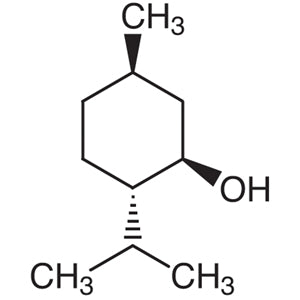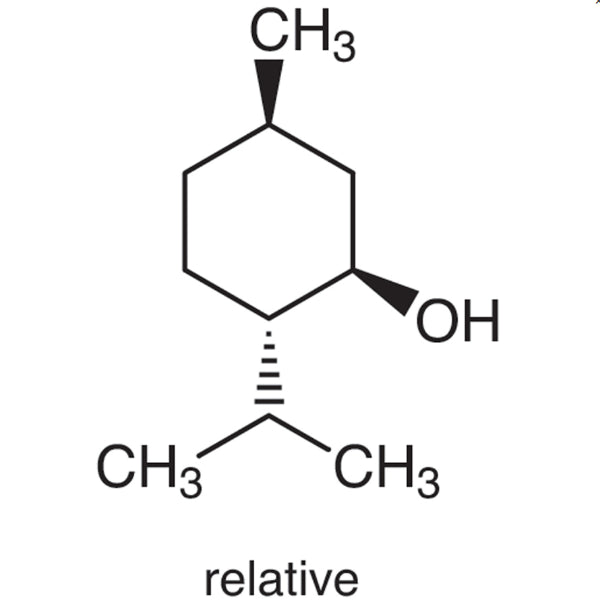
(+/-)-Menthol is an organic compound widely used in various chemical experiments conducted in laboratory settings. As a member of the terpenoid family, it possesses a complex molecular structure and exhibits interesting physical properties that make it a valuable resource for chemists. Its versatility allows it to be used as a building block in the synthesis of other compounds or as a test material in chemical analysis. Due to its stability and availability, menthol is a popular choice across a range of chemical applications. The compound is known for its strong, distinctive aroma and physical characteristics that enable its use under diverse laboratory conditions.
The physical and chemical properties of (+/-)-Menthol make it a preferred choice for laboratory use. It has relatively high melting and boiling points, which facilitate heating and cooling processes in experiments. Its non-polar nature influences its solubility and interaction with different solvents, making it adaptable to various chemical reactions. Additionally, its stability under normal laboratory conditions ensures consistent results in experiments. These properties contribute to its widespread use in both educational and research environments.
In Indonesian laboratories, (+/-)-Menthol is commonly used in both educational and research contexts. It is an essential component of practical chemistry courses in higher education institutions and is frequently employed in research laboratories for its chemical versatility. Its availability and reliability make it a standard material in the chemical supply chain for Indonesian laboratories, supporting both teaching and scientific inquiry.
- Chemical synthesis experiments benefit from (+/-)-Menthol due to its role as a building block in the creation of more complex organic compounds.
- It is widely used in analytical chemistry for testing the purity and reactivity of other substances through various analytical techniques.
- Educational institutions incorporate (+/-)-Menthol into their curriculum to teach students about organic chemistry and molecular structures.
- Research laboratories utilize it for studying its physical and chemical behavior under different experimental conditions.
- It is also applied in the development of fragrances and pharmaceuticals, where its unique properties are leveraged for product formulation.
| Brand | TCI |
|---|---|
| CAS number | 89-78-1 |
| Molecular formula | — |
| Purity | — |
| Category | Chemistry > Building Blocks > Non-Heterocyclic Building Blocks |
| Pack sizes | Available in various quantities as per supplier specifications |
| Physical form | Solid |
| Storage | Store in a cool, dry place away from direct sunlight |
(+/-)-Menthol should be stored in a cool, dry environment to maintain its stability and prevent degradation. It is recommended to keep it in airtight containers to minimize exposure to moisture and air, which can affect its physical properties. Due to its non-polar nature, it is advisable to use containers made of materials that are chemically inert to avoid any unwanted reactions. In laboratory settings, it should be handled with care to prevent inhalation of its strong aroma, and appropriate personal protective equipment should be worn when working with it. Proper storage and handling ensure the compound remains effective and safe for use in various experimental applications.
—
Produk Terkait
-
(-)-Menthol TCI M0545
Regular price From Rp 477.750,00Regular price -
Nerol TCI N0077
Regular price From Rp 823.200,00Regular price -
Linalool TCI L0048
Regular price From Rp 557.550,00Regular price -
(+/-)-Limonene TCI L0046
Regular price From Rp 980.700,00Regular price -
Hinokitiol TCI H0142
Regular price From Rp 689.850,00Regular price -
Geraniol TCI G0027
Regular price Rp 452.550,00Regular price -
1,8-Cineole TCI C0934
Regular price From Rp 505.050,00Regular price -
beta-Citronellol TCI C0370
Regular price From Rp 530.250,00Regular price