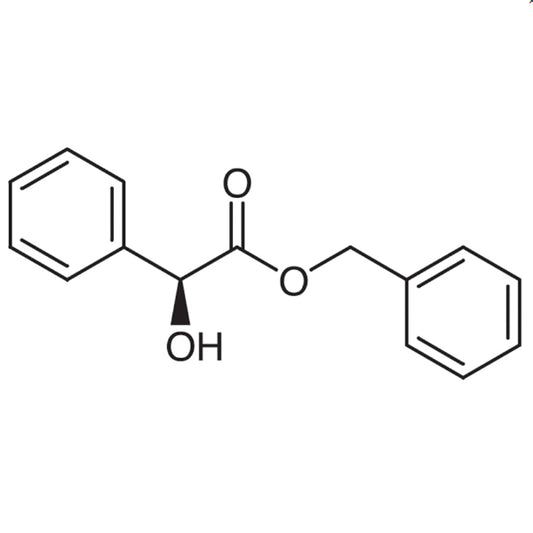
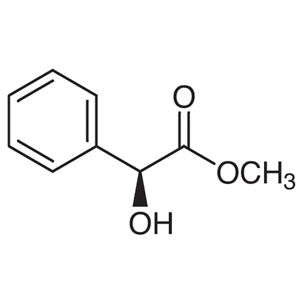
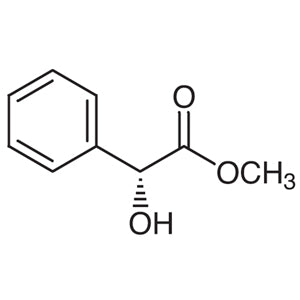
Ethyl L-(+)-Mandelate is a chiral compound widely used in asymmetric synthesis, playing a crucial role in the creation of molecules with specific stereochemistry. It serves as a chiral building block, enabling chemists to construct complex organic structures with precise optical properties. This compound is essential in the field of organic chemistry, particularly for those working on enantioselective reactions and stereoselective transformations. Its utility extends to pharmaceutical research, where controlling stereochemistry is vital for developing effective and safe drugs.
Ethyl L-(+)-Mandelate is valued for its stable molecular structure and favorable chemical properties, making it compatible with a variety of reagents and reaction conditions. It exhibits good solubility in organic solvents, which enhances its applicability in synthetic processes. The compound’s optical activity ensures that it can be used to produce enantiomerically pure products, a key requirement in pharmaceutical and fine chemical manufacturing. Its reliability and consistency make it a preferred choice for both academic and industrial research settings.
In Indonesian laboratories, Ethyl L-(+)-Mandelate is commonly used by chemists and pharmacologists for research and development purposes. It is a fundamental tool in the study of asymmetric synthesis and is integral to the training and innovation efforts of local research institutions. Its presence in laboratory workflows underscores its importance in advancing chemical and pharmaceutical sciences in the region.
- Asymmetric synthesis is a key application where Ethyl L-(+)-Mandelate is used to create chiral molecules with specific stereochemistry, enabling the production of enantiomerically pure compounds.
- Pharmaceutical research benefits from this compound as it allows for the synthesis of drug molecules with precise optical properties, which is critical for drug efficacy and safety.
- Organic chemistry experiments often incorporate Ethyl L-(+)-Mandelate to explore stereoselective reactions and to study the behavior of chiral compounds under various reaction conditions.
- Academic research in Indonesian universities utilizes this compound to teach and practice asymmetric synthesis techniques, supporting the development of skilled chemists.
- Industrial chemical production uses Ethyl L-(+)-Mandelate to manufacture fine chemicals and intermediates that require controlled stereochemistry for final product quality.
| Brand | TCI |
|---|---|
| CAS number | 13704-09-1 |
| Molecular formula | — |
| Purity | — |
| Category | Chemistry > Asymmetric Synthesis > Chiral Building Blocks |
| Pack sizes | Available in standard laboratory quantities as per supplier specifications |
| Physical form | Solid or liquid, depending on the specific formulation |
| Storage | Store in a cool, dry place away from light and moisture |
Ethyl L-(+)-Mandelate should be stored in a cool, dry environment to maintain its chemical stability and prevent degradation. It is recommended to use airtight containers to minimize exposure to moisture and air, which could affect its optical properties. Proper labeling of storage containers is essential for safety and traceability. In laboratory settings, it should be handled with care, using appropriate personal protective equipment such as gloves and safety goggles. It is important to ensure that the compound is stored away from incompatible substances to avoid any potential chemical interactions. Regular monitoring of storage conditions helps maintain the integrity of the material for reliable use in research applications.
—
Produk Terkait
-
Methyl2-Chloro-L-mandelate TCI M2383
Regular price Rp 1.749.300,00Regular price -
Methyl2-Chloro-D-mandelate TCI M2382
Regular price From Rp 1.644.300,00Regular price -
BenzylL-(+)-Mandelate TCI M1355
Regular price From Rp 928.200,00Regular price -
BenzylD-(-)-Mandelate TCI M1354
Regular price From Rp 505.050,00Regular price -
MethylL-(+)-Mandelate TCI M1350
Regular price From Rp 477.750,00Regular price -
MethylD-(-)-Mandelate TCI M1349
Regular price From Rp 505.050,00Regular price -
EthylD-(-)-Mandelate TCI M1344
Regular price From Rp 1.538.250,00Regular price -
IsoamylDL-Mandelate TCI M0716
Regular price Rp 3.843.000,00Regular price