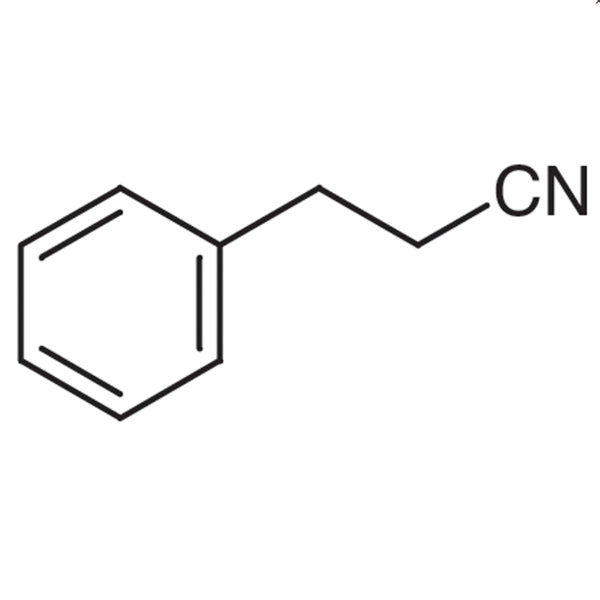
3-Phenylpropionitrile from TCI (product code P0611) is an aliphatic nitrile with a phenyl group at the end of a three-carbon chain. It is also known as hydrocinnamonitrile. As a non-heterocyclic building block, it supplies a phenylpropyl framework carrying a nitrile group, which is a very easy functional group to convert. Synthesis laboratories use it as a starting material for amines, carboxylic acids, amides, ketones, and other intermediates in pharmaceutical and fine chemical research. It is a simple, well-defined reagent for adding a phenylpropyl unit to larger target molecules.
Its main advantage is a nitrile group that is versatile yet reasonably stable in storage. The nitrile can be reduced to 3-phenylpropylamine, hydrolysed to hydrocinnamic acid or its amide, or treated with Grignard reagents to give ketones. The carbon next to the nitrile is acidic enough to be deprotonated and alkylated, so chemists can lengthen or branch the carbon chain. Two methylene groups separate the phenyl ring from the nitrile, so each part of the molecule reacts largely on its own. This lets chemists plan selective transformations on either end of the structure.
In Indonesian laboratories, this compound is relevant to organic chemistry and medicinal chemistry research groups that need a phenylpropyl framework for building target molecules. University synthesis laboratories, pharmaceutical research and development units, and fine chemical developers can use it for multistep synthesis, for teaching nitrile functional group transformations, and for preparing compound series in structure–activity studies. Because it is a TCI reagent, researchers get a consistent, documented starting material that supports reproducible results across repeated experiments and between research teams.
- Primary amine synthesis: reducing the nitrile gives 3-phenylpropylamine, a useful amine building block for medicinal chemistry and for preparing amide or sulfonamide libraries.
- Carboxylic acid and amide preparation: hydrolysing the nitrile under suitable conditions gives hydrocinnamic acid or its amide, a direct route to these common phenylpropanoid intermediates.
- Ketone synthesis using organometallic reagents: adding Grignard reagents to the nitrile group, followed by workup, gives ketones with a phenylpropyl framework for later synthetic steps.
- Chain extension by alpha-alkylation: the acidic carbon next to the nitrile can be deprotonated and alkylated, so chemists can add branches or lengthen the carbon chain in a controlled way.
- Teaching and method development: the simple, well-defined structure makes it a good model substrate for showing nitrile transformations and for optimising new reaction conditions in research laboratories.
| Brand | TCI (product code P0611) |
|---|---|
| CAS number | 645-59-0 |
| Molecular formula | — |
| Purity | — |
| Category | Chemistry > Building Blocks > Non-Heterocyclic Building Blocks |
| Pack sizes | see the available pack options on the product listing |
| Physical form | liquid at room temperature; keep in a tightly closed container in a cool, dark, well-ventilated place |
| Storage | — |
- Synonym: Hydrocinnamonitrile
Keep 3-Phenylpropionitrile in its original tightly closed container in a cool, dry, dark, well-ventilated area, away from heat sources, strong oxidising agents, strong acids, and strong bases. Glass containers with chemically resistant caps are suitable for storing it and for taking out portions. Handle it in a fume hood and wear safety goggles, chemical-resistant gloves, and a laboratory coat. Do not inhale vapours and avoid contact with skin and eyes. Like other organic nitriles, treat it with care and follow the safety data sheet for specific hazards, first aid, and disposal. Label secondary containers clearly and close them immediately after use.
—
Produk Terkait
-
2-Phenylpropionitrile TCI P0860
Regular price From Rp 584.850,00Regular price -
Propionitrile TCI P0514
Regular price From Rp 477.750,00Regular price -
3-(Methylamino)propionitrile TCI M2312
Regular price From Rp 1.988.700,00Regular price -
N,N'-(Hexane-1,6-diyl)bis(3-phenylprop-2-en-1-imine) TCI D5989
Regular price Rp 1.936.200,00Regular price -
3,3-Diphenylpropionitrile TCI D2590
Regular price From Rp 848.400,00Regular price -
2,2-Diphenylpropionitrile TCI D2534
Regular price From Rp 928.200,00Regular price -
3-Benzoylpropionitrile TCI B5378
Regular price Rp 2.359.350,00Regular price -
Diarylpropionitrile TCI B4385
Regular price From Rp 2.942.100,00Regular price