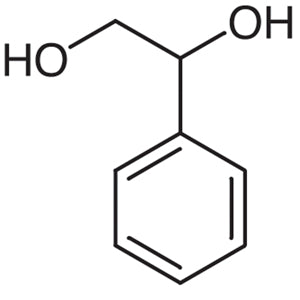
1-Phenylethane-1,2-diol from TCI, product code P0686, is an aromatic vicinal diol, also known as styrene glycol or phenyl ethylene glycol. The molecule carries two hydroxyl groups on adjacent carbon atoms, and one of those carbons is bonded directly to a benzene ring. In the laboratory, it serves as a building block for organic synthesis, a model substrate for diol reactions, and a reference compound in studies of styrene metabolism. This makes it useful in both synthetic chemistry and analytical toxicology.
Its value comes mainly from the vicinal diol structure. The two hydroxyl groups can be converted into cyclic acetals or ketals, such as an acetonide, to protect the functional group during multistep synthesis. The carbon-carbon bond between the two hydroxyls can also be cleaved oxidatively to give benzaldehyde. One hydroxyl is benzylic, so it reacts differently from the primary hydroxyl at the end of the chain, and researchers use this difference in reaction selectivity studies. The molecule also has a chiral centre, which is why it often appears in enantiomer resolution and biocatalysis research.
In Indonesian laboratories, 1-phenylethane-1,2-diol is typically used by university research groups in organic chemistry, by teams working on synthetic methodology and protecting-group strategies, and by analytical or toxicology laboratories that need a well-defined reference compound for styrene-related metabolites. Its role as a non-heterocyclic building block suits it to teaching, method development, and exploratory synthesis. Because it comes from TCI, a recognised reagent brand, researchers can rely on consistent material across repeated experiments and longer research projects.
- Organic synthesis building block: its two adjacent hydroxyl groups and aromatic ring provide a versatile starting point for building more complex non-heterocyclic molecules in multistep routes.
- Protecting-group studies: the vicinal diol readily forms cyclic acetals or ketals such as acetonides, making it a convenient model for developing and comparing diol protection methods.
- Oxidative cleavage reactions: the carbon-carbon bond between the hydroxyl groups can be cleaved oxidatively to benzaldehyde, which makes this compound a clear model substrate for studying diol cleavage chemistry.
- Reaction selectivity research: the benzylic hydroxyl and the terminal primary hydroxyl behave differently, so chemists can use the molecule to study and demonstrate chemoselective transformations.
- Styrene metabolism and chiral studies: as a known styrene-related compound with a chiral centre, it serves as an analytical reference and a substrate for enantiomer resolution and biocatalysis work.
| Brand | TCI (product code P0686) |
|---|---|
| CAS number | 93-56-1 |
| Molecular formula | — |
| Purity | — |
| Category | Chemistry > Building Blocks > Non-Heterocyclic Building Blocks |
| Pack sizes | please confirm available pack sizes with AMI Scientific at the time of enquiry |
| Physical form | generally a solid at room temperature; follow the manufacturer's label and SDS for storage |
| Storage | — |
- Synonyms: styrene glycol, phenyl ethylene glycol
Store 1-phenylethane-1,2-diol in its original, tightly closed manufacturer container in a cool, dry, well-ventilated area, away from direct sunlight, heat sources, and incompatible materials such as strong oxidising agents. Reseal the container promptly after each use to protect the material from moisture and contamination. Always follow the storage conditions on the TCI label and Safety Data Sheet. When handling, wear standard laboratory personal protective equipment, including gloves, safety glasses, and a lab coat. Avoid generating or breathing dust, prevent contact with skin and eyes, and work in a fume hood or well-ventilated space. Dispose of residues and waste according to local regulations and institutional laboratory safety procedures.
—
Produk Terkait
-
2-Bromo-1-phenylethan-1-ol TCI B6616
Regular price Rp 2.518.950,00Regular price -
2,2-Diphenylethan-1-ol TCI P3200
Regular price From Rp 1.458.450,00Regular price -
2-Methoxy-2-phenylethanol TCI M3426
Regular price From Rp 1.167.600,00Regular price -
1,1-Diphenylethanol TCI D0295
Regular price From Rp 875.700,00Regular price -
2-Chloro-1-phenylethanol TCI C3832
Regular price Rp 3.367.350,00Regular price -
2-PhenylethylMethylEther TCI P1263
Regular price From Rp 769.650,00Regular price -
2-PhenylethylAlcohol TCI P0084
Regular price From Rp 477.750,00Regular price -
(+/-)-1-PhenylethylAlcohol TCI M0163
Regular price From Rp 875.700,00Regular price