

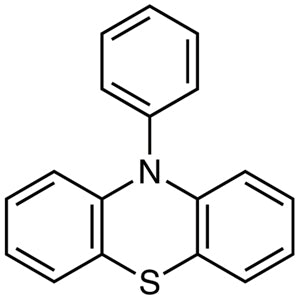
10-Phenylphenothiazine from TCI is an organic compound derived from phenothiazine, with a phenyl group attached to the nitrogen atom. In modern chemistry laboratories it is known as a metal-free organic photocatalyst: it absorbs light and then transfers an electron to a substrate. It is most important in photoredox chemistry, where light drives chemical reactions under relatively mild conditions. This makes it a useful reagent for research groups working on light-driven synthesis and polymer chemistry.
Its main advantage is that its excited state is a strong reductant, so it can reduce substrates that are otherwise hard to reduce, such as certain alkyl or aryl halides. It is a practical alternative to transition-metal photocatalysts such as iridium or ruthenium complexes, which are generally more expensive and leave metal residues in the product. It is widely used in metal-free, light-triggered atom transfer radical polymerization (metal-free photo-ATRP), which gives polymers free of metal contamination. Because it is a small organic molecule, its structure is also easy to modify. It therefore often serves as the starting scaffold in studies that design new photocatalysts with tailored redox properties.
In Indonesia, interest in photocatalysis and sustainable chemistry keeps growing, and 10-Phenylphenothiazine fits naturally into this kind of work. University research groups, polymer and materials science laboratories, and organic synthesis teams use it to explore photoredox reactions, to prepare metal-free polymers, and to compare organic catalysts with metal-based systems. Researchers who want to avoid costly metal catalysts or reduce metal residues in their products will find it a relevant choice for teaching and research.
- Metal-free photo-ATRP: the strongly reducing excited state activates alkyl halide initiators under light, producing well-defined polymers without metal contamination.
- Photoredox organic synthesis: it absorbs light and transfers electrons to substrates, so radical transformations can run under relatively mild conditions without iridium or ruthenium complexes.
- Reduction of hard-to-reduce substrates: its strong excited-state reducing power suits reactions with certain aryl or alkyl halides that milder photocatalysts cannot activate.
- Photocatalyst design studies: as a small organic molecule with an easily modified structure, it is a common scaffold for building new catalysts with tailored redox properties.
- Comparative and teaching studies: it is a clear benchmark for comparing metal-free organic photocatalysts with expensive transition-metal systems in research and advanced chemistry courses.
| Brand | TCI (product code P2470) |
|---|---|
| CAS number | 7152-42-3 |
| Molecular formula | — |
| Purity | — |
| Category | Chemistry > Catalysis and Inorganic Chemistry > Photocatalysts [Catalysis] |
| Pack sizes | available in TCI's standard pack sizes; please contact AMI Scientific for current options |
| Physical form | refer to the TCI Certificate of Analysis and product label |
| Storage | follow the storage conditions on the TCI label and Safety Data Sheet (SDS) |
Keep 10-Phenylphenothiazine in its original tightly closed container, in a cool, dry, well-ventilated place away from strong oxidizing agents. Because it is a light-active photocatalyst, store it away from direct light, for example in amber glass or in a closed cabinet, to help preserve its quality. Always follow the storage temperature and conditions on the TCI label and SDS. Handle it following good laboratory practice, wearing safety glasses, chemical-resistant gloves and a lab coat. Avoid inhaling dust and avoid contact with skin and eyes. Weigh and transfer it in a fume hood or another well-ventilated area. Dispose of waste according to local regulations and your institution's chemical waste procedures.
—
Produk Terkait
-
12-Phenyl-12H-benzo[b]phenothiazine TCI P3081
Regular price From Rp 1.936.200,00Regular price -
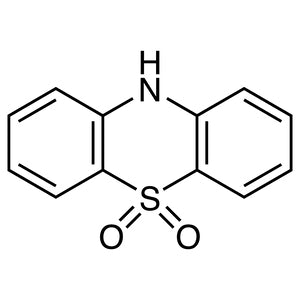
10H-Phenothiazine5,5-Dioxide TCI D6164
Regular price From Rp 3.232.950,00Regular price -
10-Hexylphenothiazine TCI H1608
Regular price From Rp 2.094.750,00Regular price -
3,7-Dibromo-10-hexylphenothiazine TCI D5222
Regular price From Rp 3.683.400,00Regular price -
10-Acetylphenothiazine TCI A3154
Regular price From Rp 3.021.900,00Regular price -
10-(4-Methoxyphenyl)-10H-phenothiazine TCI M3639
Regular price From Rp 2.625.000,00Regular price -
10-[2-(2-Methoxyethoxy)ethyl]-10H-phenothiazine TCI M3068
Regular price Rp 3.312.750,00Regular price -
2,6-Diphenylphenol TCI D2563
Regular price From Rp 1.670.550,00Regular price
![1320277-85-7 12-Phenyl-12H-benzo[b]phenothiazine - AMI Scientific](http://amiscientific.com/cdn/shop/files/TCI2510P3081.jpg?v=1767137088&width=533)


![2098786-35-5 10-[2-(2-Methoxyethoxy)ethyl]-10H-phenothiazine - AMI Scientific](http://amiscientific.com/cdn/shop/files/TCI2510M3068.jpg?v=1767127707&width=533)
