
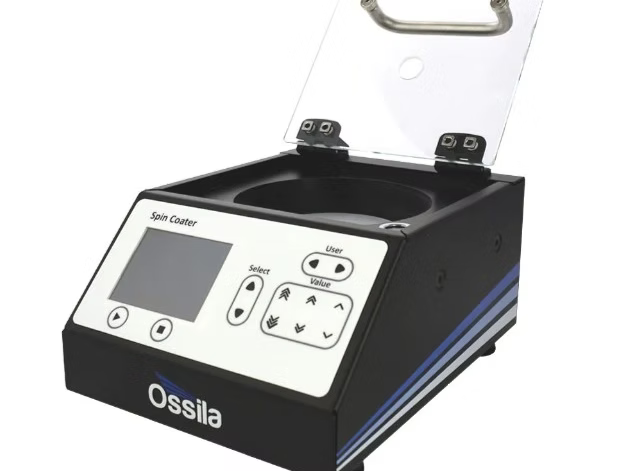
Spin Coater - Teknik Pelapisan Serbaguna di Semua Industri
Bagikan
Spin coater is a technique for depositing material onto a substrate by utilizing a controlled film thickness. The film layer is flattened by centrifugal force, making it much better than other coating methods.
This tool works with continuous rotation as the liquid spins from the edge of the substrate until it reaches the desired thickness.
Actually, how does a spin coater work and what are its applications in industry? Read the discussion until the end.
What is a Spin Coater?
A spin coater is a tool used to apply a film onto a substrate. This system rotates the substrate at various speeds as the coating material is dispensed onto its surface.
Then, rotation is performed to spin the liquid from the edge of the substrate until it reaches the desired film thickness.
Uses of Spin Coating
Spin coating is a versatile technique for depositing material onto a substrate with controllable film thickness. It is used for microscopic and spectroscopic investigations.
The uniform film layer is produced by applying centrifugal force, making it much faster than other thin-film coating methods.
Spin coating is ideal for batch processing in research and industry. Examples of its application include the microfabrication of functional oxide layers on substrates or single crystals using sol-gel precursors. Not only that, but also the creation of uniform thin films with nanoscale thickness.
Working Principle of Spin Coater (Spin Coating)
A spin coater works with continuous rotation as the liquid spins from the edge of the substrate until it reaches the desired thickness. The solvent used evaporates simultaneously.
There are four stages of spin coater operation: deposition, spin-up, spin-off, and evaporation.
a. Deposition
Using a pipette, the substrate is dropped into the solution. Then the solution is distributed over the entire substrate, whether the substrate is in dynamic or static spin coating, through centrifugal motion.
b. Spin-up
After spreading at low or high speed, the medium reaches the appropriate rotation speed. The majority of the solution is spun off the substrate during this stage.
The fluid flattens when the drag force equals the rotational acceleration. The result is an appropriate rotation speed.
c. Spin Off
In this condition, viscous forces become dominant to thin the fluid.
Due to interference effects, the film color often changes when the liquid is removed. The film is almost dry after stopping the color shift.
d. Evaporation
After the liquid outflow stops, solvent evaporation occurs. Volatility, vapor pressure, and environmental conditions determine the rate of solvent evaporation.
Advantages of Spin Coater
-
Produces high uniformity due to high rotation speed to facilitate the drying period.
-
Compared to other technologies, a spin coater is a cheap approach for batch processing on each substrate.
-
In many cases, it eliminates the need for post-deposition heat treatment.
-
In research and prototyping, it offers ease of procedure setup, and thin and homogeneous layers are obtained with various thicknesses.
Limitations of Spin Coater
-
Waste occurs because the actual material utilization in the spin coating process is often relatively low.
-
As a single substrate process, spin coating has relatively low productivity compared to roll-to-roll techniques.
-
In nanotechnology, it takes time to aggregate and crystallize, which is hindered by the rapid drying period.
Applications of Spin Coater
Spin coater is the most common technique in the coating industry, which is versatile in various types of applications.
Spin coating can be used for small surfaces from millimeters to meters, depending on the available equipment. Some of these include synthetic metals, nanomaterials, insulators, and semiconductors.