


Carbazole is a tricyclic aromatic heterocyclic compound consisting of two benzene rings fused onto a central pyrrole ring. It is one of the most fundamental building blocks in organic chemistry and materials science, with a long history of use as a raw material for dyes, pigments, and pharmaceutical compounds. In the laboratory, carbazole serves as an inexpensive and widely available starting scaffold for constructing a broad range of functional molecules, from organic semiconductor materials and photoconductive polymers to ligands and more elaborate bioactive compounds.
Several properties make carbazole a preferred choice among researchers. Its aromatic core is highly electron-rich, giving it good hole-transporting ability — an essential requirement for p-type semiconductor materials. Its thermal and chemical stability are high, and the pyrrolic nitrogen atom is readily deprotonated and then alkylated or arylated to tune the solubility and electronic properties of the resulting derivatives. The 3- and 6-positions on the ring system are highly reactive toward electrophilic substitution such as bromination, providing a straightforward route to derivatives that can be coupled further.
In Indonesian laboratories, carbazole is typically used in university and institutional research groups working on organic electronics, polymer chemistry, and synthetic organic methodology. It commonly appears in graduate and postgraduate research on hole-transport materials and photoconductive polymers, as well as in synthetic programs that build functionalized heterocycles from a low-cost commercial scaffold. Its wide availability and well-established chemistry make it a practical entry point for groups establishing new materials-chemistry capability.
TCI brochures (PDF)
- Carbazoles 2025-06-27 · p. 2
- Building Blocks for Organic Semiconductor 2026-03-24 · p. 19
Related TCI products
- TCI T3882 6558-85-6 1,3,6,8-Tetramethyl-9H-carbazole
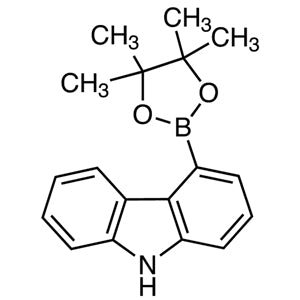
- TCI T3747 1255309-13-7 4-(4,4,5,5-Tetramethyl-1,3,2-dioxaborolan-2-yl)-9H-carbazole
- TCI T3642 1630723-98-6 N,N,N',N'-Tetrakis(4-methoxyphenyl)-9H-carbazole-3,6-diamine
- TCI T3612 1345614-94-9 3-(4,4,5,5-Tetramethyl-1,3,2-dioxaborolan-2-yl)-9-(p-tolyl)-9H-carbazole
- TCI T3452 785051-54-9 9-[4-(4,4,5,5-Tetramethyl-1,3,2-dioxaborolan-2-yl)phenyl]-9H-carbazole
- TCI T3441 1242412-60-7 2-(4,4,5,5-Tetramethyl-1,3,2-dioxaborolan-2-yl)-9H-carbazole
- Organic semiconductor synthesis — the electron-rich aromatic core provides good hole-transporting behaviour, making carbazole a standard p-type building block for functional device materials.
- Photoconductive polymer preparation — the nitrogen atom is readily alkylated or arylated, allowing the carbazole unit to be attached to polymer backbones with tuned solubility.
- Building block for cross-coupling chemistry — bromination at the reactive 3- and 6-positions gives halogenated intermediates suitable for further coupling into extended conjugated systems.
- Dye and pigment research — carbazole has a long history as a raw material in dye and pigment chemistry, supporting both classical preparations and new chromophore development.
- Pharmaceutical and ligand synthesis — the scaffold serves as a starting framework for constructing ligands and more elaborate bioactive compounds in medicinal chemistry programmes.
| Brand | TCI |
|---|---|
| CAS number | 86-74-8 |
| Molecular formula | — |
| Purity | — |
| Category | Materials Science > Material Building Blocks > Small Molecule Semiconductor Building Blocks |
| Pack sizes | available in the pack sizes listed on this product page |
| Physical form | — |
| Storage | store according to the conditions stated on the manufacturer's label and safety data sheet |
- Product code: C0032
- Chemical name: Carbazole
Store carbazole in a tightly closed original container in a cool, dry, well-ventilated area away from direct sunlight, heat sources, and strong oxidising agents. Keep the container sealed when not in use to prevent moisture uptake and contamination, and return material to storage promptly after weighing. Handle the compound in a fume hood using appropriate personal protective equipment, including gloves, safety goggles, and a laboratory coat, and avoid generating or inhaling dust during transfer operations. Label all secondary containers clearly and consult the manufacturer's safety data sheet before first use and before disposal of residues.
—
Produk Terkait
-
1,3,6,8-Tetramethyl-9H-carbazole TCI T3882
Regular price Rp 4.108.650,00Regular priceRp 2.888.550,00Sale price Rp 4.108.650,00 -
4-(4,4,5,5-Tetramethyl-1,3,2-dioxaborolan-2-yl)-9H-carbazole TCI T3747
Regular price Rp 5.246.850,00Regular priceRp 3.684.450,00Sale price Rp 5.246.850,00 -
N,N,N',N'-Tetrakis(4-methoxyphenyl)-9H-carbazole-3,6-diamine TCI T3642
Regular price Rp 9.778.650,00Regular priceRp 6.853.350,00Sale price Rp 9.778.650,00 -
3-(4,4,5,5-Tetramethyl-1,3,2-dioxaborolan-2-yl)-9-(p-tolyl)-9H-carbazole TCI T3612
Regular price Rp 1.113.000,00Regular priceRp 793.800,00Sale price Rp 1.113.000,00 -
9-[4-(4,4,5,5-Tetramethyl-1,3,2-dioxaborolan-2-yl)phenyl]-9H-carbazole TCI T3452
Regular price Rp 1.801.800,00Regular priceRp 1.275.750,00Sale price Rp 1.801.800,00 -
2-(4,4,5,5-Tetramethyl-1,3,2-dioxaborolan-2-yl)-9H-carbazole TCI T3441
Regular price Rp 2.597.700,00Regular priceRp 1.832.250,00Sale price Rp 2.597.700,00 -
9-[3-(4,4,5,5-Tetramethyl-1,3,2-dioxaborolan-2-yl)phenyl]carbazole TCI T3386
Regular price Rp 2.013.900,00Regular priceRp 1.423.800,00Sale price Rp 2.013.900,00 -
9,9'-(5-Bromo-1,3-phenylene)bis(9H-carbazole) TCI B5502
Regular price Rp 2.835.000,00Regular priceRp 1.998.150,00Sale price Rp 2.835.000,00



![785051-54-9 9-[4-(4,4,5,5-Tetramethyl-1,3,2-dioxaborolan-2-yl)phenyl]-9H-carbazole - AMI Scientific](http://amiscientific.com/cdn/shop/files/TCI2510T3452.jpg?v=1769143736&width=533)

![870119-58-7 9-[3-(4,4,5,5-Tetramethyl-1,3,2-dioxaborolan-2-yl)phenyl]carbazole - AMI Scientific](http://amiscientific.com/cdn/shop/files/TCI2510T3386.jpg?v=1769143726&width=533)
