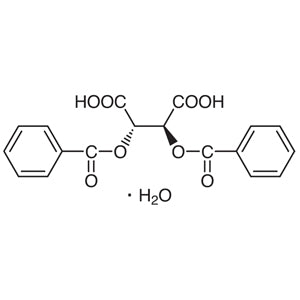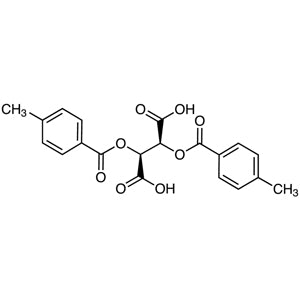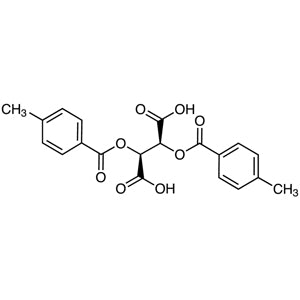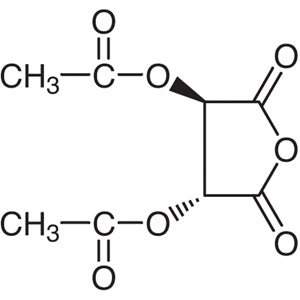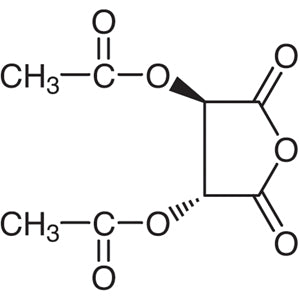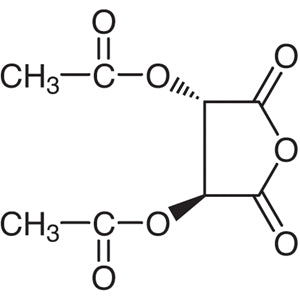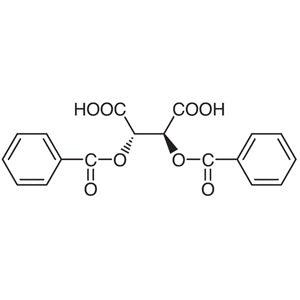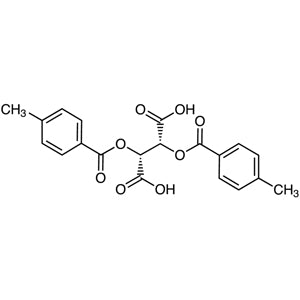
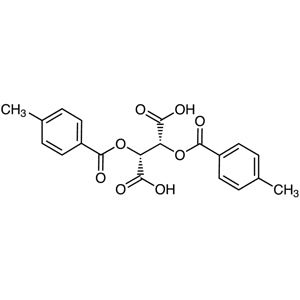
(-)-Di-p-toluoyl-L-tartaric Acid, identified by CAS number 32634-66-5 and commonly abbreviated by laboratory practitioners as DTTA, is a tartrate ester in which both hydroxyl groups of the tartaric acid backbone have been esterified with p-toluic acid. The compound belongs to the family of classical chiral resolving agents most frequently employed in preparative organic chemistry. Its role in the laboratory is highly specific but crucial: it converts the racemic mixture of an organic base into a pair of diastereomeric salts that are physically distinguishable, so that separation of enantiomers can be achieved through simple crystallisation techniques alone, without the need for expensive preparative chromatography instrumentation.
The property that makes DTTA so widely favoured is the pair of bulky aromatic p-toluoyl rings attached to the tartrate skeleton. These aromatic groups increase lipophilicity, strengthen aromatic stacking interactions, and promote the formation of a tightly packed crystal lattice, so that the solubility difference between the two diastereomeric salts becomes far more pronounced than with smaller tartrate derivatives. The L configuration ensures that the agent consistently selects one particular enantiomer from a racemic pair, giving reproducible and predictable resolution outcomes across repeated preparations. Its crystalline solid form remains stable under normal storage conditions.
In Indonesian laboratories, this reagent is typically found in university organic chemistry research groups, pharmaceutical synthesis laboratories, and institutional research centres engaged in asymmetric synthesis work. It is generally selected by teams that need to obtain enantiomerically enriched material from a racemic base but do not have routine access to preparative chiral chromatography systems. As a chiral building block within the asymmetric synthesis category, it serves both dedicated research programmes and advanced teaching laboratories demonstrating the principles of classical resolution.
- Classical resolution of racemic amines: the reagent forms diastereomeric salts with basic nitrogen centres, allowing the two enantiomers to be separated by fractional crystallisation rather than chromatography.
- Preparation of enantiomerically enriched pharmaceutical intermediates: its consistent L configuration reliably selects one enantiomer, which supports reproducible batch-to-batch outcomes in medicinal chemistry synthesis routes.
- Chiral building block in asymmetric synthesis: the defined tartrate stereocentres provide a dependable source of chirality for constructing target molecules with controlled stereochemical outcomes.
- Crystallisation-based purification method development: the bulky aromatic rings promote tight crystal packing, making this reagent useful when researchers are screening conditions for salt crystallisation studies.
- Teaching and demonstration of stereochemical principles: its well-established behaviour makes it a suitable material for advanced practical classes illustrating how diastereomeric salt formation enables enantiomer separation.
| Brand | TCI |
|---|---|
| CAS number | 32634-66-5 |
| Molecular formula | — |
| Purity | — |
| Category | Chemistry > Asymmetric Synthesis > Chiral Building Blocks |
| Pack sizes | — |
| Physical form | crystalline solid |
| Storage | stable under normal storage conditions |
- Product code: TCI D1387
Store this material in a tightly closed original container, kept in a cool, dry and well-ventilated area away from moisture and direct sunlight. Amber glass or the supplier's original packaging is suitable, and the container should be closed promptly after each weighing to limit moisture uptake by the crystalline solid. Handle the material inside a fume hood using a laboratory coat, safety goggles and chemical-resistant gloves, and avoid generating dust during transfer and weighing operations. Keep the reagent separated from strong bases and strong oxidising agents, use clean and dry spatulas to prevent cross-contamination of the stock, and consult the supplier safety data sheet before first use. Wash hands thoroughly after handling and dispose of residues in accordance with institutional chemical waste procedures.
—
Produk Terkait
-
(-)-Diacetyl-L-tartaricAcid TCI D1386
Regular price Rp 4.691.400,00Regular price -
(+)-Dibenzoyl-D-tartaricAcidMonohydrate TCI D1398
Regular price From Rp 637.350,00Regular price -
(+)-Di-p-toluoyl-D-tartaricAcid TCI D1417
Regular price From Rp 1.193.850,00Regular price -
(+)-Diacetyl-L-tartaricAnhydride TCI D1911
Regular price Rp 1.220.100,00Regular price -
(+)-Diacetyl-D-tartaricAcid TCI D2636
Regular price Rp 2.625.000,00Regular price -
(-)-Diacetyl-D-tartaricAnhydride TCI D2645
Regular price From Rp 743.400,00Regular price -
(+)-Di-p-anisoyl-D-tartaricAcid TCI D3490
Regular price From Rp 769.650,00Regular price -
(+)-Dibenzoyl-D-tartaricAcid TCI D3826
Regular price From Rp 903.000,00Regular price