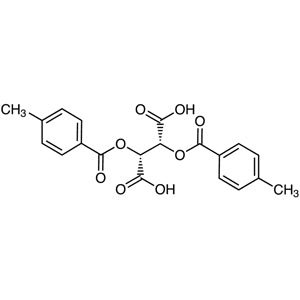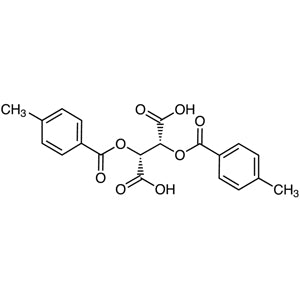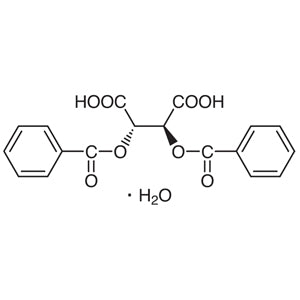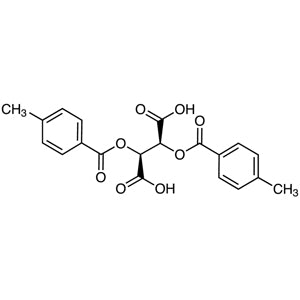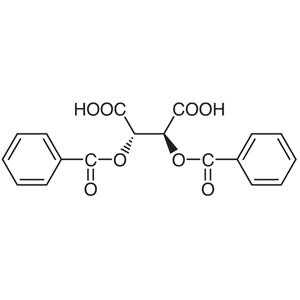
(+)-Dibenzoyl-D-tartaric Acid from TCI, CAS 17026-42-5, is a tartaric acid derivative in which both hydroxyl groups have been esterified with benzoyl groups. The compound belongs to the family of chiral building blocks — chiral construction materials whose role is central to asymmetric synthesis. In the laboratory it is best known as a classical resolving agent: it forms diastereomeric salts with racemic organic bases, particularly amines, so that enantiomer pairs which were originally difficult to separate can be resolved through ordinary crystallization. Its availability allows enantiomer separation work to be carried out without expensive chiral chromatography instrumentation.
The characteristics that make this compound the preferred choice are its rigid tartrate framework bearing two well-defined stereogenic centers, together with the two aromatic rings contributed by the benzoyl groups, which enhance the crystalline character of the diastereomeric salts formed. That combination widens the solubility difference between the two diastereomeric salts, so crystallization selectivity becomes sharper and the separation result more reliable. The two free carboxylate groups provide strong acid–base interaction points toward the basic substrate, anchoring the salt-forming step that the whole resolution depends upon.
In Indonesian laboratories, this material is typically used in organic synthesis and medicinal chemistry groups that need to obtain single enantiomers of amine intermediates, as well as in university research laboratories studying asymmetric synthesis. Because the resolution is performed by crystallization rather than by chiral chromatography, the compound suits laboratories where chiral separation instrumentation is limited but enantiomerically defined products are still required for further reaction steps or characterization.
- Resolution of racemic amines — forms diastereomeric salts with basic amine substrates, and the resulting solubility difference lets the two enantiomers be separated by ordinary crystallization.
- Preparation of enantiomerically defined synthetic intermediates — supplies a defined stereochemical framework so downstream reaction steps begin from a single enantiomer rather than a racemic mixture.
- Asymmetric synthesis research — serves as a chiral building block whose two stereogenic centers can be carried into target molecules during stereocontrolled construction work in academic and industrial groups.
- Crystallization-based chiral separation method development — allows laboratories to develop and optimize diastereomeric salt crystallization protocols without requiring access to costly chiral chromatography instrumentation.
- Medicinal chemistry intermediate purification — used where single-enantiomer amine building blocks are needed, since the benzoyl aromatic rings improve salt crystallinity and therefore the reliability of the recovered material.
| Brand | TCI |
|---|---|
| CAS number | 17026-42-5 |
| Molecular formula | — |
| Purity | — |
| Category | Chemistry > Asymmetric Synthesis > Chiral Building Blocks |
| Pack sizes | available in laboratory research pack sizes; please contact us for the size options currently offered |
| Physical form | — |
| Storage | store in a closed container under the conditions stated on the manufacturer's label |
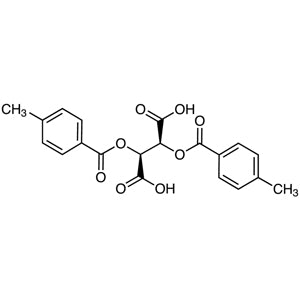
- Chemical class: tartaric acid derivative with both hydroxyl groups esterified as benzoyl esters; two free carboxylate groups
Store the material in its original tightly closed container, kept in a cool, dry and well-ventilated area away from moisture and from direct sunlight, and follow the storage conditions stated on the manufacturer's label and safety data sheet. Suitable containers are the supplied chemically resistant bottle or an equivalent tightly sealed glass container, closed again immediately after each weighing to limit moisture uptake. Handle the compound in a fume hood or a well-ventilated workspace, and wear standard laboratory personal protective equipment including a lab coat, safety goggles and chemically resistant gloves. As a carboxylic acid derivative, keep it separated from strong bases and strong oxidizing agents, avoid the generation of dust during transfer, and consult the safety data sheet before first use and before disposal.
—
Produk Terkait
-
(-)-Diacetyl-L-tartaricAcid TCI D1386
Regular price Rp 4.691.400,00Regular price -
(-)-Di-p-toluoyl-L-tartaricAcid TCI D1387
Regular price From Rp 1.961.400,00Regular price -
(+)-Dibenzoyl-D-tartaricAcidMonohydrate TCI D1398
Regular price From Rp 637.350,00Regular price -
(+)-Di-p-toluoyl-D-tartaricAcid TCI D1417
Regular price From Rp 1.193.850,00Regular price -
(+)-Diacetyl-L-tartaricAnhydride TCI D1911
Regular price Rp 1.220.100,00Regular price -
(+)-Diacetyl-D-tartaricAcid TCI D2636
Regular price Rp 2.625.000,00Regular price -
(-)-Diacetyl-D-tartaricAnhydride TCI D2645
Regular price From Rp 743.400,00Regular price -
(+)-Di-p-anisoyl-D-tartaricAcid TCI D3490
Regular price From Rp 769.650,00Regular price