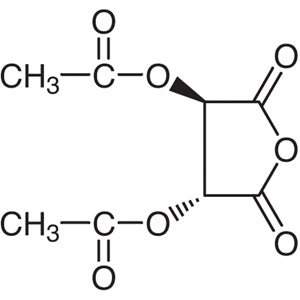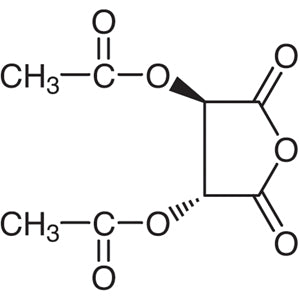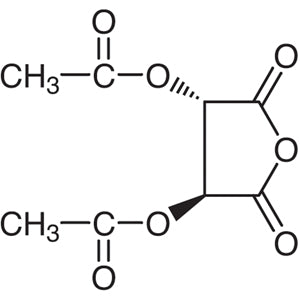
TCI D2645 (-)-Diacetyl-D-tartaric Anhydride, CAS 70728-23-3, is the cyclic anhydride form of diacetyl tartaric acid — a tartaric acid derivative in which the hydroxyl groups are protected as acetates and the two carboxyl groups have been condensed into an anhydride ring. The material belongs to the chiral building blocks group used in asymmetric synthesis, where it functions as an active chiral acylating reagent. In the laboratory, the anhydride ring makes the compound immediately ready to react with nucleophiles such as alcohols and amines without requiring any additional activating agent, so the working procedure becomes more compact and cleaner than when the corresponding acid form is used.
The property that makes this reagent widely chosen is its high reactivity combined with defined stereochemical information. When it reacts with a racemic mixture of an alcohol or an amine, the compound produces a pair of diastereomers whose physical properties differ, so they can be separated by crystallisation or by chromatography; after separation, the tartrate group can be released again by mild hydrolysis. Ring opening of the anhydride proceeds in one direction and yields one ester or amide group together with one carboxyl group, which gives predictable products and a straightforward work-up.
In Indonesian laboratories, this reagent is typically used in university and institutional research groups working on asymmetric synthesis, as well as in analytical and pharmaceutical development laboratories that need to resolve racemic mixtures or prepare stereochemically defined intermediates. It is normally handled at bench scale in fume hoods under dry conditions, as part of method development, resolution work, and derivatisation procedures where a ready-to-use chiral acylating agent shortens the synthetic route.
- Chiral resolution of racemic alcohols — the reagent converts an enantiomeric mixture into a pair of diastereomeric esters that differ in physical properties and can be separated by crystallisation or chromatography.
- Chiral resolution of racemic amines — reaction with the anhydride ring forms diastereomeric amides directly, without needing a separate coupling or activating agent for the acylation step.
- Asymmetric synthesis as a chiral building block — the defined stereochemistry of the tartaric acid backbone transfers stereochemical information into intermediates prepared during multi-step synthetic route development.
- Derivatisation prior to chromatographic analysis — because the diastereomers formed have different physical properties, they can be distinguished and separated during chromatographic evaluation of enantiomeric composition.
- Introduction of a removable chiral auxiliary — after separation is complete, the tartrate group can be cleaved again by mild hydrolysis, returning the target compound in resolved form.
| Brand | TCI |
|---|---|
| CAS number | 70728-23-3 |
| Molecular formula | — |
| Purity | — |
| Category | Chemistry > Asymmetric Synthesis > Chiral Building Blocks |
| Pack sizes | — |
| Physical form | — |
| Storage | store in a tightly closed container, protected from moisture; refer to the manufacturer's label and safety data sheet for the specified conditions and available pack sizes |
- Chemical name: (-)-Diacetyl-D-tartaric Anhydride
- Catalogue code: D2645
As a cyclic anhydride, this material reacts readily with nucleophiles and should be protected from moisture and humid air during storage and handling. Keep the product in its original tightly closed container, or in a clean, dry, well-sealed glass container, and store it in a cool, dry place away from water, alcohols, amines, and strong bases. Handle the material in a fume hood using standard laboratory protective equipment — safety goggles, gloves, and a laboratory coat — and weigh out portions quickly to limit exposure to atmospheric moisture. Close the container immediately after use, label any transferred material clearly, and follow the manufacturer's safety data sheet for detailed handling, first aid, and disposal instructions.
—
Produk Terkait
-
(-)-Diacetyl-L-tartaricAcid TCI D1386
Regular price Rp 4.691.400,00Regular price -
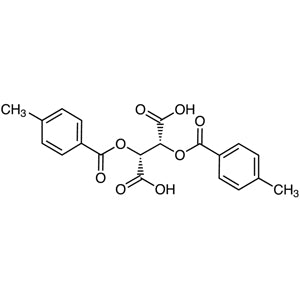
(-)-Di-p-toluoyl-L-tartaricAcid TCI D1387
Regular price From Rp 1.961.400,00Regular price -
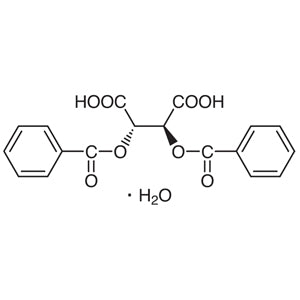
(+)-Dibenzoyl-D-tartaricAcidMonohydrate TCI D1398
Regular price From Rp 637.350,00Regular price -
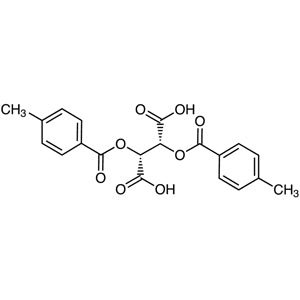
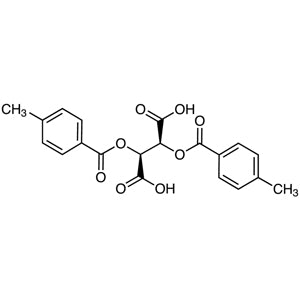
(+)-Di-p-toluoyl-D-tartaricAcid TCI D1417
Regular price From Rp 1.193.850,00Regular price -
(+)-Diacetyl-L-tartaricAnhydride TCI D1911
Regular price Rp 1.220.100,00Regular price -
(+)-Diacetyl-D-tartaricAcid TCI D2636
Regular price Rp 2.625.000,00Regular price -
(+)-Di-p-anisoyl-D-tartaricAcid TCI D3490
Regular price From Rp 769.650,00Regular price -
(+)-Dibenzoyl-D-tartaricAcid TCI D3826
Regular price From Rp 903.000,00Regular price