

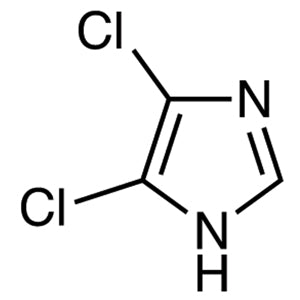
TCI D2091 4,5-Dichloroimidazole is an imidazole derivative bearing chlorine atoms at the 4- and 5-positions of the ring. As a heterocyclic building block, this compound supplies a pre-halogenated imidazole core, allowing researchers to proceed directly to further functionalisation without first working through a selective halogenation step that is often difficult to control. The imidazole core itself is one of the most important scaffolds in medicinal chemistry, coordination chemistry, and agrochemistry, thanks to its ability to act as an electron-pair donor, to form hydrogen bonds, and to constitute a stable aromatic system across a wide range of reaction conditions.
The characteristic that makes this reagent a preferred choice is the presence of two chlorine atoms serving a dual function. Electronically, both withdraw electron density, lowering the basicity of the ring and altering its reactivity pattern relative to unsubstituted imidazole. Synthetically, both act as handles for nucleophilic aromatic substitution as well as for transition-metal-catalysed cross-coupling reactions. The NH nitrogen of the ring can also be alkylated or arylated to give N-substituted derivatives, so a single starting material opens several independent routes for structural elaboration.
This solid reagent is stable under normal storage and is typically used in Indonesian laboratories as a starting material in synthetic organic chemistry and medicinal chemistry research programmes. It suits university and institutional research groups building heterocyclic compound libraries, as well as coordination chemistry and agrochemical research work where a halogenated imidazole core is required. Because the halogenation step is already in place, the compound helps shorten synthetic sequences in laboratories where reagent availability and reaction time both matter.
Related TCI products
- TCI C3370 6188-25-6 6-Chloroimidazo[1,2-a]pyridine
- TCI C3127 6775-78-6 6-Chloroimidazo[1,2-b]pyridazine
- TCI B3503 65902-59-2 2-Bromo-4-nitroimidazole
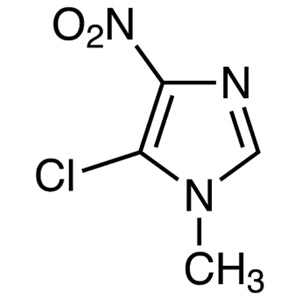
- TCI C1646 4897-25-0 5-Chloro-1-methyl-4-nitroimidazole
- TCI B5848 474708-88-8 6-Bromo-8-chloroimidazo[1,2-a]pyridine
- TCI T2266 2034-22-2 2,4,5-Tribromoimidazole
- Heterocyclic library synthesis — the pre-installed chlorine atoms at the 4- and 5-positions let researchers diversify a common imidazole core without repeating a selective halogenation step.
- Transition-metal-catalysed cross-coupling — both ring chlorines serve as reaction handles for metal-catalysed coupling chemistry, giving direct access to carbon-substituted imidazole derivatives.
- Nucleophilic aromatic substitution studies — the electron-withdrawing chlorines lower electron density on the ring, making the positions suitable points of attack for incoming nucleophiles.
- N-substituted imidazole preparation — the ring NH nitrogen can be alkylated or arylated, so the compound acts as a precursor to a broad family of N-substituted derivatives.
- Coordination chemistry and ligand work — the imidazole nitrogen functions as an electron-pair donor and hydrogen-bond partner, making the scaffold useful for building metal-binding ligands.
| Brand | TCI (Tokyo Chemical Industry) |
|---|---|
| CAS number | 15965-30-7 |
| Molecular formula | — |
| Purity | — |
| Category | Chemistry > Building Blocks > Heterocyclic Building Blocks |
| Pack sizes | — |
| Physical form | solid reagent; available in standard research pack sizes — please contact AMI Scientific for the pack size options currently offered |
| Storage | stable under normal storage conditions |
- Product code: D2091
- Chemical name: 4,5-Dichloroimidazole
Store this reagent in a tightly closed original container in a cool, dry, well-ventilated place, away from moisture, direct sunlight, and sources of heat or ignition. Keep it separated from strong oxidising agents and strong bases. Handle the solid in a fume hood or a well-ventilated area to avoid inhaling dust, and use standard personal protective equipment: a laboratory coat, chemical-resistant gloves, and safety glasses or goggles. Weigh the material with clean, dry spatulas and glassware to prevent contamination and moisture uptake, reseal the container immediately after use, and label any secondary containers clearly. Review the manufacturer's Safety Data Sheet before first use and dispose of residues and contaminated consumables in accordance with your institution's chemical waste procedures.
—
Produk Terkait
-
6-Chloroimidazo[1,2-a]pyridine TCI C3370
Regular price From Rp 848.400,00Regular price -
6-Chloroimidazo[1,2-b]pyridazine TCI C3127
Regular price From Rp 477.750,00Regular price -
2-Bromo-4-nitroimidazole TCI B3503
Regular price From Rp 1.749.300,00Regular price -
5-Chloro-1-methyl-4-nitroimidazole TCI C1646
Regular price Rp 2.041.200,00Regular price -
6-Bromo-8-chloroimidazo[1,2-a]pyridine TCI B5848
Regular price From Rp 1.829.100,00Regular price -
2,4,5-Tribromoimidazole TCI T2266
Regular price From Rp 875.700,00Regular price -
6-Bromoimidazo[1,2-a]pyridine TCI B5225
Regular price From Rp 928.200,00Regular price -
3-Bromoimidazo[1,2-b]pyridazine TCI B4652
Regular price Rp 2.359.350,00Regular price
![6-Chloroimidazo[1,2-a]pyridine (CAS 6188-25-6) - TCI C3370 - AMI Scientific](http://amiscientific.com/cdn/shop/files/TCI2510C3370.jpg?v=1767099512&width=533)
![6-Chloroimidazo[1,2-b]pyridazine (CAS 6775-78-6) - TCI C3127 - AMI Scientific](http://amiscientific.com/cdn/shop/files/TCI2510C3127.jpg?v=1767099249&width=533)

![TCI B5848 474708-88-8 6-Bromo-8-chloroimidazo[1,2-a]pyridine — struktur kimia](http://amiscientific.com/cdn/shop/files/TCI2510B5848-struktur.jpg?v=1791524944&width=533)

![6188-23-4 6-Bromoimidazo[1,2-a]pyridine - AMI Scientific](http://amiscientific.com/cdn/shop/files/TCI2510B5225_f7a0a48e-3be4-4414-84f6-ee7e42200900.jpg?v=1767855975&width=533)
![18087-73-5 3-Bromoimidazo[1,2-b]pyridazine - AMI Scientific](http://amiscientific.com/cdn/shop/files/TCI2510B4652.jpg?v=1769180049&width=533)